 뒤로
Pure Cultures and Bacterial Growth: Isolation, Preservation, and Measurement
스터디 가이드 - 스마트 노트
 자료에 맞춘 맞춤형 노트, 핵심 정의, 예시, 맥락을 확장해 제공합니다.
Pure Cultures and Bacterial Growth
Obtaining Pure Cultures
Microbiologists often work with mixed samples containing multiple bacterial species. To study or identify a specific microorganism, it is essential to isolate it as a pure culture, which consists of only one kind of microorganism derived from a single cell or clone. Isolation allows for accurate identification, research, and further testing.
Pure culture: A culture containing only one type of microorganism.
Isolation goal: Separate individual cells far enough apart so each forms an isolated colony.
Limitation: Only a small fraction of environmental bacteria can be cultured by conventional methods.
Example: Urine, soil, water, and food samples are typically mixed and require isolation for study.
The Streak Plate Method
The streak plate method is the most common technique for isolating pure cultures. It physically dilutes bacterial cells across the surface of an agar plate, allowing individual cells to form isolated colonies.
Step 1: Sterilize the inoculating loop and collect the mixed culture.
Step 2: Streak the first region, then sterilize the loop before streaking subsequent regions.
Step 3: Each new streak dilutes the cells further.
Result: Final streaks contain separated cells that form isolated colonies.
Core idea: Decrease cell density until individual cells can give rise to separated colonies.
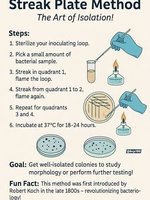
Example: The streak plate method was introduced by Robert Koch in the late 1800s and revolutionized bacteriology.
Preserving Bacterial Cultures
Short-term and Long-term Preservation
Once a pure culture is obtained, it must be preserved for future use. Preservation methods depend on the intended duration and purpose.
Short-term: Refrigeration slows microbial reproduction and is suitable for temporary storage.
Long-term: Deep-freezing (-54°C to -72°C) and freeze-drying (lyophilization) are used for extended preservation.
Purpose: Maintain known cultures for identification, research, quality control, or teaching.
Bacterial Growth and Binary Fission
Definition and Process
Bacterial growth refers to an increase in population size, not the enlargement of individual cells. The most common method of bacterial reproduction is binary fission.
Binary fission steps:
Cell elongates and DNA replicates.
Plasma membrane constricts; new cell wall forms.
Cross-wall forms; DNA copies separate.
Two daughter cells separate.
Result: Two genetically similar daughter cells (clones), barring mutation.
Generation Time
Generation time is the time required for a cell to divide and for the population to double. It varies among species and depends on environmental conditions.
Population after n generations: (starting from one cell)
Example: If one bacterium divides every 30 minutes, after 2 hours (4 generations), there will be cells.
Logarithmic Scale in Growth Measurement
Bacterial populations grow rapidly, so microbiologists use logarithmic scales to visualize and compare growth rates effectively.
Advantages: Huge ranges fit on one graph, exponential growth becomes a straight line, early changes are visible, and growth rates are easier to compare.
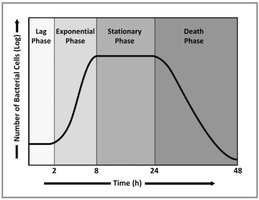
The Bacterial Growth Curve
Phases of Growth
A closed bacterial culture exhibits four distinct phases:
Lag phase: Cells prepare for division by synthesizing enzymes and molecules; little change in population size.
Log (exponential) phase: Cells actively divide; population doubles each generation; generation time is constant.
Stationary phase: Births and deaths are balanced; carrying capacity is reached; nutrients and space become limiting.
Death phase: Deaths exceed new cells; population declines logarithmically.
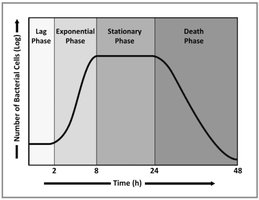
Carrying capacity: The maximum number of organisms an environment can support, limited by nutrients, waste accumulation, and space.
Measuring Microbial Growth
Direct Methods
Direct methods estimate or count cells or colony-forming units (CFUs) more directly. These methods are essential for quantifying viable cells.
Plate count: Measures viable cells that can form colonies; requires time for colony development.
Serial dilution: Dilutes samples to obtain countable colonies on plates.
Filtration: Useful for low numbers in large volumes; bacteria are trapped on a membrane and cultured.
Most probable number (MPN): Statistical estimate based on growth in dilution series; useful for microbes not growing well on solid media.
Direct microscopic count: Cells are counted in a known microscopic volume; fast, but includes dead cells.
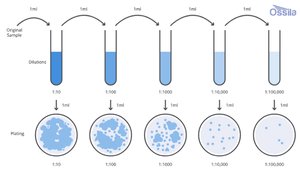
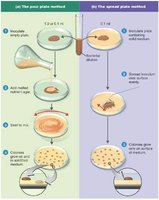
CFUs, Pour Plates, and Spread Plates
Not every colony originates from a single cell; colonies may arise from chains or clumps. Plate counts are reported as CFUs.
Pour plate: Sample mixed with melted agar; colonies form within and on the surface; heat-sensitive cells may be damaged.
Spread plate: Sample spread over solid agar; colonies remain on the surface; avoids melted agar.
Indirect Methods
Indirect methods estimate population size from a related measurable property, rather than direct cell counts.
Turbidity: As bacteria multiply, the culture becomes cloudier; measured by a spectrophotometer.
Metabolic activity: Estimate cell numbers from products such as acid, ATP, DNA, or other metabolic outputs.
Dry weight: Useful for filamentous bacteria and molds, where colony counts do not represent increasing filament mass well.
Example: Metabolic activity can be used to estimate vitamin content in a sample by measuring a metabolic product.
Synthesis: Isolation, Preservation, Growth, and Measurement
Microbiology involves isolating pure cultures, preserving them, growing populations, and accurately measuring their size. Each step is crucial for research, identification, and application in clinical and environmental settings.
ISOLATE: Streak plate → isolated colony → pure culture
PRESERVE: Short-term refrigeration; long-term preservation methods
GROW: Binary fission → generation time → growth curve
MEASURE: Direct counts or indirect estimates
