 뒤로
뒤로Viruses and Bacteriophages: Structure, Diversity, and Molecular Biology
스터디 가이드 - 스마트 노트
 자료에 맞춘 맞춤형 노트, 핵심 정의, 예시, 맥락을 확장해 제공합니다.
Viruses: Structure and Classification
General Properties of Viruses
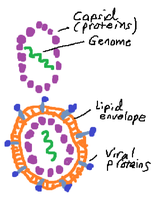
Viruses are acellular infectious agents that require a host cell for replication. They are much smaller than most cells, typically less than 0.1 μm (100 nm) in diameter, and exhibit a variety of shapes. Viral genomes can consist of either DNA or RNA, which may be single-stranded (ss) or double-stranded (ds), and encode only a few to several hundred genes. Viruses lack ribosomes and most metabolic machinery, relying entirely on the host cell for protein synthesis and energy production. Some viruses possess a lipid envelope derived from the host cell membrane, which contains viral surface proteins essential for host recognition and entry.
Capsid: Protein shell that encases the viral genome.
Lipid Envelope: Present in some viruses, derived from host cell membrane, contains viral proteins.
Genome: DNA or RNA, single or double stranded.
Host Range: Viruses can infect all forms of cellular life, including bacteria, archaea, and eukaryotes.
Classification of Viruses
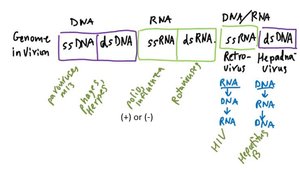
Viruses are classified based on the nature of their genomic material and their replication strategies. The main categories include:
DNA Viruses: Can be single-stranded (ssDNA) or double-stranded (dsDNA).
RNA Viruses: Can be single-stranded (ssRNA, which may be positive-sense or negative-sense) or double-stranded (dsRNA).
Reverse Transcribing Viruses: Retroviruses (RNA to DNA) and Hepadnaviruses (DNA to RNA to DNA).
Bacteriophages: Viruses That Infect Bacteria
Introduction to Bacteriophages
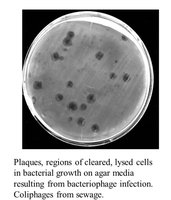
Bacteriophages, or phages, are viruses that specifically infect bacteria. They are important tools in molecular biology and biotechnology, and play a significant role in bacterial ecology and evolution. Phages can be observed by the formation of plaques—clear zones of lysed bacteria—on bacterial lawns grown on agar plates.
Plaques: Regions of cleared, lysed cells indicating phage infection.
Applications: Used in molecular biology research, gene cloning, and as potential antibacterial agents (phage therapy).
Structural Organization of Bacteriophages
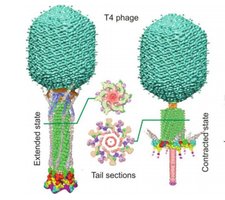
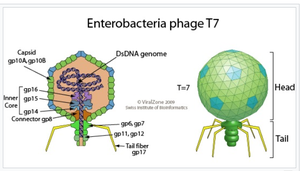
Bacteriophages exhibit complex structures, often with a head-tail morphology. The head contains the nucleic acid genome, while the tail facilitates attachment to and penetration of the bacterial cell wall.
Head (Capsid): Contains the viral genome (usually dsDNA).
Tail: Used for attachment and injection of DNA into the host cell.
Life Cycle of Lytic Bacteriophages (e.g., T4 Phage)
Lytic Cycle Overview
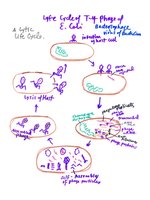
The lytic cycle is characterized by the infection of a host cell, replication of the phage genome, synthesis of viral proteins, assembly of new virions, and lysis of the host cell to release progeny phages.
Attachment: Phage binds to specific receptors on the bacterial surface.
Penetration: Phage injects its DNA into the host cell.
Biosynthesis: Host machinery is redirected to produce phage components.
Assembly: New phage particles are assembled.
Lysis: Host cell is lysed, releasing new phages.
Gene Expression Timing in T4 Phage
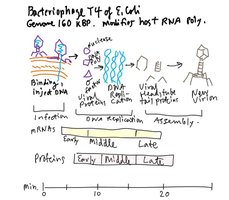
T4 phage gene expression is temporally regulated, with early, middle, and late genes expressed in sequence. Early genes are involved in host takeover and DNA replication, middle genes in DNA metabolism, and late genes in phage assembly and lysis.
Early Genes: Modify host RNA polymerase, degrade host DNA.
Middle Genes: DNA replication and repair.
Late Genes: Structural proteins and lysis enzymes.
T4 Phage Genome Organization
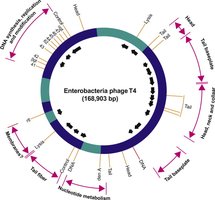
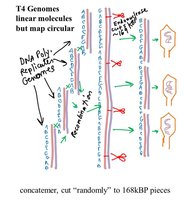
The T4 phage genome is a linear double-stranded DNA molecule (~169 kbp) with over 250 protein-coding genes. The genome is circularly permuted and terminally redundant, allowing for efficient packaging and recombination.
Own DNA Polymerase: Encodes its own DNA replication machinery.
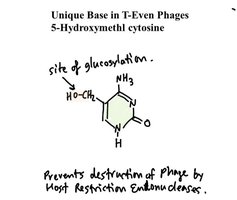
Modified Bases: Contains 5-hydroxymethylcytosine instead of cytosine, protecting against host restriction enzymes.
Host Defense Mechanisms and Phage Countermeasures
Bacteria possess restriction-modification systems to degrade foreign DNA, including phage DNA. Phages like T4 evade these defenses by modifying their DNA bases (e.g., glycosylation of 5-hydroxymethylcytosine). Additionally, the CRISPR-Cas9 system provides adaptive immunity against phages by targeting and cleaving viral DNA or RNA.
Restriction Endonucleases: Enzymes that cut foreign DNA at specific sequences.
DNA Methylation: Protects host DNA from cleavage.
Phage Modifications: Chemical modifications of phage DNA prevent recognition and cleavage.
CRISPR-Cas9: Adaptive immune system in bacteria, now widely used in gene editing.
Genome Processing and Packaging in T4 Phage
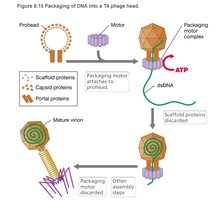
T4 phage genomes are replicated as long concatemers, which are then cut into genome-length segments and packaged into preformed capsids. This process ensures each virion receives a complete genome.
Concatemer Formation: Linear genomes joined end-to-end.
Packaging: Segments cut and inserted into capsids by a packaging motor using ATP.
Bacteriophage T7: Structure and Gene Expression
Structure and Genome of T7 Phage
Bacteriophage T7 infects E. coli and has a linear dsDNA genome (~39 kbp). It encodes its own DNA and RNA polymerases, allowing for efficient and selective transcription of phage genes.
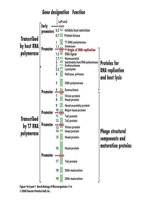
Early Genes: Transcribed by host RNA polymerase; inhibit host restriction enzymes.
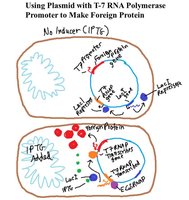
Late Genes: Transcribed by T7 RNA polymerase; encode DNA replication and structural proteins.
Use of T7 RNA Polymerase in Biotechnology
The T7 RNA polymerase/promoter system is widely used in molecular biology to express recombinant proteins in E. coli. The system allows for tight regulation and high-level expression of foreign genes.
IPTG Induction: IPTG is a lactose analog used to induce expression of T7 RNA polymerase, which then transcribes the gene of interest under the T7 promoter.
Applications: Production of recombinant proteins for research and industry.
Bacteriophage Lambda (λ): Lytic and Lysogenic Cycles
Lambda Phage Genome and Life Cycles
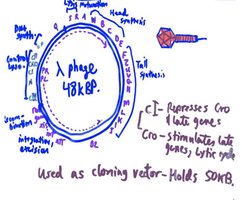
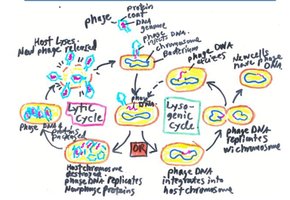
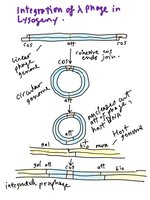
Lambda phage can undergo either a lytic cycle, resulting in host cell lysis, or a lysogenic cycle, where the phage genome integrates into the host chromosome as a prophage. The choice between these cycles is tightly regulated.
Lytic Cycle: Phage replicates and lyses host cell.
Lysogenic Cycle: Phage DNA integrates into host genome and is passively replicated.
Regulation of Lytic and Lysogenic Pathways
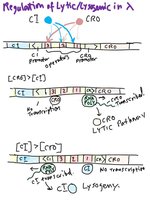
The decision between lytic and lysogenic cycles is controlled by the CI and Cro proteins, which act as transcriptional repressors of each other's genes. High CI levels favor lysogeny, while high Cro levels favor lysis.
CI Protein: Represses lytic genes, maintains lysogeny.
Cro Protein: Represses CI, promotes lytic cycle.
Integration of Lambda DNA into Host Chromosome
During lysogeny, lambda DNA integrates at a specific site (att) in the E. coli chromosome, between the gal and bio genes. The integrated prophage can later be induced to enter the lytic cycle.
Site-Specific Recombination: Integration at att site.
Prophage: Dormant form of phage DNA in host genome.
Filamentous Bacteriophage M13: Structure, Life Cycle, and Applications
Structure and Genome of M13 Phage
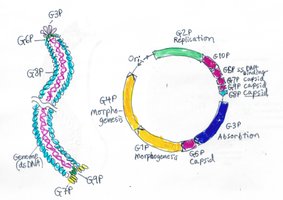
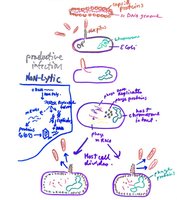
M13 is a filamentous bacteriophage with a single-stranded DNA genome (~6.4 kbp). It infects E. coli via the F pilus and is unique in that it does not lyse the host cell; instead, new virions are continuously extruded from the living cell.
Filamentous Shape: Long, flexible filament.
Non-Lytic Release: Host cell remains viable during phage production.
Phage Display Technology
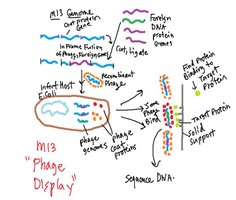
M13 phage display is a powerful technique in molecular biology for identifying protein-protein, protein-peptide, and protein-DNA interactions. Foreign DNA sequences are inserted into the phage genome, resulting in the display of the encoded protein on the phage surface. This allows for the selection of binding partners from large libraries.
Applications: Identification of ligands, antibodies, and protein interactions.
Viruses of Archaea
Diversity of Archaeal Viruses
Most known viruses of Archaea have DNA genomes, but they are not closely related to known bacteriophages. RNA genome viruses of uncultured Archaea are likely to exist, highlighting the diversity and evolutionary distinctiveness of archaeal viruses.
Genome Types: Mostly DNA, some RNA viruses predicted.
Distinct Evolution: Archaeal viruses are evolutionarily distinct from bacterial and eukaryotic viruses.
Discussion Questions
What mechanisms do bacteria have to target and destroy bacteriophage DNA? How do some phages overcome these host defenses?
Bacteria use restriction-modification systems (restriction endonucleases and DNA methylation) and CRISPR-Cas systems to target and destroy phage DNA.
Phages overcome these defenses by modifying their DNA (e.g., glycosylation of 5-hydroxymethylcytosine in T4) or encoding proteins that inhibit host restriction enzymes.
What ways do bacteriophages have to ensure that phage genes, and not host chromosomal genes, are transcribed? How is the Bacteriophage T7 RNAP used for expressing proteins in E. coli?
Phages encode their own RNA polymerases (e.g., T7 RNAP) or modify host RNA polymerase specificity to preferentially transcribe phage genes.
T7 RNAP is used in biotechnology to drive high-level expression of recombinant proteins in E. coli under the control of the T7 promoter.
How does the Lambda phage control whether to enter a lytic or lysogenic cycle? Under what conditions would the lysogenic cycle be advantageous for perpetuation of lambda? When would the lytic cycle be best to perpetuate lambda?
Lambda phage uses CI and Cro proteins to regulate the switch between lytic and lysogenic cycles. High CI promotes lysogeny; high Cro promotes lysis.
Lysogeny is advantageous under conditions of low host density or stress, allowing the phage to persist without killing the host. The lytic cycle is favored when host cells are abundant and conditions are optimal for phage replication.
In what ways does the Mu bacteriophage resemble Lambda? In what respects is Mu distinctive?
Both can integrate into the host genome and establish lysogeny.
Mu is distinctive in its ability to transpose randomly within the host genome, causing mutations (hence "Mu" for mutator phage).
In terms of the structure of its virion and genome, how is bacteriophage M13 different from other phages? What is unique about its life cycle? How is “phage display” used in molecular biology research?
M13 is filamentous with a circular ssDNA genome, unlike the icosahedral, dsDNA phages like T4 and lambda.
It does not lyse the host cell; new virions are extruded without killing the host.
Phage display uses M13 to present foreign peptides or proteins on its surface, enabling selection of binding partners from large libraries.
