 뒤로
Viruses: Structure, Multiplication, and Comparison with Bacteria
스터디 가이드 - 스마트 노트
 자료에 맞춘 맞춤형 노트, 핵심 정의, 예시, 맥락을 확장해 제공합니다.
Distinctive Features of Viruses
Obligatory Intracellular Parasites
Viruses are unique infectious agents that require living host cells to multiply. Unlike bacteria, they cannot reproduce or carry out metabolic processes independently.
Obligatory intracellular parasites: Viruses must invade host cells to replicate.
Contain DNA or RNA: Viral genomes are composed of either DNA or RNA, but never both.
Protein coat: The viral genome is enclosed in a protein coat called a capsid.
No ribosomes or ATP-generating mechanism: Viruses lack cellular machinery for protein synthesis and energy production.
Host Range
The host range of a virus refers to the spectrum of host cells it can infect. This specificity is determined by the presence of suitable attachment sites and cellular factors.
Bacteriophages: Viruses that infect bacteria, often binding to cell wall, fimbriae, or flagella.
Animal viruses: Typically attach to receptors on the plasma membrane of animal cells.
Comparison of Viruses and Bacteria
Key Differences
The following table summarizes the main differences between typical bacteria, rickettsias/chlamydias, and viruses.
Bacteria Typical Bacteria | Bacteria Rickettsias/Chlamydias | Viruses | |
|---|---|---|---|
Intracellular Parasite | No | Yes | Yes |
Plasma Membrane | Yes | Yes | No |
Binary Fission | Yes | Yes | No |
Pass through Bacteriological Filters | No | No/Yes | Yes |
Possess Both DNA and RNA | Yes | Yes | No |
ATP-Generating Metabolism | Yes | Yes/No | No |
Ribosomes | Yes | Yes | No |
Sensitive to Antibiotics | Yes | Yes | No |
Sensitive to Interferon | No | No | Yes |
Viral Structure
Virion Components
A virion is a complete, fully developed viral particle. Its structure includes:
Nucleic acid: DNA or RNA, single- or double-stranded, linear, circular, or segmented.
Capsid: Protein coat made of capsomeres (subunits).
Envelope: Lipid, protein, and carbohydrate coating present in some viruses, often derived from the host cell membrane.
Spikes: Projections from the envelope, used for attachment.
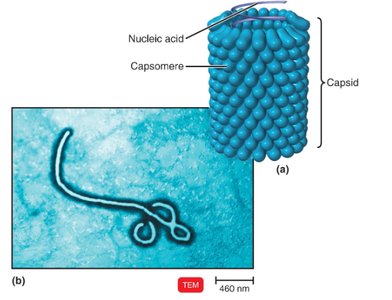
General Morphology
Viruses exhibit several structural types:
Helical viruses: Hollow, cylindrical capsid (e.g., rabies, Ebola).
Polyhedral viruses: Many-sided, most commonly icosahedral (e.g., adenovirus, poliovirus).
Enveloped viruses: Spherical appearance due to envelope.
Complex viruses: Complicated structures, such as bacteriophages.
Growing Viruses in the Laboratory
Bacteriophage Cultivation
Bacteriophages are grown in bacteria, forming plaques (clearings) on bacterial lawns. Each plaque corresponds to a single virus and is measured as plaque-forming units (PFU).
Animal Virus Cultivation
Animal viruses can be grown in living animals, embryonated eggs, or cell cultures.
Cell cultures: Cells form a monolayer; viral infection is detected by cytopathic effects (CPE).
Serological tests: ELISA and other antibody-based assays.
Nucleic acid tests: PCR for viral genome detection.
Viral Multiplication
One-Step Growth Curve
Viral multiplication involves invasion of a host cell and takeover of its metabolic machinery. The one-step growth curve illustrates the phases of viral replication. 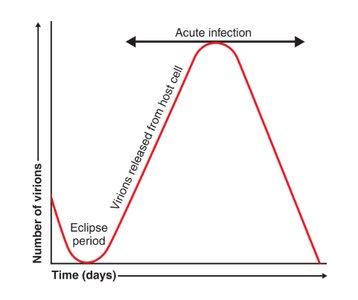
Multiplication of Bacteriophages
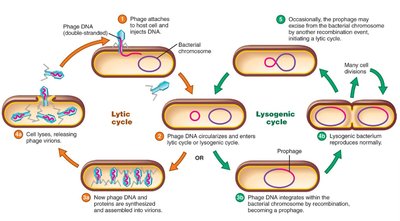
Bacteriophages multiply via two main mechanisms:
Lytic cycle: Phage causes lysis and death of the host cell.
Lysogenic cycle: Phage DNA is incorporated into the host genome, remaining latent.
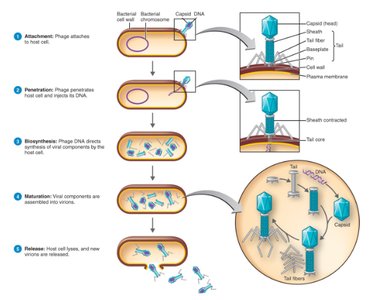
Lytic Cycle Steps
Attachment: Phage attaches to host cell via tail fibers.
Penetration: Phage injects DNA into host cell.
Biosynthesis: Production of phage DNA and proteins; host protein synthesis halts.
Maturation: Assembly of new phage particles.
Release: Phage lysozyme breaks cell wall, releasing new virions.
Lysogenic Cycle Steps
Lysogeny: Phage DNA integrates into host DNA as a prophage.
Outcomes:
Lysogenic cells are immune to reinfection by the same phage.
Phage conversion: Host exhibits new properties (e.g., toxin production).
Specialized transduction: Specific bacterial genes transferred via phage.
Biosynthesis of DNA and RNA Viruses
DNA Viruses
Adenoviridae: Double-stranded DNA, nonenveloped; causes respiratory infections and tumors.
RNA Viruses Using DNA
Retroviridae: Single-stranded RNA viruses that use reverse transcriptase to produce DNA, which integrates into the host genome as a provirus (e.g., HIV).
Viruses and Cancer
Oncogenic Viruses
Some viruses can cause cancer by transforming normal cells into tumor cells.
Oncogenes: Genes that induce transformation and tumor formation.
Retroviridae: HTLV-1 and HTLV-2 cause adult T cell leukemia and lymphoma; FeLV causes feline leukemia.
Latent and Persistent Viral Infections
Latent Infections
Latent viruses remain dormant in host cells for long periods and may reactivate.
Herpesviruses: Capable of latency (e.g., cold sores, shingles).
Persistent Infections
Persistent viral infections progress slowly and are often fatal (e.g., subacute sclerosing panencephalitis from measles virus).
Plant Viruses and Viroids
Plant Viruses
Plant viruses enter through wounds or via insects, causing diseases in economically important plants.
Viroids and Virusoids
Viroids: Short pieces of naked RNA causing diseases like potato spindle tuber.
Virusoids: Viroids enclosed in a protein coat, requiring coinfection with a virus.
Prions
Proteinaceous Infectious Particles
Prions are infectious proteins, inherited and transmissible by ingestion, transplant, or surgical instruments.
Spongiform encephalopathies: Includes "mad cow disease," Creutzfeldt-Jakob disease, and others.
Additional info: The notes above expand on the original content with academic context, definitions, and examples for clarity and completeness.
