 뒤로
Chapter 1: The Principles and Practice of Economics - Microeconomics Study Guide
스터디 가이드 - 스마트 노트
 자료에 맞춘 맞춤형 노트, 핵심 정의, 예시, 맥락을 확장해 제공합니다.
Chapter 1: The Principles and Practice of Economics
Learning Objectives
Understand the scope of economics and its relevance to everyday life.
Identify and explain the three fundamental principles of economics: optimization, equilibrium, and empiricism.
Apply economic reasoning to real-world scenarios and evaluate the costs and benefits of economic decisions.
The Scope of Economics
What is Economics?
Economics is the study of how people make choices under conditions of scarcity and how those choices affect society. The central focus is on decision-making, not just money, and applies to individuals, firms, and governments.
Scarcity: The situation where unlimited wants exist in a world of limited resources.
Economic Agent: Any individual or group that makes choices, such as consumers, firms, parents, politicians, etc.
Microeconomics: The study of how individuals, firms, and governments make choices.
Macroeconomics: The study of the whole economy.

Additional info: Economic agents can be individuals (e.g., consumers, parents) or groups (e.g., families, firms).
Scarcity and Choice
Scarce resources are things people want, where the quantity desired exceeds the quantity available. Economics studies how agents make choices among these scarce resources.
Example: If a bowl of candies is available, not everyone may get a piece if some take more than one. This illustrates scarcity and the need for choice.
Positive vs. Normative Economics
Economics distinguishes between describing what people actually do (positive economics) and recommending what people ought to do (normative economics).
Positive Economics: Describes actual behavior (e.g., some people took more than one candy).
Normative Economics: Recommends actions (e.g., each student should take one candy so everyone gets a piece).
Normative analysis also generates advice for public policy.
Three Principles of Economics
Overview
Optimization: Making the best choice possible with given information.
Equilibrium: When everyone is optimizing; no one would be better off with a different choice.
Empiricism: Using data to figure out answers to interesting questions.
The First Principle: Optimization
Trade-offs and Budget Constraints
Optimization involves making the best choice possible given available information. All optimization problems involve trade-offs, where some benefits must be given up to gain others.
Budget Constraint: The set of things a person can choose to do (or buy) without breaking their budget.
Opportunity Cost: The best alternative use of a resource. Economists often assign a monetary value to opportunity cost.
Example: If you want to buy a $20 book but can get it for $10 by driving 3 miles, the opportunity cost of not driving is $10. Similarly, for a $1,000 computer, the opportunity cost of not driving is $10.
Formula:
Application: Estimating the opportunity cost of going to see a movie: If you earn $10/hr and the movie is 2 hours, the opportunity cost is $20.


The Second Principle: Equilibrium
Definition and Application
Equilibrium is a situation in which no one benefits by changing their behavior. It is achieved when everyone is optimizing and no individual can improve their outcome by making a different choice.
Free Rider Problem: Occurs when individuals or groups enjoy benefits without incurring the costs.
Dealing with Free Riders: Groups must decide what is fair and apply pressure to free riders to conform. Markets do not have mechanisms for deciding fairness.

The Third Principle: Empiricism
Evidence-Based Analysis
Empiricism refers to the use of data to test economic theories and determine what causes real-world phenomena. Economists use data to verify whether theories about optimization and equilibrium match actual human behavior.
Example: Crowded beaches and hot temperatures go together. Empirical analysis can help determine causality.
Is Economics Good for You?
Costs and Benefits of Studying Economics
Studying economics involves weighing the costs and benefits, similar to any economic decision.
Costs: Tuition, other courses, sleep, stress.
Benefits: Graduation, knowledge, higher earnings potential, learning to think like an economist.

Summary Table: Opportunity Cost Example
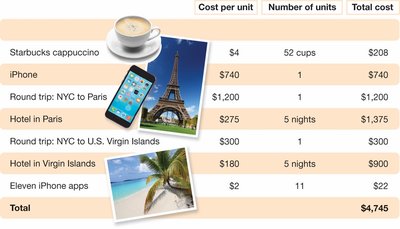
The following table illustrates what could be purchased with the opportunity cost of time spent on social media, valued at $4,745 per year.
Item | Cost per unit | Number of units | Total cost |
|---|---|---|---|
Starbucks cappuccino | $4 | 52 cups | $208 |
iPhone | $740 | 1 | $740 |
Round trip: NYC to Paris | $1,200 | 1 | $1,200 |
Hotel in Paris | $275 | 5 nights | $1,375 |
Round trip: NYC to U.S. Virgin Islands | $300 | 1 | $300 |
Hotel in Virgin Islands | $180 | 5 nights | $900 |
Eleven iPhone apps | $2 | 11 | $22 |
Total | $4,745 |
Conclusion
Economics provides a framework for understanding how individuals and groups make choices under scarcity, how these choices interact to form equilibria, and how empirical analysis can inform and improve decision-making. The principles of optimization, equilibrium, and empiricism are foundational to microeconomic reasoning and are applicable to a wide range of real-world situations.
