 뒤로
Chapter 2: The Economic Problem – Production Possibilities, Opportunity Cost, and Gains from Trade
스터디 가이드 - 스마트 노트
 자료에 맞춘 맞춤형 노트, 핵심 정의, 예시, 맥락을 확장해 제공합니다.
The Production Possibilities Frontier (PPF) and Opportunity Cost
Definition and Basic Concepts
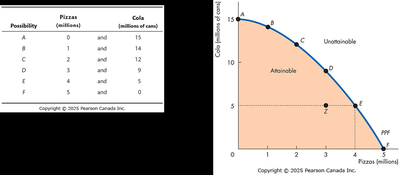
The Production Possibilities Frontier (PPF) is a fundamental model in microeconomics that illustrates the maximum combinations of two goods or services that can be produced in an economy, given fixed resources and technology. The PPF demonstrates the concepts of scarcity, choice, and opportunity cost.
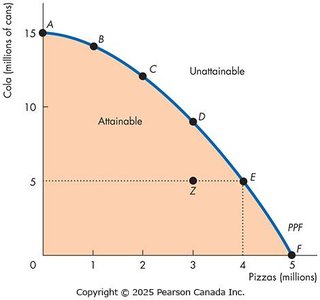
Attainable Points: Any combination of goods on or inside the PPF is attainable with the available resources.
Unattainable Points: Points outside the PPF cannot be reached with current resources and technology.
Production Efficiency: Achieved when it is impossible to produce more of one good without producing less of another. All points on the PPF are efficient.
Inefficiency: Points inside the PPF indicate underutilized or misallocated resources.
Tradeoffs and Opportunity Cost
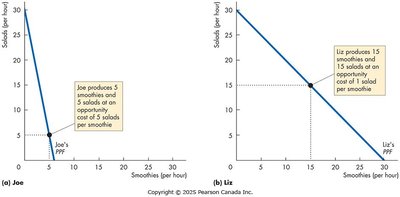
Moving along the PPF involves a tradeoff: to produce more of one good, the economy must produce less of another. The opportunity cost of a good is the amount of the other good that must be forgone to produce an additional unit.
Opportunity Cost as a Ratio: The opportunity cost of producing one good is the inverse of the opportunity cost of producing the other.
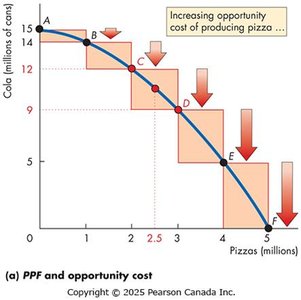
Increasing Opportunity Cost: The PPF is typically bowed outward, reflecting that resources are not equally productive in all activities. As production of one good increases, its opportunity cost rises.
Using Resources Efficiently: Marginal Cost and Marginal Benefit
Marginal Cost
The marginal cost of a good is the opportunity cost of producing one more unit of that good. As production increases, marginal cost typically rises due to increasing opportunity cost.
Marginal cost is represented by the slope of the PPF at any given point.
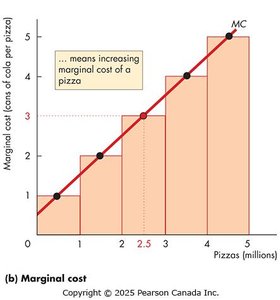
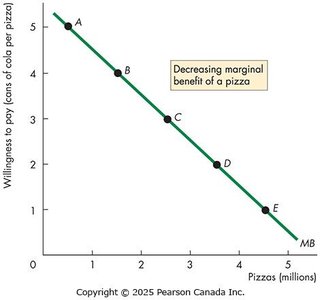
Marginal Benefit and Preferences
Preferences describe a person's likes and dislikes. The marginal benefit of a good is the benefit received from consuming one more unit, measured by the maximum amount a person is willing to pay for it. The marginal benefit curve shows the relationship between the marginal benefit and the quantity consumed.
Principle of Decreasing Marginal Benefit: As more of a good is consumed, its marginal benefit decreases.
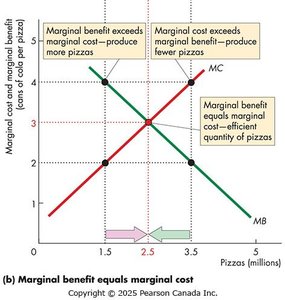
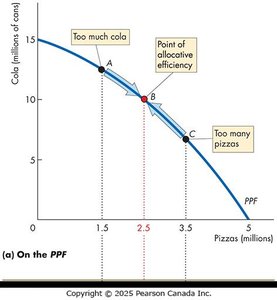
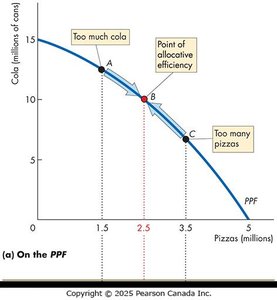
Allocative Efficiency
Allocative efficiency occurs when resources are allocated in a way that maximizes total benefit to society. This is achieved at the point where marginal benefit equals marginal cost.
At this point, the economy is producing the combination of goods most desired by society.
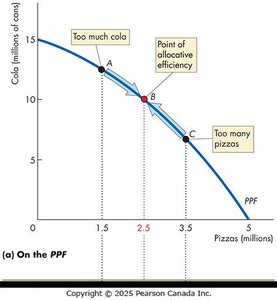
Comparative Advantage, Specialization, and Gains from Trade
Comparative and Absolute Advantage
Comparative advantage exists when a person or country can produce a good at a lower opportunity cost than others. Absolute advantage refers to being more productive in producing a good.
Comparative advantage is the basis for specialization and trade.
Specialization and Trade
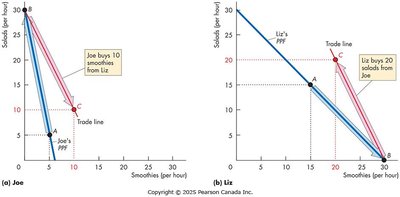
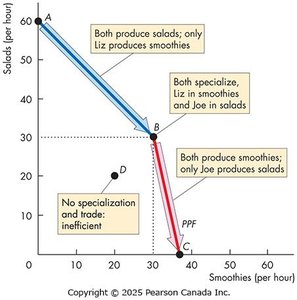
When individuals or countries specialize in the production of goods for which they have a comparative advantage and trade with others, both parties can achieve consumption levels beyond their own PPFs.
Specialization increases total output and allows for mutually beneficial trade.
Economic Growth
Sources and Costs of Economic Growth
Economic growth is the expansion of production possibilities, leading to a higher standard of living. It is driven by:
Technological change: Development of new goods and better production methods.
Capital accumulation: Growth of capital resources, including human capital.
The opportunity cost of economic growth is reduced current consumption, as resources are diverted to research and capital formation.
Economic Coordination and Institutions
Institutions for Coordination
To realize the gains from trade, economic choices must be coordinated. Four key institutions facilitate this:
Firms: Economic units that hire resources and produce goods/services.
Markets: Arrangements that enable buyers and sellers to interact.
Property rights: Social arrangements governing ownership and use of resources.
Money: A generally accepted medium of exchange.
The Circular Flow Model
The circular flow model illustrates the flow of resources, goods, services, and money in an economy. Households provide factors of production to firms and receive income, while firms produce goods and services for households.
Market Coordination
Markets coordinate individual decisions through price adjustments, ensuring that resources are allocated efficiently in response to changes in supply and demand.
