 뒤로
Chapter 8: Trade – Microeconomics Study Guide
스터디 가이드 - 스마트 노트
 자료에 맞춘 맞춤형 노트, 핵심 정의, 예시, 맥락을 확장해 제공합니다.
Trade in Microeconomics
Learning Objectives
Understand the Production Possibilities Curve (PPC) and its implications for trade.
Analyze the basis for trade using comparative advantage.
Examine trade between states and countries.
Evaluate arguments against free trade.
The Production Possibilities Curve (PPC)
Definition and Purpose
The Production Possibilities Curve illustrates the maximum possible output combinations of two goods that can be produced with available resources and technology. It is a fundamental tool for understanding trade-offs and opportunity costs in economics.
Efficient Production: Points on the PPC represent efficient use of resources.
Inefficient Production: Points inside the PPC indicate underutilization of resources.
Unattainable Production: Points outside the PPC are not possible with current resources.
Opportunity Cost: The slope of the PPC shows the opportunity cost of producing one good over another.
Example: If moving from point D to B on the PPC means giving up 4 computer programs to gain 2 websites, the opportunity cost of 1 website is 2 programs.
Calculating Opportunity Cost
Opportunity cost is calculated as the amount of one good foregone to produce an additional unit of another good.
For example, Olivia's PPC shows that giving up 8 programs yields 16 websites, so 1 program costs 2 websites.
Formula:
The Basis for Trade: Comparative Advantage
Comparative vs. Absolute Advantage
Comparative advantage is the ability of an economic agent to produce a good at a lower opportunity cost than another. Absolute advantage is the ability to produce more output with the same resources.
Trade is based on comparative, not absolute, advantage.
Agents should specialize in goods for which they have the lowest opportunity cost.
Example: If you have a lower opportunity cost for producing programs and Olivia for websites, you should specialize and trade.
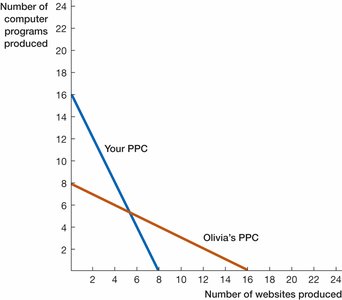
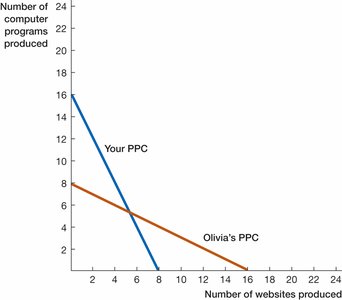
Gains from Specialization and Trade
Specialization increases total output and allows both parties to consume beyond their individual PPCs.
Terms of trade are negotiated so both parties benefit.
Example: If you produce 16 programs and Olivia produces 16 websites, both can trade to reach a point (T) unattainable individually.
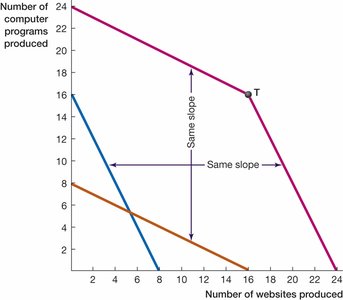
Trade Between States
Sources of Comparative Advantage
States gain from specialization and trade due to differences in resources, climate, technology, and labor.
Export: Goods produced domestically and sold elsewhere.
Import: Goods produced elsewhere and sold domestically.
Example: California and Florida have different opportunity costs for producing apricots and bananas, leading to specialization and trade.
Expanding the PPC
Production can be expanded by increasing resources, improving resource quality, or advancing technology.
Trade Between Countries
World Price and Trade Outcomes
Free trade leads to a world price, which determines whether a country imports or exports a good.
If world price > domestic price: Export
If world price < domestic price: Import
Winners and Losers:
Exporting: Producers gain, consumers lose.
Importing: Consumers gain, producers lose.
Net overall gain from trade is positive.
Example: In Denmark, if the world price of tennis shoes is above the domestic price, Danish producers benefit and consumers lose. If below, consumers benefit and producers lose.
Arguments Against Free Trade
Key Arguments
National Security: Over-reliance on imports may threaten security.
Cultural Concerns: Globalization may dilute national culture.
Environmental Concerns: Free trade can increase pollution and resource depletion.
Infant Industry: New industries may need protection to develop.
Local Wages and Jobs: Free trade may negatively affect domestic employment and wages.
Protectionism and Tariffs
Protectionism is the view that governments should control trade to mitigate harmful effects. Tariffs are taxes on imports that raise prices and protect domestic producers.
Tariffs reduce consumer surplus and increase producer surplus and government revenue.
Deadweight loss occurs when tariffs reduce overall welfare.
Evidence-Based Economics: Trade and Employment
Impact of Trade on Jobs
While some workers may lose jobs due to trade, there is no systematic evidence that trade broadly harms workers. Winners from trade can compensate losers, increasing overall welfare.
Summary Table: Comparative Advantage Example
Producer | Website Opportunity Cost | Program Opportunity Cost |
|---|---|---|
You | 2 computer programs | 0.5 websites |
Olivia | 0.5 computer programs | 2 websites |
Additional info: Table summarizes opportunity costs for specialization and trade.
Key Formulas
