 뒤로
뒤로Elasticity in Microeconomics: Calculation, Interpretation, and Applications
스터디 가이드 - 스마트 노트
 자료에 맞춘 맞춤형 노트, 핵심 정의, 예시, 맥락을 확장해 제공합니다.
Elasticity: Concepts and Calculation
Understanding Elasticity
Elasticity measures the responsiveness of one economic variable to changes in another. In microeconomics, the most common forms are price elasticity of demand (PED), cross-price elasticity of demand (CPED), income elasticity of demand (IED), and price elasticity of supply (PES). Accurate calculation and interpretation of elasticity are crucial for analyzing consumer and producer behavior.
Issues in Calculating Elasticity
Unit Dependence of Slope: Slope values depend on the units of measurement, making direct comparison problematic. For example, changing from hundreds to thousands of dollars alters the slope, even if the underlying data is unchanged.
Solution: Percentage Change: Using percentage changes standardizes the measurement, ensuring consistency across different units.
Example: Calculating slope with different units yields different values, but percentage change calculations yield the same elasticity regardless of units.
Midpoint Formula for Elasticity
Simple percentage change formulas can yield different elasticity values depending on the direction of movement between two points. The midpoint formula resolves this by providing a single, consistent value:
Midpoint Formula for PED:
This formula can be applied to all elasticity measurements (PED, CPED, IED, PES).
Interpreting Elasticity Values
Elastic (|E| > 1): Quantity is relatively responsive to price/income/related good changes.
Unit Elastic (|E| = 1): Proportional response.
Inelastic (|E| < 1): Quantity is not very responsive to changes.
Types of Elasticity
Price Elasticity of Demand (PED)
Definition: The responsiveness of quantity demanded to a change in price.
Interpretation: If PED = -1.89, a 1% increase in price causes a 1.89% decrease in quantity demanded.
Law of Demand: PED is usually negative due to the inverse relationship between price and quantity demanded.
Cross-Price Elasticity of Demand (CPED)
Definition: The responsiveness of quantity demanded for one good to a change in the price of another good.
CPED > 0: Substitutes (positive relationship).
CPED < 0: Complements (negative relationship).
CPED = 0: Unrelated goods.
Example: CPED = -1.41 (complements, cross-price elastic); CPED = +3.31 (substitutes, cross-price elastic).
Income Elasticity of Demand (IED)
Definition: The responsiveness of quantity demanded to a change in income.
IED > 1: Luxury good (income elastic).
0 < IED < 1: Necessity (income inelastic).
IED < 0: Inferior good.
Example: IED = +7.33 (luxury, income elastic); IED = +0.89 (necessity, income inelastic); IED = -0.77 (inferior, income inelastic).
Price Elasticity of Supply (PES)
Definition: The responsiveness of quantity supplied to a change in price.
PES > 1: Price elastic supply.
PES < 1: Price inelastic supply.
Determinant: Time is the primary determinant; supply is more elastic in the long run.
Example: PES = +0.69 (price inelastic supply).
Elasticity, Price, and Total Revenue
Price Effect and Output Effect
Price Effect: Change in revenue from a change in price (holding quantity constant).
Output Effect: Change in revenue from a change in quantity sold (holding price constant).
When price changes, both effects occur simultaneously:
If demand is price elastic (|PED| > 1): Output effect dominates. Price and total revenue move in opposite directions.
If demand is price inelastic (|PED| < 1): Price effect dominates. Price and total revenue move in the same direction.
Summary Table: Relationship Between Price, Elasticity, and Total Revenue
Elasticity | Price Increases | Price Decreases |
|---|---|---|
Elastic (|PED| > 1) | TR decreases | TR increases |
Inelastic (|PED| < 1) | TR increases | TR decreases |
Unit Elastic (|PED| = 1) | TR unchanged | TR unchanged |
Example Calculation: Price Elastic Demand and Total Revenue
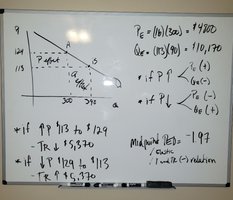
Suppose the price increases from $113 to $129:
Price effect (PE): +$4,800
Output effect (QE): -$10,170
Total revenue change: -$5,370
Midpoint PED: -1.97 (elastic)
Conclusion: A price increase reduces total revenue when demand is price elastic.
Summary of Key Elasticity Formulas
Price Elasticity of Demand (PED):
Cross-Price Elasticity of Demand (CPED):
Income Elasticity of Demand (IED):
Price Elasticity of Supply (PES):
Midpoint Formula (general):
Additional info:
Elasticity concepts are foundational for understanding consumer and producer responses to market changes, and for making pricing and production decisions.
Always specify the type of elasticity and the variable being analyzed (e.g., "price elastic demand").
