 뒤로
뒤로Elasticity in Microeconomics: Concepts, Calculation, and Applications
스터디 가이드 - 스마트 노트
 자료에 맞춘 맞춤형 노트, 핵심 정의, 예시, 맥락을 확장해 제공합니다.
Elasticity
Introduction to Elasticity
Elasticity is a fundamental concept in microeconomics used to quantify how one variable responds to changes in another. It is especially important for understanding how price changes affect consumer and producer behavior in markets. Economists use elasticity to measure the responsiveness of quantity demanded or supplied to changes in price, income, or the price of related goods.
Elasticity: The percentage change in one variable resulting from a percentage change in another variable.
Price Elasticity of Demand: Measures how much the quantity demanded of a good responds to changes in its price.
Price Elasticity of Demand
Definition and Formula
The price elasticity of demand is defined as the ratio of the percentage change in quantity demanded to the percentage change in price. It provides insight into how sensitive consumers are to price changes.
Formula:
Slope vs. Elasticity
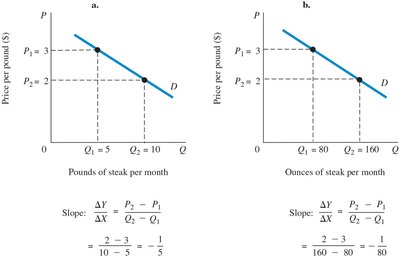
The slope of the demand curve is not a reliable measure of responsiveness because changing the unit of measurement alters the numerical value of the slope, even if buyer behavior remains unchanged.
Types of Elasticity
Perfectly Inelastic and Perfectly Elastic Demand
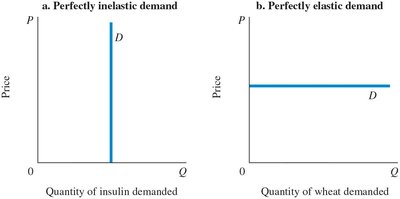
There are two extreme cases of price elasticity of demand: perfectly inelastic and perfectly elastic. These cases help illustrate the range of possible responses to price changes.
Perfectly Inelastic Demand: Quantity demanded does not change at all when price changes (elasticity = 0).
Perfectly Elastic Demand: Quantity demanded drops to zero with any increase in price (elasticity approaches infinity).
Elastic, Inelastic, and Unitary Elasticity
Most goods fall between the extremes. Elasticity can be classified as follows:
Elastic Demand: Absolute value of elasticity greater than one; quantity demanded changes more than price.
Inelastic Demand: Absolute value of elasticity between zero and one; quantity demanded changes less than price.
Unitary Elasticity: Absolute value of elasticity equals one; percentage change in quantity equals percentage change in price.
Calculating Elasticities
Percentage Change Calculation
Elasticity calculations require determining percentage changes in quantity and price. The initial value or midpoint formula can be used.
Initial Value Formula:
Midpoint Formula:
Midpoint:
Point Elasticity
Point elasticity uses the slope of the demand curve and measures elasticity at a specific point.
Formula:
Alternatively:
Elasticity Changes Along a Demand Curve
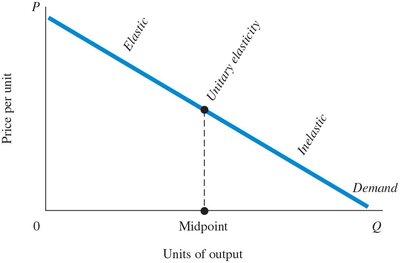
Elasticity varies along a straight-line demand curve. At higher prices and lower quantities, demand tends to be more elastic; at lower prices and higher quantities, demand is more inelastic.
Elasticity and Total Revenue
Relationship Between Price, Quantity, and Total Revenue
Total revenue (TR) is the product of price and quantity sold. The effect of price changes on total revenue depends on the elasticity of demand.
Formula:
If demand is inelastic, a price increase raises total revenue.
If demand is elastic, a price increase lowers total revenue.
For a price cut, the opposite effects occur.
The Determinants of Demand Elasticity
Factors Affecting Elasticity
Several factors influence the price elasticity of demand:
Availability of Substitutes: More substitutes make demand more elastic.
Budget Share: Goods that represent a small portion of the budget tend to have inelastic demand.
Luxuries vs. Necessities: Luxuries are more elastic; necessities are more inelastic.
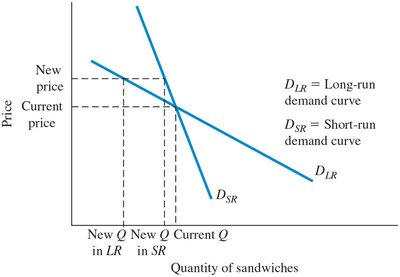
Time Horizon: Demand is more elastic in the long run as consumers adjust their behavior.
Other Important Elasticities
Income Elasticity of Demand
Income elasticity measures how demand changes in response to changes in consumer income.
Formula:
Normal goods have positive income elasticity; inferior goods have negative income elasticity.
Cross-Price Elasticity of Demand
Cross-price elasticity measures how the quantity demanded of one good responds to changes in the price of another good.
Formula:
Substitutes have positive cross-price elasticity; complements have negative cross-price elasticity.
Elasticity of Supply
Elasticity of supply measures how the quantity supplied responds to changes in price.
Formula:
Elasticity of Labor Supply
Elasticity of labor supply measures how the quantity of labor supplied responds to changes in the wage rate.
Formula:
Using Elasticity: Taxes and Market Outcomes
Excise Taxes and Market Equilibrium
Excise taxes are per-unit taxes imposed on specific goods. The effect of such taxes depends on the elasticity of demand and supply. When a tax is imposed, the supply curve shifts upward by the amount of the tax, resulting in a new equilibrium price and quantity.
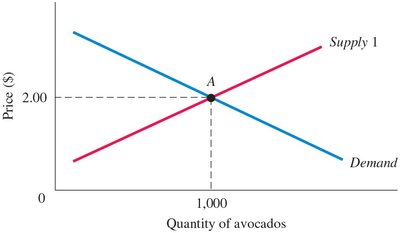
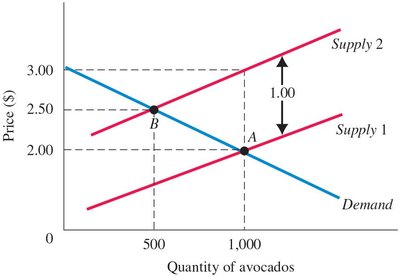
After a tax, the equilibrium quantity falls and the price paid by consumers rises.
The division of the tax burden between buyers and sellers depends on the relative elasticities of demand and supply.
Summary Table: Types of Elasticity
Type of Elasticity | Formula | Interpretation |
|---|---|---|
Price Elasticity of Demand | Responsiveness of quantity demanded to price changes | |
Income Elasticity of Demand | Responsiveness of demand to income changes | |
Cross-Price Elasticity of Demand | Effect of price change in one good on demand for another | |
Elasticity of Supply | Responsiveness of supply to price changes | |
Elasticity of Labor Supply | Responsiveness of labor supply to wage changes |
