 뒤로
뒤로Elasticity in Microeconomics: Concepts, Calculation, and Applications
스터디 가이드 - 스마트 노트
 자료에 맞춘 맞춤형 노트, 핵심 정의, 예시, 맥락을 확장해 제공합니다.
Elasticity
Introduction to Elasticity
Elasticity is a fundamental concept in microeconomics used to quantify how one variable responds to changes in another. It is especially important for understanding how price changes affect consumer and producer behavior in markets.
Elasticity: Measures the responsiveness of one variable (such as quantity demanded) to changes in another variable (such as price).
Direction of change is not enough; elasticity quantifies the magnitude of response.
Price Elasticity of Demand
The price elasticity of demand is the ratio of the percentage change in quantity demanded to the percentage change in price. It measures how sensitive consumers are to price changes.
Price Elasticity of Demand:
Formula:
Example: If the price of a product increases by 10% and the quantity demanded decreases by 20%, the price elasticity of demand is .
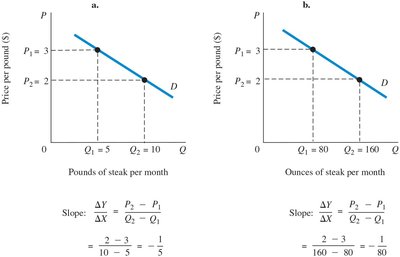
Changing the unit of measure (e.g., pounds vs. ounces) alters the numerical value of the slope, but not the underlying behavior of buyers.
Types of Elasticity
Elasticity can be classified into several types based on the degree of responsiveness:
Perfectly Inelastic Demand: Quantity demanded does not respond at all to price changes (elasticity = 0).
Perfectly Elastic Demand: Quantity demanded drops to zero with any price increase (elasticity approaches infinity).
Elastic Demand: Percentage change in quantity demanded is greater than percentage change in price (elasticity > 1).
Inelastic Demand: Percentage change in quantity demanded is less than percentage change in price (0 < elasticity < 1).
Unitary Elasticity: Percentage change in quantity demanded equals percentage change in price (elasticity = 1).
A mnemonic to remember: 'E' for Elastic, 'I' for Inelastic.
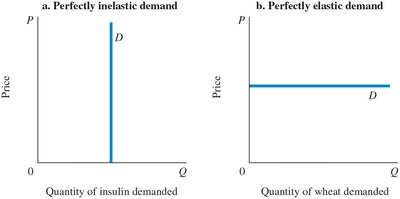
Panel (a): Perfectly inelastic demand (vertical line, e.g., insulin). Panel (b): Perfectly elastic demand (horizontal line, e.g., wheat).
Calculating Elasticities
Elasticity is calculated using percentage changes. There are several methods:
Percentage Change Method:
Midpoint Formula: , where Midpoint =
Point Elasticity: Uses calculus for small changes:
Example: If , , then percentage change in quantity = .
Elasticity Changes Along a Demand Curve
Elasticity is not constant along a straight-line demand curve. It varies depending on the position:
At higher prices and lower quantities, demand tends to be more elastic.
At lower prices and higher quantities, demand tends to be more inelastic.
At the midpoint, demand is unitary elastic.
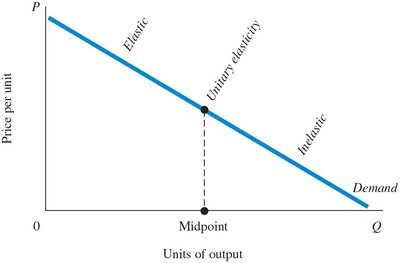
The midpoint divides the demand curve into elastic and inelastic regions.
Elasticity and Total Revenue
Total revenue (TR) is the product of price and quantity: .
If demand is elastic, a price increase decreases total revenue; a price decrease increases total revenue.
If demand is inelastic, a price increase increases total revenue; a price decrease decreases total revenue.
Example: For a product with elastic demand, lowering the price increases total revenue.
The Determinants of Demand Elasticity
Several factors influence the elasticity of demand:
Availability of Substitutes: More substitutes make demand more elastic.
Budget Share: Goods that are a small part of the budget tend to have inelastic demand.
Luxuries vs. Necessities: Luxuries are more elastic; necessities are more inelastic.
Time Horizon: Demand is more elastic in the long run as consumers adjust their behavior.
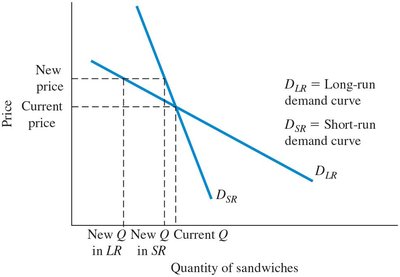
Long-run demand is more elastic than short-run demand, as shown by the greater change in quantity for the same price change.
Other Important Elasticities
Elasticity concepts extend beyond price elasticity of demand:
Income Elasticity of Demand:
Cross-Price Elasticity of Demand:
Elasticity of Supply:
Elasticity of Labor Supply:
Using Elasticity: Taxes and Market Outcomes
Elasticity is crucial for understanding the effects of taxes on markets. An excise tax shifts the supply curve upward by the amount of the tax, creating a new equilibrium.
Excise Tax: A per-unit tax on a specific good.
Tax incidence depends on the relative elasticities of supply and demand.
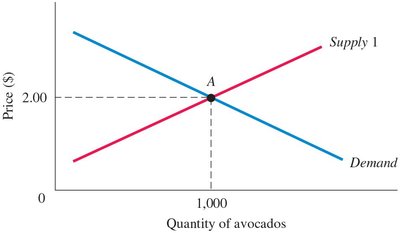
Before tax: 1,000 avocados sold at $2.00 each.
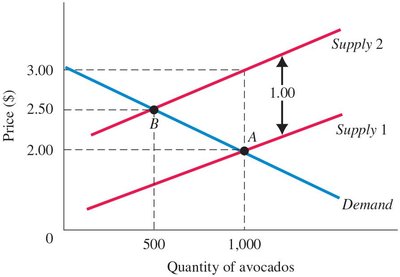
After tax: Supply curve shifts up, new equilibrium at 500 avocados sold, price rises to $2.50, storeowners receive $1.50 per avocado.
Summary Table: Types of Elasticity
Type | Definition | Elasticity Value |
|---|---|---|
Perfectly Inelastic | No response to price change | 0 |
Perfectly Elastic | Quantity drops to zero with any price increase | Infinity |
Elastic | Quantity changes more than price | >1 |
Inelastic | Quantity changes less than price | 0-1 |
Unitary Elasticity | Quantity changes equal to price | 1 |
Additional info: Academic context and examples were added to clarify calculation methods, determinants, and applications of elasticity.
