 뒤로
Government Actions in Markets: Price Ceilings, Price Floors, Taxes, Quotas, Subsidies, and Illegal Goods
스터디 가이드 - 스마트 노트
 자료에 맞춘 맞춤형 노트, 핵심 정의, 예시, 맥락을 확장해 제공합니다.
Government Actions in Markets
Price Ceilings and Rent Control
Government-imposed price ceilings are regulations that make it illegal to charge a price higher than a specified level. When applied to housing, this is known as a rent ceiling. The effects of rent ceilings depend on their relationship to the market equilibrium rent.
Rent Ceiling Above Equilibrium: No effect; market operates normally.
Rent Ceiling Below Equilibrium: Creates a housing shortage, increased search activity, and illegal trading.
Example: If the equilibrium rent is $1,200/month and the rent ceiling is set at $1,000/month, the market cannot clear, resulting in a shortage.
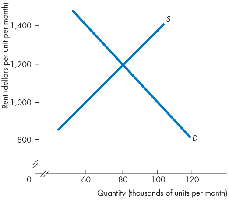
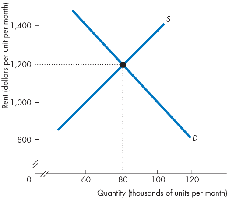
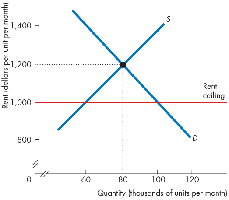
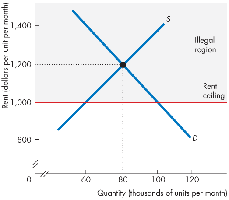
Housing Shortage
At the rent ceiling, the quantity of housing demanded exceeds the quantity supplied, resulting in a shortage.
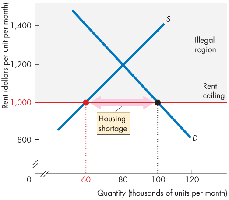
Increased Search Activity and Illegal Trading
With shortages, individuals spend more time searching for housing, increasing the opportunity cost. Some may pay above the ceiling, leading to illegal trading.
Inefficiency of Rent Ceilings
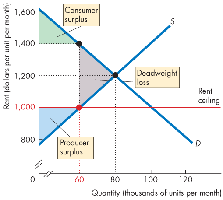
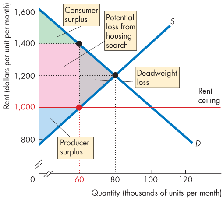
A rent ceiling below equilibrium leads to inefficient underproduction of housing services. Marginal social benefit exceeds marginal social cost, creating a deadweight loss.
Consumer surplus shrinks
Producer surplus shrinks
Potential loss from increased search activity
Fairness of Rent Ceilings
Rent ceilings are debated for fairness. According to the fair rules view, they block voluntary exchange. According to the fair results view, they do not generally benefit the poor. Scarce housing is allocated by lottery, first-come-first-served, or discrimination, none of which are considered fair outcomes.
Price Floors and Minimum Wage
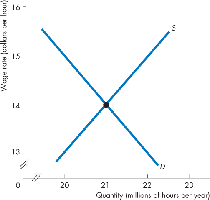
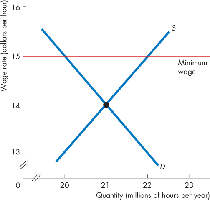
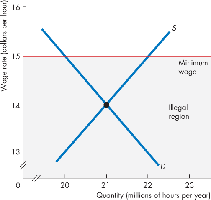
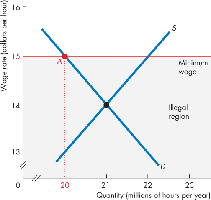
A price floor is a regulation that makes it illegal to trade at a price lower than a specified level. In labor markets, this is known as the minimum wage. If set above the equilibrium wage, it creates unemployment.
Minimum Wage Above Equilibrium: Quantity of labor supplied exceeds quantity demanded, creating a surplus (unemployment).
Minimum Wage Below Equilibrium: No effect; market operates normally.
Inefficiency of Minimum Wage
Minimum wage laws decrease the quantity of labor employed below the efficient quantity. Marginal social cost (leisure forgone) and marginal social benefit (value of goods produced) are not equal, resulting in deadweight loss.
Worker surplus and firm surplus decrease
Increased job search adds to the loss of surplus
Taxes: Incidence and Efficiency
Taxes are imposed on earnings and purchases. Tax incidence refers to the division of the tax burden between buyers and sellers. The actual burden depends on the elasticities of demand and supply, not on who the tax is levied upon.
Tax on Sellers: Supply decreases, price paid by buyers rises, price received by sellers falls.
Tax on Buyers: Demand decreases, price paid by buyers rises, price received by sellers falls.
Tax as a Wedge: The tax creates a wedge between the price buyers pay and sellers receive.
Efficiency Effects of Taxes
Except in cases of perfectly inelastic demand or supply, taxes create inefficiency by reducing the quantity traded and generating deadweight loss.
Tax Incidence and Elasticity
The division of the tax burden depends on elasticity:
Perfectly Inelastic Demand: Buyers pay the entire tax.
Perfectly Elastic Demand: Sellers pay the entire tax.
Perfectly Inelastic Supply: Sellers pay the entire tax.
Perfectly Elastic Supply: Buyers pay the entire tax.
Taxes in Practice
Taxes are often levied on goods with inelastic demand or supply, such as alcohol, tobacco, and gasoline. Buyers pay most of the tax on these items. For labor, workers pay most of the income and social security taxes due to low elasticity of supply.
Fairness Principles
Benefits Principle: People should pay taxes equal to the benefits they receive.
Ability-to-Pay Principle: People should pay taxes according to their ability to bear the burden.
Production Quotas and Subsidies
Governments intervene in markets for farm products through production quotas (upper limits on production) and subsidies (payments to producers).
Production Quotas
Quotas decrease quantity produced, raise price, and lower marginal cost, leading to inefficiency and incentives to cheat.
Subsidies
Subsidies increase supply, lower market price, and raise quantity produced. They result in inefficient overproduction, where marginal social cost exceeds marginal social benefit.
Markets for Illegal Goods
Even when trade is prohibited, markets for illegal goods exist. Penalties on sellers or buyers decrease supply or demand, respectively, raising prices and reducing quantity traded. Penalties on both sides further decrease market activity.
Legalizing and Taxing Illegal Goods: Legalization and taxation can achieve similar reductions in consumption as prohibition, but involve broader social and political considerations.
Key Formulas
Deadweight Loss:
Tax Incidence:
Summary Table: Effects of Government Actions
Action | Market Effect | Efficiency | Fairness |
|---|---|---|---|
Rent Ceiling | Shortage, search activity, illegal trading | Deadweight loss, reduced surplus | Debated: blocks exchange, may not benefit poor |
Minimum Wage | Unemployment, surplus of labor | Deadweight loss, reduced surplus | Debated: increases unemployment for low-skilled |
Tax | Reduced quantity, price wedge | Deadweight loss, reduced surplus | Depends on benefits and ability-to-pay principles |
Quota | Reduced quantity, higher price | Inefficient underproduction | May benefit producers |
Subsidy | Increased quantity, lower price | Inefficient overproduction | May benefit producers |
Illegal Goods | Reduced supply/demand, higher price | Inefficient, increased opportunity cost | Social and legal issues |
