뒤로
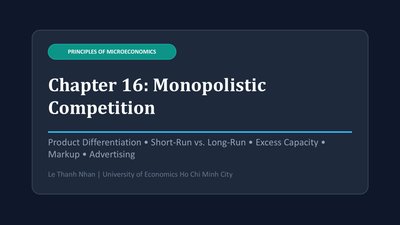
Monopolistic Competition: Structure, Outcomes, and Policy Implications
스터디 가이드 - 스마트 노트
 자료에 맞춘 맞춤형 노트, 핵심 정의, 예시, 맥락을 확장해 제공합니다.
Monopolistic Competition
Introduction to Monopolistic Competition
Monopolistic competition is a market structure characterized by many firms selling differentiated products with free entry and exit. Unlike perfect competition, products are not identical, and unlike monopoly, no single firm dominates the market. This chapter explores the defining features, outcomes, and policy implications of monopolistic competition.
The Spectrum of Market Structures
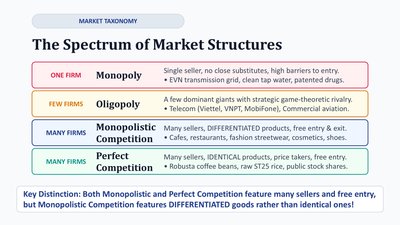
Market Taxonomy
Market structures can be classified based on the number of firms, product differentiation, and entry barriers. The main types are monopoly, oligopoly, monopolistic competition, and perfect competition.
Monopoly: One firm, unique product, high barriers to entry.
Oligopoly: Few firms, strategic interaction, some barriers to entry.
Monopolistic Competition: Many firms, differentiated products, free entry and exit.
Perfect Competition: Many firms, identical products, free entry and exit.
Key Distinction: Both monopolistic and perfect competition feature many sellers and free entry, but monopolistic competition features differentiated goods rather than identical ones.
Structural Foundations of Monopolistic Competition
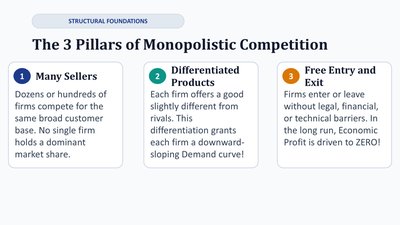
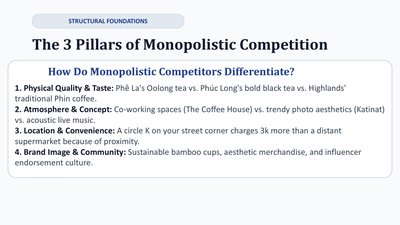
The 3 Pillars of Monopolistic Competition
Monopolistic competition rests on three foundational characteristics:
Many Sellers: Numerous firms compete for the same broad customer base; no single firm dominates.
Differentiated Products: Each firm offers a product that is slightly different from rivals, resulting in a downward-sloping demand curve for each firm.
Free Entry and Exit: Firms can enter or leave the market without significant barriers, driving long-run economic profit to zero.
How Do Monopolistic Competitors Differentiate?
Firms differentiate their products through various means:
Physical Quality & Taste: Differences in taste, quality, or ingredients (e.g., types of tea or coffee).
Atmosphere & Concept: Unique store concepts or aesthetics (e.g., co-working spaces vs. trendy cafes).
Location & Convenience: Proximity to customers can justify higher prices.
Brand Image & Community: Branding, merchandise, and endorsements create a sense of community and loyalty.
Comparing Market Structures
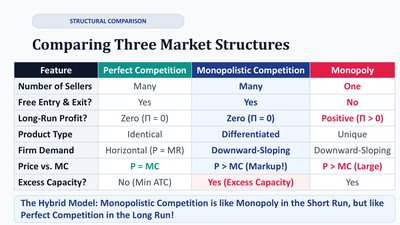
Comparison Table: Perfect Competition, Monopolistic Competition, Monopoly
The following table summarizes key differences among the three market structures:
Feature | Perfect Competition | Monopolistic Competition | Monopoly |
|---|---|---|---|
Number of Sellers | Many | Many | One |
Free Entry & Exit? | Yes | Yes | No |
Long-Run Profit? | Zero () | Zero () | Positive () |
Product Type | Identical | Differentiated | Unique |
Firm Demand | Horizontal () | Downward-Sloping | Downward-Sloping |
Price vs. MC | (Markup!) | (Large) | |
Excess Capacity? | No (Min ATC) | Yes (Excess Capacity) | Yes |
Hybrid Model: Monopolistic competition is like monopoly in the short run, but like perfect competition in the long run.
Short-Run Equilibrium
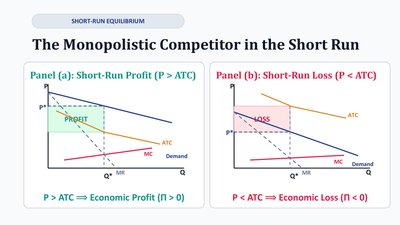
The Monopolistic Competitor in the Short Run
In the short run, a monopolistically competitive firm can earn profits or incur losses, depending on its cost and demand conditions.
Profit: If , the firm earns economic profit ().
Loss: If , the firm incurs economic loss ().
Active Learning: Short-Run Cafe Optimization
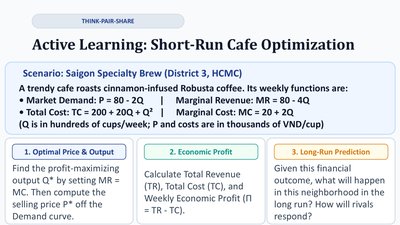
Consider a cafe with the following weekly functions:
Market Demand:
Marginal Revenue:
Total Cost:
Marginal Cost:
Optimal Price & Output: Set to find , then use the demand curve to find .
Economic Profit: Calculate Total Revenue (TR), Total Cost (TC), and Economic Profit ().
Long-Run Prediction: Predict how profits and market entry will evolve over time.
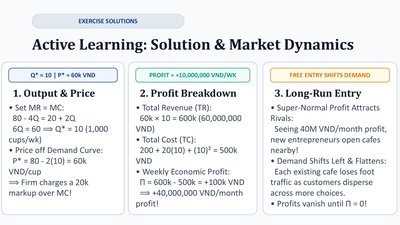
Active Learning: Solution & Market Dynamics
Output & Price: , VND/cup
Profit Breakdown: Weekly Economic Profit = 100k VND
Long-Run Entry: Profits attract new entrants, shifting demand and reducing profits to zero in the long run.
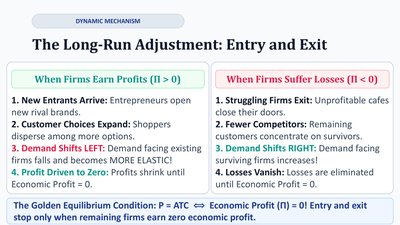
Long-Run Adjustment: Entry and Exit
Dynamic Mechanism
Entry and exit drive the market toward zero economic profit in the long run:
When Firms Earn Profits (): New entrants arrive, customer choices expand, demand for existing firms shifts left, and profits shrink to zero.
When Firms Suffer Losses (): Struggling firms exit, demand for survivors shifts right, and losses vanish as the market stabilizes.
Golden Equilibrium Condition: Economic Profit
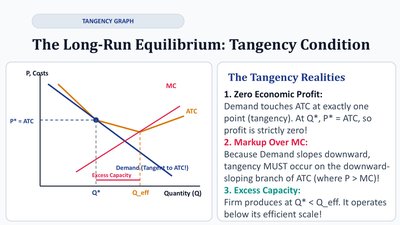
Long-Run Equilibrium: Tangency Condition
The Tangency Realities
Zero Economic Profit: Demand touches ATC at exactly one point (tangency). At , .
Markup Over MC: Because demand slopes downward, tangency must occur where .
Excess Capacity: The firm produces at , below its efficient scale.
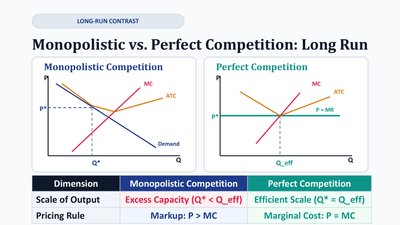
Monopolistic vs. Perfect Competition: Long Run
Key Contrasts
Monopolistic Competition: Excess capacity (), markup ().
Perfect Competition: Efficient scale (), price equals marginal cost ().
Excess Capacity
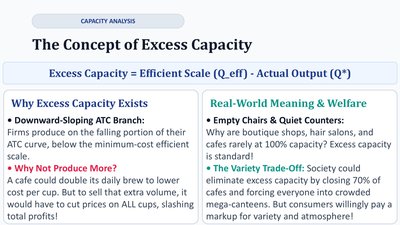
The Concept of Excess Capacity
Excess capacity is the difference between the efficient scale of production and the actual output of the firm:
Formula:
Why Excess Capacity Exists: Firms produce on the downward-sloping portion of their ATC curve, below the minimum-cost efficient scale.
Real-World Meaning: Empty seats or unused resources are common in monopolistic competition due to product variety and differentiation.
The Variety Trade-Off: Society could eliminate excess capacity by reducing the number of firms, but consumers value variety and are willing to pay a markup for it.
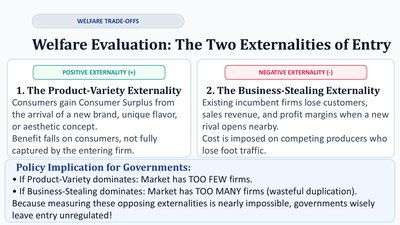
Welfare Evaluation: The Two Externalities of Entry
Positive and Negative Externalities
The Product-Variety Externality (Positive): Consumers gain surplus from new brands, flavors, or concepts.
The Business-Stealing Externality (Negative): New entrants steal customers and profits from incumbents, imposing costs on existing firms.
Policy Implication: If product-variety dominates, there are too few firms; if business-stealing dominates, there are too many. Because these effects are hard to measure, governments usually leave entry unregulated.
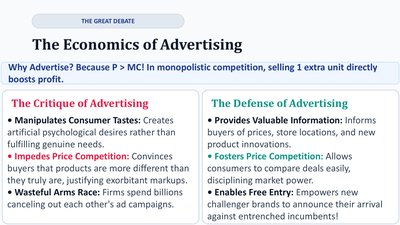
The Economics of Advertising
Debate: Critique vs. Defense
Critique: Advertising manipulates tastes, impedes price competition, and leads to wasteful spending.
Defense: Advertising provides valuable information, fosters competition, and enables free entry by informing consumers about new products.
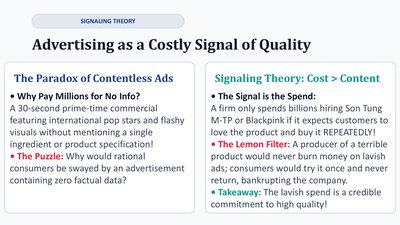
Advertising as a Costly Signal of Quality
Signaling Theory
The Paradox of Contentless Ads: Expensive ads with little factual content can still influence consumers by signaling a firm's confidence in its product.
Signaling Theory: High advertising spend is a credible signal of quality, as only firms with good products can afford to advertise lavishly without going bankrupt.
The Economics of Brand Names
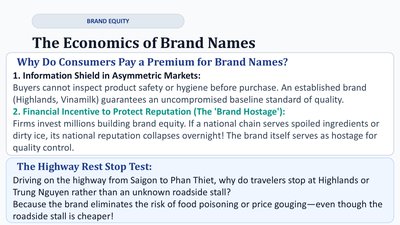
Why Do Consumers Pay a Premium for Brand Names?
Information Shield: Brands provide assurance of quality in markets with asymmetric information.
Financial Incentive to Protect Reputation: Firms invest in brand equity to signal quality and avoid reputational collapse.
Highway Rest Stop Test: Consumers prefer established brands to avoid risks, even if alternatives are cheaper.