뒤로
Oligopoly: Strategic Behavior, Cartels, and Game Theory
스터디 가이드 - 스마트 노트
 자료에 맞춘 맞춤형 노트, 핵심 정의, 예시, 맥락을 확장해 제공합니다.
Chapter 17: Oligopoly
Overview
This chapter explores the structure and behavior of oligopolistic markets, where a few large firms dominate and strategic interdependence shapes outcomes. Key topics include market concentration, collusion, game theory, the prisoner's dilemma, and public policy responses.
Measuring Market Concentration
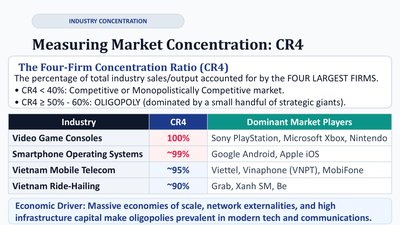
The Four-Firm Concentration Ratio (CR4)
Definition: The percentage of total industry sales/output accounted for by the four largest firms.
Interpretation:
CR4 < 40%: Competitive or Monopolistically Competitive market.
CR4 ≥ 50%–60%: Oligopoly (dominated by a small handful of strategic giants).
Industry | CR4 | Dominant Market Players |
|---|---|---|
Video Game Consoles | 100% | Sony PlayStation, Microsoft Xbox, Nintendo |
Smartphone Operating Systems | ~99% | Google Android, Apple iOS |
Vietnam Mobile Telecom | ~95% | Viettel, Vinaphone (VNPT), MobiFone |
Vietnam Ride-Hailing | ~90% | Grab, Xanh SM, Be |
Economic Driver: Massive economies of scale, network externalities, and high infrastructure capital make oligopolies prevalent in modern tech and communications.
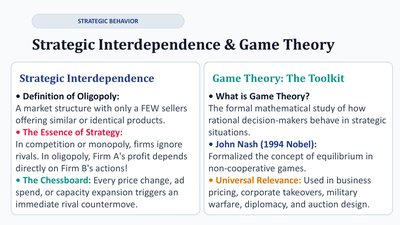
Strategic Interdependence & Game Theory
Strategic Interdependence
Oligopoly: A market structure with only a few sellers offering similar or identical products.
Essence of Strategy: In competition or monopoly, firms ignore rivals. In oligopoly, each firm's profit depends directly on rivals' actions.
The Chessboard: Every price change, ad spend, or capacity expansion triggers an immediate rival countermove.
Game Theory: The Toolkit
Definition: The formal mathematical study of how rational decision-makers behave in strategic situations.
John Nash (1994 Nobel): Formalized the concept of equilibrium in non-cooperative games.
Universal Relevance: Used in business pricing, corporate takeovers, military strategy, diplomacy, and auction design.
The Duopoly Model: Setting the Stage
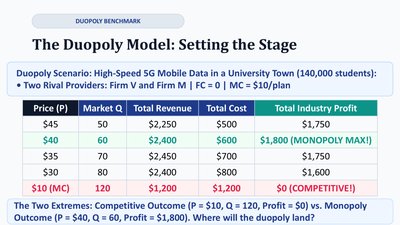
Duopoly is the simplest form of oligopoly, with only two firms. The model illustrates how firms' decisions affect market outcomes.
Price (P) | Market Q | Total Revenue | Total Cost | Total Industry Profit |
|---|---|---|---|---|
$45 | 50 | $2,250 | $500 | $1,750 |
$40 | 60 | $2,400 | $600 | $1,800 (MONOPOLY MAX!) |
$35 | 70 | $2,450 | $700 | $1,750 |
$30 | 80 | $2,400 | $800 | $1,600 |
$10 (MC) | 120 | $1,200 | $1,200 | $0 (COMPETITIVE!) |
Key Point: The duopoly outcome lies between the competitive (P = MC) and monopoly (P > MC) extremes.
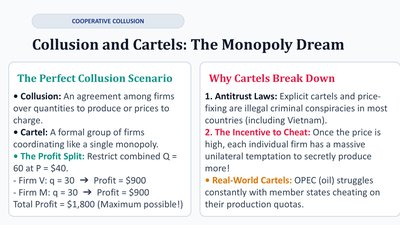
Collusion and Cartels: The Monopoly Dream
The Perfect Collusion Scenario
Collusion: An agreement among firms over quantities to produce or prices to charge.
Cartel: A formal group of firms coordinating like a single monopoly.
Profit Split Example: Restrict combined Q = 60 at P = $40. Each firm produces 30, earning $900 profit. Total profit = $1,800 (maximum possible).
Why Cartels Break Down
Antitrust Laws: Explicit cartels and price-fixing are illegal criminal conspiracies in most countries.
Incentive to Cheat: Once the price is high, each firm has a massive unilateral temptation to secretly produce more and earn more profit.
Real-World Example: OPEC (oil) struggles with member states cheating on production quotas.
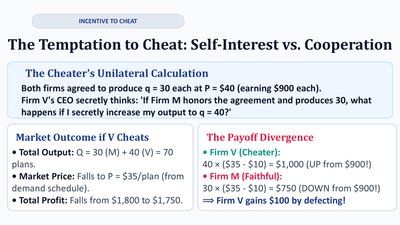
The Temptation to Cheat: Self-Interest vs. Cooperation
Even when firms agree to collude, individual incentives often lead to cheating, undermining the cartel.
The Cheater's Calculation: If one firm secretly increases output, it can gain at the other's expense.
Market Outcome if One Cheats:
Total Output: Q = 70 plans
Market Price: Falls to P = $35/plan
Total Profit: Falls from $1,800 to $1,750
Payoff Divergence:
Cheater: Profit rises to $1,000
Faithful: Profit falls to $750
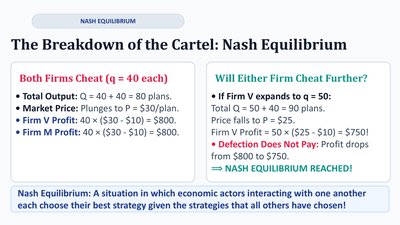
The Breakdown of the Cartel: Nash Equilibrium
When both firms cheat, the cartel collapses to a Nash Equilibrium, where neither can improve their outcome by changing strategy alone.
Both Firms Cheat: Q = 80, P = $30, Profit = $800 each.
Further Cheating: If one expands further, profit drops even more (defection does not pay).
Nash Equilibrium: Each chooses their best strategy given the other's choice; mutual cheating is stable but suboptimal.
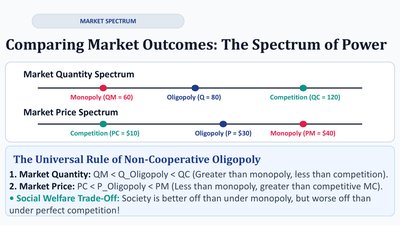
Comparing Market Outcomes: The Spectrum of Power
Market Quantity Spectrum: Monopoly (Q = 60) < Oligopoly (Q = 80) < Competition (Q = 120)
Market Price Spectrum: Competition (P = $10) < Oligopoly (P = $30) < Monopoly (P = $40)
Social Welfare Trade-Off: Society is better off than under monopoly, but worse off than under perfect competition.
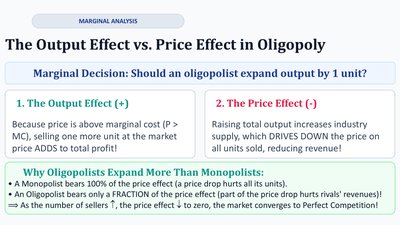
The Output Effect vs. Price Effect in Oligopoly
Oligopolists face two opposing effects when deciding whether to expand output by one unit.
The Output Effect (+): Selling one more unit at a price above marginal cost increases total profit.
The Price Effect (–): Raising total output lowers market price, reducing revenue on all units sold.
Why Oligopolists Expand More Than Monopolists: A monopolist bears the full price effect; an oligopolist bears only a fraction. As the number of sellers rises, the price effect falls, and the market outcome approaches perfect competition.
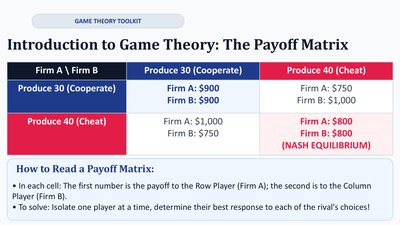
Introduction to Game Theory: The Payoff Matrix
The payoff matrix is a tool for analyzing strategic choices in oligopoly and other games.
Firm A \ Firm B | Produce 30 (Cooperate) | Produce 40 (Cheat) |
|---|---|---|
Produce 30 (Cooperate) | Firm A: $900 Firm B: $900 | Firm A: $750 Firm B: $1,000 |
Produce 40 (Cheat) | Firm A: $1,000 Firm B: $750 | Firm A: $800 Firm B: $800 (NASH EQUILIBRIUM) |
How to Read: Each cell shows the payoffs to both players. To solve, isolate one player at a time and determine their best response to each rival's choice.
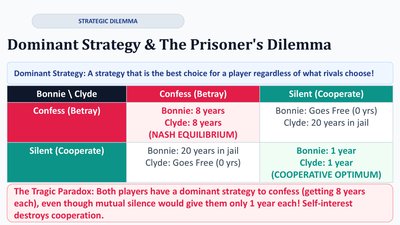
Dominant Strategy & The Prisoner's Dilemma
The prisoner's dilemma illustrates why rational self-interest can prevent cooperation, even when it is mutually beneficial.
Bonnie \ Clyde | Confess (Betray) | Silent (Cooperate) |
|---|---|---|
Confess (Betray) | Bonnie: 8 yrs Clyde: 8 yrs (NASH EQUILIBRIUM) | Bonnie: Goes Free Clyde: 20 yrs |
Silent (Cooperate) | Bonnie: 20 yrs Clyde: Goes Free | Bonnie: 1 yr Clyde: 1 yr (COOPERATIVE OPTIMUM) |
Tragic Paradox: Both players have a dominant strategy to confess, resulting in a worse outcome than mutual cooperation.
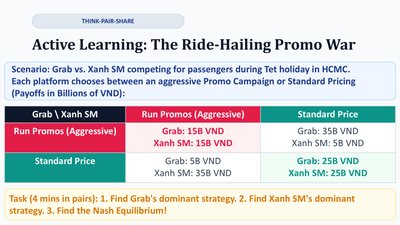
Active Learning: The Ride-Hailing Promo War
Example: Grab vs. Xanh SM competing for passengers. Each chooses between an aggressive promo campaign or standard pricing.
Grab \ Xanh SM | Run Promos (Aggressive) | Standard Price |
|---|---|---|
Run Promos (Aggressive) | Grab: 15B VND Xanh SM: 15B VND | Grab: 35B VND Xanh SM: 5B VND |
Standard Price | Grab: 5B VND Xanh SM: 35B VND | Grab: 25B VND Xanh SM: 25B VND |
Task: Find each firm's dominant strategy and the Nash Equilibrium.
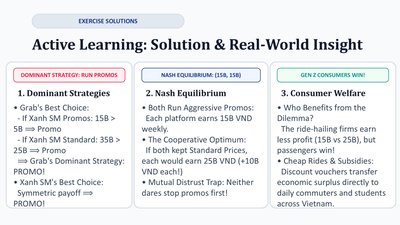
Active Learning: Solution & Real-World Insight
Dominant Strategies: Both firms' best choice is to run promos, regardless of the rival's action.
Nash Equilibrium: Both run aggressive promos (15B, 15B VND weekly). Mutual distrust trap: neither dares stop first.
Consumer Welfare: Consumers benefit from cheap rides and discounts, but firms earn less profit.
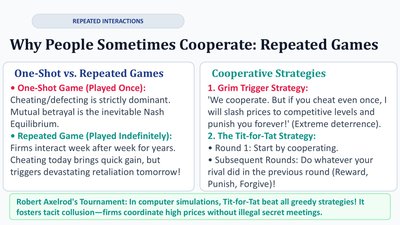
Why People Sometimes Cooperate: Repeated Games
One-Shot Game: Cheating/defecting is strictly dominant; mutual betrayal is the inevitable Nash Equilibrium.
Repeated Game: Firms interact week after week for years. Cheating today brings quick gain, but triggers retaliation tomorrow.
Cooperative Strategies:
Grim Trigger: "If you cheat once, I will slash prices to competitive levels and punish you forever."
Tit-for-Tat: Start by cooperating; in subsequent rounds, do whatever your rival did in the previous round (reward, punish, forgive).
Robert Axelrod's Tournament: In computer simulations, Tit-for-Tat beat all greedy strategies, fostering tacit collusion without illegal secret meetings.
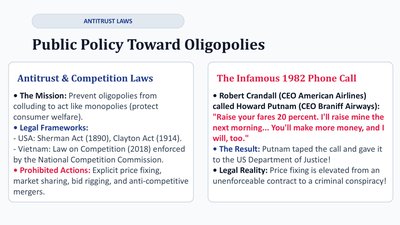
Public Policy Toward Oligopolies
Antitrust & Competition Laws
Mission: Prevent oligopolies from colluding to act like monopolies (protect consumer welfare).
Legal Frameworks:
USA: Sherman Act (1890), Clayton Act (1914)
Vietnam: Law on Competition (2018)
Prohibited Actions: Explicit price fixing, market sharing, bid rigging, and anti-competitive mergers.
Case Study: The Infamous 1982 Phone Call
Robert Crandall (American Airlines) called Howard Putnam (Braniff Airlines): "Raise your fares 20 percent. I'll raise mine the next morning... You'll make more money, and I will, too."
Putnam taped the call and reported it to the US Department of Justice.
Legal Reality: Price fixing is elevated from an unenforceable contract to a criminal conspiracy!
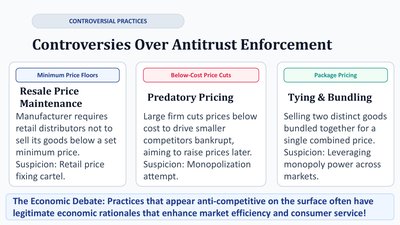
Controversies Over Antitrust Enforcement
Resale Price Maintenance: Manufacturer requires retailers not to sell below a set minimum price. Suspicion: Retail price fixing cartel.
Predatory Pricing: Large firm cuts prices below cost to drive smaller competitors bankrupt, aiming to raise prices later. Suspicion: Monopolization attempt.
Tying & Bundling: Selling two distinct goods bundled together for a single combined price. Suspicion: Leveraging monopoly power across markets.
Economic Debate: Practices that appear anti-competitive on the surface often have legitimate economic rationales that enhance market efficiency and consumer service.