 뒤로
뒤로Production Possibilities Frontier and the Economic Problem: Study Notes
스터디 가이드 - 스마트 노트
 자료에 맞춘 맞춤형 노트, 핵심 정의, 예시, 맥락을 확장해 제공합니다.
The Economic Problem
Introduction to the Economic Problem
The economic problem arises because resources are scarce, while human wants are virtually unlimited. This fundamental issue forces societies to make choices about what to produce, how to produce, and for whom to produce. Microeconomics addresses these questions using models such as the Production Possibilities Frontier (PPF).
Production Possibilities and Opportunity Cost
Production Possibilities Frontier (PPF)
The Production Possibilities Frontier (PPF) is a curve that shows the maximum attainable combinations of two goods or services that can be produced with available resources and technology, holding all else constant. It illustrates the trade-offs and opportunity costs involved in production decisions.
Points on the PPF: Efficient production points where all resources are fully utilized.
Points inside the PPF: Attainable but inefficient, as some resources are underutilized.
Points outside the PPF: Unattainable with current resources and technology.
Scarcity: The limited nature of resources, which restricts the combinations of goods that can be produced.
Opportunity Cost: The value of the next best alternative forgone when making a choice. On the PPF, producing more of one good requires sacrificing some of the other good.
Numerical Example: Brazil's PPF
Consider the following table showing Brazil's production possibilities for ethanol and food crops:
Ethanol (barrels/day) | Food Crops (tonnes/day) |
|---|---|
70 | 0 |
64 | 1 |
54 | 2 |
40 | 3 |
22 | 4 |
0 | 5 |
For example, increasing food production from 2 to 3 tonnes per day has an opportunity cost of 14 barrels of ethanol per day. Increasing from 3 to 4 tonnes costs 18 barrels of ethanol. This demonstrates the principle of increasing opportunity cost: as more of one good is produced, the opportunity cost (in terms of the other good) rises.
Shape of the PPF
Linear PPF: Indicates constant opportunity cost. The trade-off between goods is always the same.
Bowed-Outward (Concave) PPF: Indicates increasing opportunity cost. Resources are not equally efficient in producing all goods.
Using Resources Efficiently
Production Efficiency and Allocative Efficiency
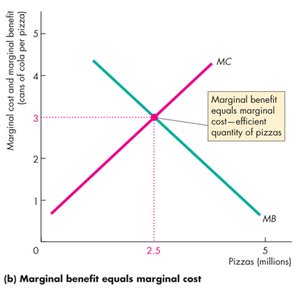
Production efficiency is achieved when the economy operates on the PPF, meaning resources are fully and efficiently utilized. Allocative efficiency occurs at the point on the PPF where the marginal benefit (MB) of a good equals its marginal cost (MC). This is the optimal allocation of resources from society's perspective.
Marginal Cost (MC): The opportunity cost of producing one more unit of a good. Generally, MC increases as more of a good is produced.
Marginal Benefit (MB): The additional benefit received from consuming one more unit of a good. MB typically decreases as more of a good is consumed.
Allocative Efficiency: Achieved where MB = MC.
Economic Growth
Sources and Effects of Economic Growth
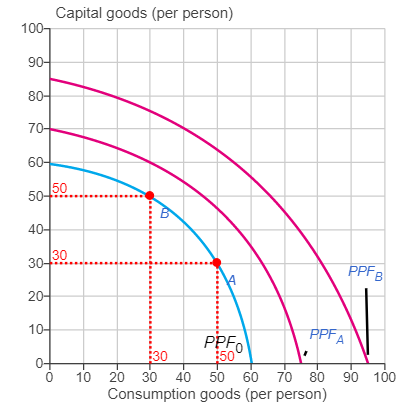
Economic growth is represented by an outward shift of the PPF, indicating that more of both goods can be produced. Growth can result from technological advances, capital accumulation, or improvements in human capital. However, investing in capital goods (like machinery) often requires sacrificing current consumption, illustrating the opportunity cost of growth.
Technological Change: Improves the ability to produce goods and services, shifting the PPF outward.
Capital Accumulation: Increasing the stock of capital goods, which enhances future production possibilities.
Opportunity Cost of Growth: The current consumption forgone to invest in capital goods for future production.
Practice Application
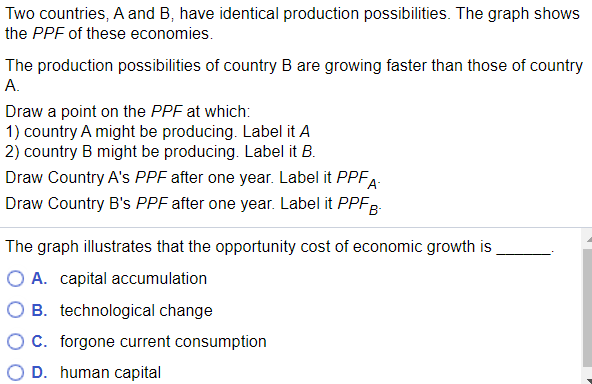
Consider two countries, A and B, with identical initial PPFs. If country B's PPF grows faster due to greater capital accumulation or technological progress, its future production possibilities will be higher. The opportunity cost of this growth is the current consumption that is forgone to invest in capital goods.
Summary Table: Key Concepts of the PPF
Concept | Definition | Example |
|---|---|---|
Scarcity | Limited resources vs. unlimited wants | Only so much land, labor, and capital available |
Opportunity Cost | Value of next best alternative forgone | Producing more food means less ethanol |
Production Efficiency | Operating on the PPF | All resources fully used |
Allocative Efficiency | MB = MC | Optimal mix of goods for society |
Economic Growth | Outward shift of PPF | More capital goods today, more output tomorrow |
Key Equations
Marginal Cost (MC):
Marginal Benefit (MB):
Allocative Efficiency Condition:
Additional info: The PPF is a foundational model in microeconomics, illustrating the core concepts of scarcity, choice, and opportunity cost. It also provides a framework for understanding efficiency and the trade-offs involved in economic growth.
