 뒤로
Scarcity, Choice, and Production Possibilities in Microeconomics
스터디 가이드 - 스마트 노트
 자료에 맞춘 맞춤형 노트, 핵심 정의, 예시, 맥락을 확장해 제공합니다.
The Economic Problem: Scarcity and Choice
Three Basic Economic Questions
Every society faces the fundamental economic problem of scarcity, which leads to three basic questions:
What gets produced? Societies must decide which goods and services to produce with their limited resources.
How is it produced? The methods and processes used to transform resources into goods and services must be chosen.
Who gets what is produced? The distribution of goods and services among individuals and groups must be determined.
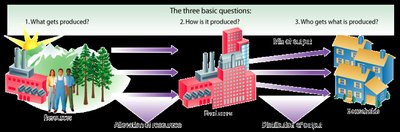
Production is the process of transforming scarce resources into useful goods and services. The basic resources, or factors of production, are land, labor, and capital.
Production Terminology
Inputs, Capital, and Outputs
Key terms in production include:
Inputs: Anything provided by nature or previous generations that can be used to satisfy human wants.
Capital: Goods that are produced and then used in the production of other goods or services (e.g., machinery).
Outputs: Goods and services of value to households.
Scarcity and Choice in a One-Person Economy
Production Possibilities Frontier (PPF)
Even in a one-person society, scarcity requires choices about what and how to produce. The Production Possibilities Frontier (PPF) illustrates the trade-offs between two goods. For example, if Tom can produce either 3 fish or 15 coconuts per day, the PPF is a straight line between these two points.
Marginal Rate of Transformation (MRT): The slope of the PPF, representing the opportunity cost of one good in terms of the other.
Opportunity Cost: The value of the next best alternative foregone. For Tom, the opportunity cost of 1 fish is 5 coconuts.
Formula for slope:
For Tom:
Comparative and Absolute Advantage
Specialization and Trade
When more than one person is involved, specialization and trade can increase overall welfare. The theory of comparative advantage states that parties should specialize in the production of goods for which they have the lowest opportunity cost.
Absolute Advantage: The ability to produce more of a good with the same resources.
Comparative Advantage: The ability to produce a good at a lower opportunity cost.
Example: Wilson can produce either 4 fish or 28 coconuts. Wilson has the absolute advantage in both goods, but Tom has the comparative advantage in fish, and Wilson in coconuts.
Production Possibilities with and without Trade
Colleen and Bill Example
Colleen can collect either 10 logs or 10 food bushels; Bill can collect either 4 logs or 8 food bushels. Their PPFs show the trade-offs between logs and food bushels. Specialization according to comparative advantage increases total production.
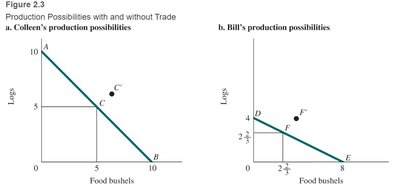
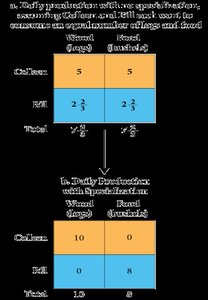
Table: Total Production with and without Specialization
Logs | Food Bushels | |
|---|---|---|
Colleen (without specialization) | 5 | 5 |
Bill (without specialization) | 2 2/3 | 2 2/3 |
Total (without specialization) | 7 2/3 | 7 2/3 |
Colleen (with specialization) | 10 | 0 |
Bill (with specialization) | 0 | 8 |
Total (with specialization) | 10 | 8 |
Additional info: Specialization increases total output, demonstrating the gains from trade.
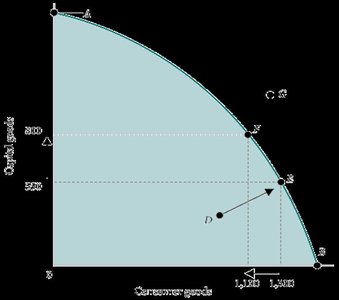
Production Possibility Frontier (PPF) for Societies
Capital Goods vs. Consumer Goods
The PPF can be extended to entire societies, showing the trade-off between producing capital goods (for future production) and consumer goods (for present consumption). Efficient points are on the PPF; inefficient points are inside; unattainable points are outside.
Law of Increasing Opportunity Cost
Bowed-Out PPF
As more resources are devoted to one good, the opportunity cost of producing additional units increases, resulting in a bowed-out PPF. This reflects the fact that resources are not equally suited to all types of production.
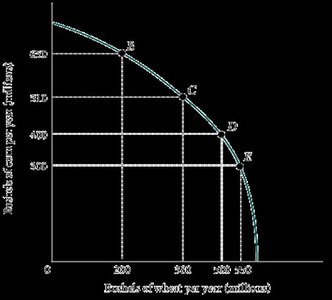
Table: Production Possibility Schedule for Corn and Wheat
Point on PPF | Corn Production (million bushels) | Wheat Production (million bushels) |
|---|---|---|
A | 700 | 100 |
B | 650 | 200 |
C | 510 | 380 |
D | 400 | 500 |
E | 300 | 550 |
Additional info: The opportunity cost of corn increases as more corn is produced, measured in lost wheat.
Causes of Inefficiency and Economic Growth
Inside the PPF and Shifts
Points inside the PPF represent inefficiency or unemployment. Economic growth shifts the PPF outward, while contraction shifts it inward. Growth can result from increased resources or improved technology.
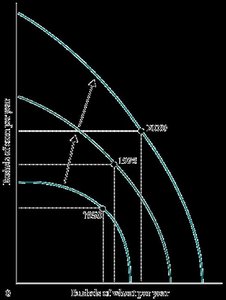
Rotations of the PPF
Technological Change Affecting One Good
Technological improvements or setbacks affecting only one good cause the PPF to rotate, changing the intercept for that good while leaving the other unchanged.
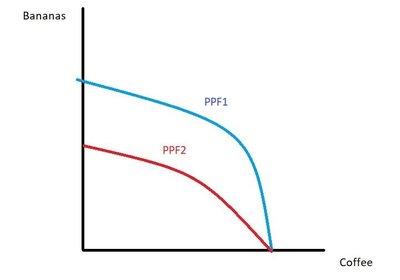
Economic Systems and the Role of Government
Command vs. Laissez-Faire Economies
Economic systems answer the basic questions of production and distribution in different ways:
Command Economy: The government sets output targets, incomes, and prices.
Laissez-Faire Economy: Individuals and firms pursue their own interests with minimal government intervention.
Mixed Economy: Most real-world economies combine elements of both systems.
Consumer Sovereignty: In market economies, consumers dictate what is produced by their purchasing choices.
Free Enterprise: Producers decide how to organize production, and output is distributed based on income, which can be increased through education or training.
Price Theory: In free markets, prices allocate resources and answer basic economic questions without central planning.
Additional info: The example of Feeding America demonstrates how introducing a market mechanism can improve allocation of resources.
