 뒤로
Short-Run Costs and Output Decisions in Microeconomics
스터디 가이드 - 스마트 노트
 자료에 맞춘 맞춤형 노트, 핵심 정의, 예시, 맥락을 확장해 제공합니다.
Short-Run Costs and Output Decisions
Overview
This chapter examines the costs of production and output decisions that firms make in the short run, focusing on the relationships between costs, revenues, and profit maximization in perfectly competitive markets.
Costs in the Short Run
Types of Costs
Fixed Cost: Any cost that does not depend on the firm’s level of output. These costs are incurred even if the firm is producing nothing. There are no fixed costs in the long run.
Variable Cost: A cost that depends on the level of production chosen. Variable costs change as output changes.
Total Cost (TC): The sum of total fixed costs and total variable costs.
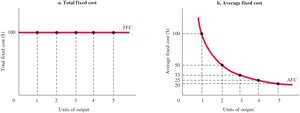
Total Fixed Cost (TFC) and Average Fixed Cost (AFC)
Total Fixed Cost (TFC): The total of all costs that do not change with output, even if output is zero.
Average Fixed Cost (AFC): Total fixed cost divided by the number of units of output; a per-unit measure of fixed costs.
Spreading Overhead: As output increases, average fixed cost declines because the fixed cost is spread over more units.
Variable Costs
Total Variable Cost (TVC): The total of all costs that vary with output in the short run.
Total Variable Cost Curve: Shows the relationship between total variable cost and the level of a firm’s output.
Marginal Cost (MC)
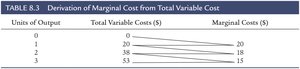
Marginal Cost (MC): The increase in total cost that results from producing one more unit of output. Marginal costs reflect changes in variable costs.
Units of Output | Total Variable Costs ($) | Marginal Costs ($) |
|---|---|---|
0 | 0 | 0 |
1 | 20 | 20 |
2 | 38 | 18 |
3 | 53 | 15 |
The Shape of the Marginal Cost Curve
In the short run, firms are constrained by some fixed input, leading to diminishing returns to variable inputs and limited capacity.
As capacity is approached, marginal costs rise due to diminishing marginal product.
Average Variable Cost (AVC)
Average Variable Cost (AVC): Total variable cost divided by the number of units of output; a per-unit measure of variable costs.
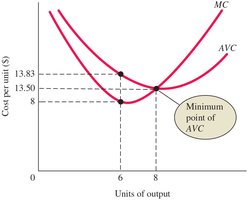
Relationship Between Marginal Cost and Average Variable Cost
When marginal cost is below average variable cost, AVC is declining.
When marginal cost is above average variable cost, AVC is increasing.
Marginal cost intersects AVC at the minimum point of AVC.
Total Costs
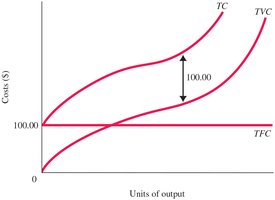
Total Cost Curve
Adding TFC to TVC means adding the same amount of total fixed cost to every level of total variable cost.
The total cost curve has the same shape as the total variable cost curve, but is higher by an amount equal to TFC.
Average Total Cost (ATC)
Average Total Cost (ATC): Total cost divided by the number of units of output; a per-unit measure of total costs.
ATC is the sum of average fixed cost and average variable cost:
As output increases, AFC falls, so ATC and AVC get closer together but never meet.
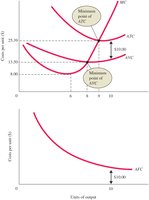
Relationship Between ATC and MC
If MC is below ATC, ATC will decline toward MC.
If MC is above ATC, ATC will increase.
MC intersects ATC at ATC’s minimum point, just as it does with AVC.
Output Decisions: Revenues, Costs, and Profit Maximization
Perfect Competition
Perfect Competition: An industry structure in which there are many firms, each small relative to the industry, producing identical products, and no firm has control over prices. Entry and exit are free.
Homogeneous Products: Products that are identical or indistinguishable from one another.
Total Revenue and Marginal Revenue
Total Revenue (TR): The total amount a firm receives from the sale of its product: price per unit times quantity of output.
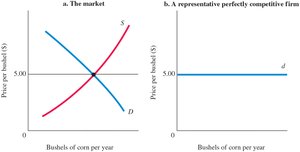
Marginal Revenue (MR): The additional revenue from selling one more unit. In perfect competition, MR equals price.
The demand curve facing a competitive firm is perfectly elastic (horizontal), and is identical to the marginal revenue curve.
Profit Maximization
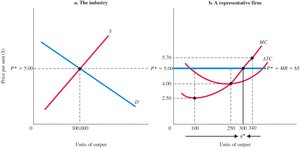
Firms maximize profit by producing up to the point where marginal revenue equals marginal cost:
As long as MR > MC, increasing output adds to profit.
If MR < MC, increasing output reduces profit.
The Short-Run Supply Curve
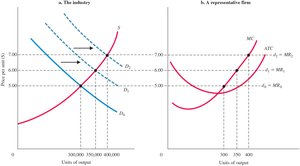
At any market price, the marginal cost curve shows the output level that maximizes profit.
The marginal cost curve of a perfectly competitive, profit-maximizing firm is the firm’s short-run supply curve, except when price is so low that it pays to shut down.
Key Terms and Concepts
Average Fixed Cost (AFC)
Average Total Cost (ATC)
Average Variable Cost (AVC)
Fixed Cost
Homogeneous Products
Marginal Cost (MC)
Marginal Revenue (MR)
Perfect Competition
Spreading Overhead
Total Cost (TC)
Total Fixed Cost (TFC)
Total Revenue (TR)
Total Variable Cost (TVC)
Total Variable Cost Curve
Variable Cost
Summary Table: Cost Concepts
Cost Concept | Definition |
|---|---|
Fixed Cost (FC) | Cost that does not vary with output |
Variable Cost (VC) | Cost that varies with output |
Total Cost (TC) | Sum of fixed and variable costs |
Average Fixed Cost (AFC) | Fixed cost per unit of output |
Average Variable Cost (AVC) | Variable cost per unit of output |
Average Total Cost (ATC) | Total cost per unit of output |
Marginal Cost (MC) | Cost of producing one more unit |
Equations
Profit maximization:
Additional info:
Cost curves and their relationships are fundamental to understanding firm behavior in the short run.
Perfect competition is characterized by firms being price takers, with no control over market price.
The marginal cost curve is central to both cost analysis and supply decisions in competitive markets.
