 뒤로
The Behavior of Consumers: Indifference Curves, Budget Lines, and Consumer Choice
스터디 가이드 - 스마트 노트
 자료에 맞춘 맞춤형 노트, 핵심 정의, 예시, 맥락을 확장해 제공합니다.
The Behavior of Consumers
Introduction to Consumer Theory
Consumer theory in microeconomics seeks to explain how individuals make choices given their preferences, income, and the prices of goods. The analysis relies on understanding both the consumer's tastes and the opportunities available to them, which are determined by prices and income.
Preferences: The consumer's likes and dislikes, represented graphically by indifference curves.
Opportunities: The set of consumption bundles a consumer can afford, represented by the budget line.
Tastes and Indifference Curves
Understanding Tastes
Economists often state, "De Gustibus Non Est Disputandum"—there is no accounting for tastes. Preferences are taken as given and are not subject to judgment or explanation within the model.
Indifference Curves
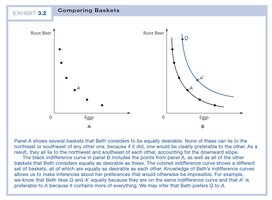
Indifference curves are a fundamental tool for representing consumer preferences. Each curve shows combinations of two goods that provide the consumer with the same level of satisfaction.
Definition: An indifference curve is a graphical collection of baskets (combinations of goods) that are equally desirable to the consumer.
Downward Sloping: To maintain the same satisfaction, an increase in one good must be offset by a decrease in the other.
Convexity: Indifference curves are typically convex to the origin, reflecting a diminishing marginal rate of substitution.
Using Indifference Curves
Consumers are indifferent between points on the same curve, prefer points above the curve, and find points below the curve less desirable.
Preference Ordering: The position of a basket relative to the indifference curve indicates preference.
Comparing Baskets: Indifference curves help determine which baskets are preferred when preferences are known.
Properties of Indifference Curves
Downward Sloping: Reflects the trade-off between goods.
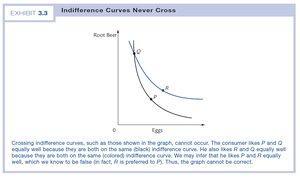
Do Not Cross: No two indifference curves for the same consumer can cross, as this would violate the consistency of preferences.
Fill the Plane: For any basket, there is an indifference curve passing through it.
Convexity: Curves are bowed inward toward the origin, indicating a diminishing marginal rate of substitution.
Marginal Value and the Slope of Indifference Curves
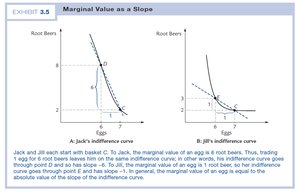
The marginal value of a good is the amount of the other good a consumer is willing to give up for one more unit of the first good. This is represented by the slope of the indifference curve at a given point.
Marginal Rate of Substitution (MRS): The absolute value of the slope of the indifference curve; it typically decreases as the consumer has more of one good and less of the other.
Steepness and Value: A steeper curve indicates a higher marginal value for the good on the horizontal axis.
The Shape of Indifference Curves
Indifference curves are generally convex to the origin, reflecting the principle of diminishing marginal rate of substitution. When a consumer has little of one good, they value it more highly relative to the other good.
Composite Good Convention
To simplify analysis, economists often use the composite good convention, where all goods except one are combined into a single composite good measured in dollar value. This allows the use of two-dimensional graphs to analyze choices between one good and all others.
The Budget Line and Consumer Choice
The Budget Line
The budget line represents all combinations of two goods that a consumer can afford given their income and the prices of the goods.
Equation:
Intercepts: The maximum amount of each good the consumer can buy if they spend all income on that good.
Relative Prices: The slope of the budget line is determined by the ratio of the prices of the two goods ().
Drawing the Budget Line
Find the intercepts by dividing income by the price of each good.
Connect the intercepts to form the budget line.
Only relative prices matter for the slope.
The Consumer’s Optimum
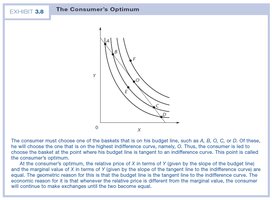
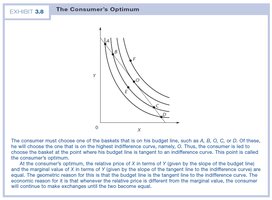
The consumer’s optimum is the most preferred basket of goods that is affordable, found at the point where the highest indifference curve is tangent to the budget line.
Tangency Condition: At the optimum, the slope of the indifference curve equals the slope of the budget line.
Equation:
Corner Solutions
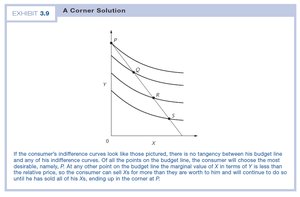
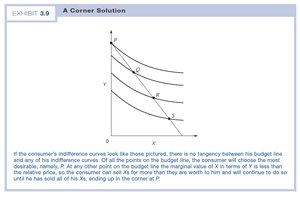
Sometimes, the consumer’s optimum occurs at a corner, where all income is spent on one good and none on the other. This happens when there is no tangency between the budget line and any indifference curve.
Corner Solution: The consumer chooses to consume only one good.
Nonconvex Preferences: More likely when indifference curves are not convex.
Applications of Indifference Curves
Standards of Living and Price Indices
Indifference curves and budget lines can be used to analyze changes in standards of living due to price changes. Price indices such as the Laspeyres and Paasche indices measure the impact of price changes on consumers.
Laspeyres Price Index: Based on the basket consumed in the earlier period.
Paasche Price Index: Based on the basket consumed in the later period.
Differences in Tastes
Differences in consumption patterns between individuals or countries may be due to differences in tastes or opportunities. By comparing budget lines and chosen baskets, economists can infer whether tastes differ.
The Least Bad Tax
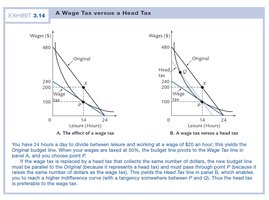
Indifference curve analysis can be used to compare the welfare effects of different types of taxes, such as a wage tax versus a head tax. For a given amount of revenue, a head tax is generally less distortionary than a wage tax.
Utility Functions and Indifference Curves
Utility Functions
A utility function assigns a numerical value to each basket of goods, representing the consumer’s level of satisfaction. Indifference curves can be derived from utility functions, with each curve corresponding to a different utility level.
Indifference Curve: The set of baskets that yield the same utility level.
Notation: defines an indifference curve for utility level .
Key Terms
Budget Line: The set of all affordable baskets given prices and income.
Composite-Good Convention: Treating all goods except one as a single composite good.
Convex: Bowed inward toward the origin; describes typical indifference curves.
Corner Solution: Optimum occurs at a corner, with all income spent on one good.
Indifference Curve: Shows combinations of goods yielding equal satisfaction.
Laspeyres Price Index: Measures price changes using the base period basket.
Marginal Value: The rate at which a consumer is willing to trade one good for another.
Optimum: The most preferred affordable basket.
Paasche Price Index: Measures price changes using the current period basket.
