 뒤로
뒤로Trade-offs, Comparative Advantage, and the Market System: Microeconomics Study Notes
스터디 가이드 - 스마트 노트
 자료에 맞춘 맞춤형 노트, 핵심 정의, 예시, 맥락을 확장해 제공합니다.
Trade-offs, Comparative Advantage, and the Market System
Scarcity and Trade-offs
Scarcity is a fundamental concept in economics, describing a situation where unlimited wants exceed the limited resources available to fulfill those wants. Because resources are scarce, individuals and societies must make choices, leading to trade-offs. Economics provides tools to analyze these choices and optimize resource allocation.
Scarcity: Limited resources versus unlimited wants.
Trade-off: Choosing more of one good or service means less of another. For example, if Tesla produces more sedans, fewer resources are available for SUVs.
Opportunity Cost: The highest-valued alternative forgone when making a choice.
Example: If Canada produces more computers, it must produce less wheat.
The Economic Problems All Societies Must Solve
Every society faces three fundamental economic questions:
What goods and services will be produced?
How will the goods and services be produced?
Who will receive the goods and services produced?
Economists use models to analyze these questions, often simplifying assumptions to focus on key relationships.
Production Possibilities Frontier (PPF)
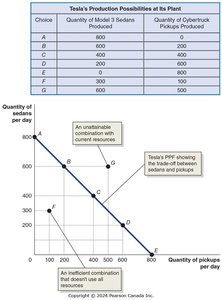
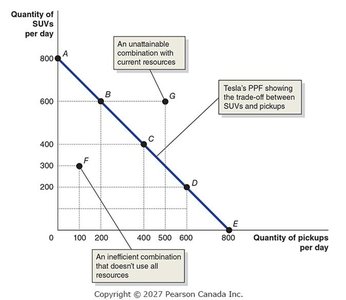
The Production Possibilities Frontier (PPF) is a curve showing the maximum attainable combinations of two goods that can be produced with available resources and current technology. The PPF illustrates trade-offs, opportunity costs, and efficiency in production.
Points on the PPF: Attainable and efficient.
Points inside the PPF: Attainable but inefficient (not all resources used).
Points outside the PPF: Unattainable with current resources and technology.
Opportunity cost is visualized on the PPF as the amount of one good that must be given up to produce more of another.
Tabular Representation of PPF
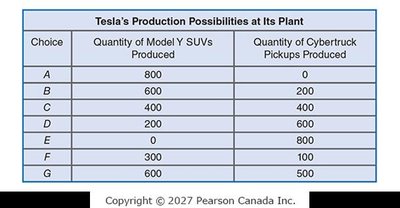
Choice | Model Y SUVs Produced | Cybertruck Pickups Produced |
|---|---|---|
A | 800 | 0 |
B | 600 | 200 |
C | 400 | 400 |
D | 200 | 600 |
E | 0 | 800 |
F | 300 | 100 |
G | 600 | 500 |
Additional info: This table shows the trade-off between producing SUVs and pickups at Tesla's plant, illustrating attainable, unattainable, and inefficient combinations.
Facing Trade-offs in Health Care Spending
Governments also face trade-offs due to scarcity. For example, increasing health care spending during COVID-19 required redirecting resources from other sectors, such as education or infrastructure. Every dollar spent on health care means giving up alternative uses, highlighting the central economic trade-off.

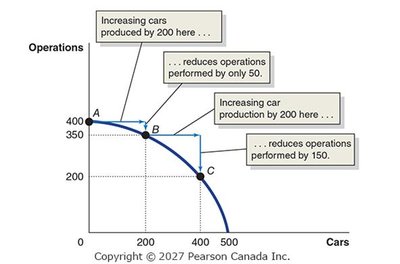
Increasing Marginal Opportunity Costs
Opportunity costs are often increasing, not constant. This occurs because some resources are better suited to one task than another. As more resources are devoted to an activity, the payoff to additional resources diminishes, and the opportunity cost rises.
Economic Growth and Shifts in the PPF
Economic growth occurs when more resources become available or when technology improves, allowing the economy to produce more goods and services. This is represented by an outward shift in the PPF.
Economic Growth: The ability of the economy to increase production.
Technological Improvement: Allows more output with the same resources.
Additional info: If labour hours increase or technology improves, previously unattainable combinations become attainable.
Comparative Advantage and Trade
Comparative advantage is the ability to produce a good at a lower opportunity cost than others. It forms the basis for trade, allowing countries to specialize and exchange goods for mutual benefit.
Absolute Advantage: The ability to produce more of a good with the same resources.
Comparative Advantage: The ability to produce at a lower opportunity cost.
Specialization: Allocating resources to the sector where a country has comparative advantage.
Example: Canada specializes in wheat, Japan in computers. Through trade, both countries can consume more than they could in self-sufficiency.
Opportunity Cost Table
Country | Opportunity Cost of 1 Computer | Opportunity Cost of 1 Ton of Wheat |
|---|---|---|
Canada | 10 tons of wheat | 0.1 computers |
Japan | 5 tons of wheat | 0.2 computers |
Additional info: This table shows the opportunity costs for Canada and Japan, helping to identify comparative advantage.
Terms of Trade
The terms of trade specify the rate at which one good is exchanged for another between countries. Both countries must agree to terms that are mutually beneficial, falling between their respective opportunity costs.
Example: If Japan wants 11 tons of wheat for a computer, Canada may not agree. If Canada offers 4 tons, Japan may not accept.
The Market System
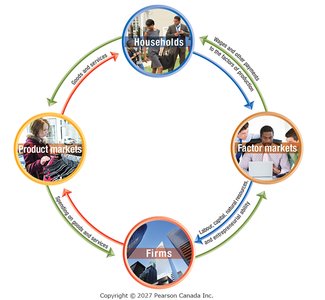
A market is a group of buyers and sellers of a good or service, and the institution or arrangement by which they come together to trade. The market system coordinates the allocation of resources through prices and competition.
Households: Provide factors of production (labour, capital, natural resources, entrepreneurial ability).
Firms: Supply goods and services to product markets.
Factor Markets: Where households sell factors of production to firms.
Product Markets: Where households buy goods and services from firms.
The Gains from Free Markets
Free markets, with few government restrictions, have historically provided rising living standards. Adam Smith's concept of the "invisible hand" describes how individuals acting in their own self-interest collectively satisfy consumer wants.
Competition: Encourages innovation and efficiency.
Decentralized Knowledge: Markets mobilize local, specialized knowledge better than central planning.
The Legal Basis of a Successful Market System
While free markets are efficient, governments play a crucial role in protecting property rights and enforcing contracts. Without these, markets cannot function effectively, as illustrated by economic collapse in countries lacking legal protections.
Property Rights: Essential for investment, specialization, and trade.
Enforcement of Contracts: Critical for transactions across time.
Trade-Offs in Consumer Choice: Buying a Car
Consumers face trade-offs when choosing between gas and electric cars, considering price, fuel cost, range, and wait times. Opportunity cost guides these decisions, and technological improvements can shift the PPF outward, increasing options.
Example: Gas cars are cheaper but cost more to operate; electric cars cost more upfront but may be preferred by environmentally conscious consumers.
Key Takeaways
The PPF illustrates trade-offs, opportunity costs, and efficiency.
Comparative advantage, not absolute advantage, is the basis for trade.
Free markets raise living standards, but governments must provide a sound legal environment.
