 뒤로
뒤로Energy Balance and Energy Expenditure in Human Nutrition
스터디 가이드 - 스마트 노트
 자료에 맞춘 맞춤형 노트, 핵심 정의, 예시, 맥락을 확장해 제공합니다.
Energy Balance
Introduction to Energy Balance
Energy balance is a fundamental concept in nutrition, describing the relationship between energy intake (calories consumed from food and beverages) and energy expenditure (calories burned by the body). Maintaining energy balance is essential for sustaining body weight and overall health.
Energy Intake: The total calories consumed from foods and beverages.
Energy Expenditure: The total calories used by the body for basal metabolism, physical activity, and processing food.
Calories and Measurement of Food Energy
The energy content of food is measured in calories (kcal). A calorie is the amount of energy needed to raise the temperature of 1 kilogram of water by 1°C. The bomb calorimeter is a device used to determine the caloric value of foods by measuring the heat released when a food sample is completely burned.
Calorie (kcal): Often used interchangeably with "kilocalorie" in nutrition.
Bomb Calorimeter: Measures the heat released from burning food to determine its energy content.

Additional info: In nutrition, the term "Calorie" (with a capital C) typically refers to a kilocalorie (kcal).
Energy Stores and Weight Change
Changes in body energy stores occur when there is an imbalance between energy intake and energy expenditure. This can result in weight gain, loss, or maintenance.
Energy Excess: Intake > Expenditure → Weight gain
Energy Deficit: Intake < Expenditure → Weight loss
Energy Balance: Intake = Expenditure → Weight maintenance
Key Weight Change Concepts
Understanding the caloric value of body weight is crucial for managing weight. Approximately 3,500 kcal equals 1 pound (lb) of body weight.
1 lb body weight = 3,500 kcal
To gain 2 lbs per week: +1,000 kcal/day × 7 days = +7,000 kcal/week → 2 lbs/week
To lose 0.8 lbs per week: -400 kcal/day × 7 days = -2,800 kcal/week → 0.8 lbs/week
Additional info: These calculations are estimates; actual weight change may vary due to metabolic adaptations and body composition.
Energy Expenditure
Components of Energy Expenditure
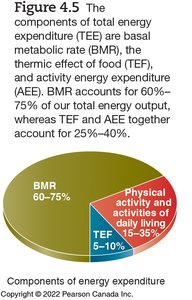
Energy expenditure is divided into three main components:
Basal Metabolic Rate (BMR): Energy used for involuntary activities (e.g., breathing, heart function, body temperature regulation).
Activity Energy Expenditure: Energy used for voluntary physical activities.
Thermic Effect of Food (TEF): Energy used to digest, absorb, and metabolize food.

BMR accounts for 60–75% of total energy expenditure, physical activity for 15–35%, and TEF for 5–10%.
Basal Metabolic Rate (BMR)
BMR is the largest component of energy expenditure and represents the energy required for basic physiological functions at rest.
Includes energy for breathing, heart function, maintaining body temperature, tissue renewal, and growth.
Excludes energy used for digestion and voluntary activities.
Factors Affecting BMR
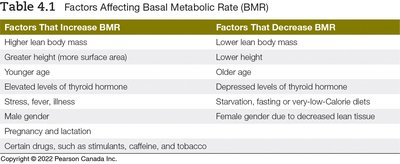
Several factors can increase or decrease BMR, influencing overall energy needs.
Factors That Increase BMR | Factors That Decrease BMR |
|---|---|
Higher lean body mass | Lower lean body mass |
Greater height (more surface area) | Lower height |
Younger age | Older age |
Elevated levels of thyroid hormone | Depressed levels of thyroid hormone |
Stress, fever, illness | Starvation, fasting, or very-low-calorie diets |
Male gender | Female gender (due to decreased lean tissue) |
Pregnancy and lactation | |
Certain drugs (stimulants, caffeine, tobacco) |
Physical Activity and BMR
Physical activity increases total energy expenditure. While short-term exercise does not immediately increase BMR, long-term increases in voluntary activity and lean muscle mass can elevate BMR over time.
Lean tissue has a higher BMR than fat tissue.
Regular exercise can increase lean body mass and thus BMR.
Estimated Energy Requirement (EER)
The Estimated Energy Requirement (EER) is a predictive equation used to estimate the average dietary energy intake needed to maintain energy balance in healthy adults. The EER equation considers age, gender, weight, height, and physical activity level.
Formula for Men (19+):
Formula for Women (19+):
Where PA = Physical Activity Coefficient, wt = weight in kg, ht = height in meters.

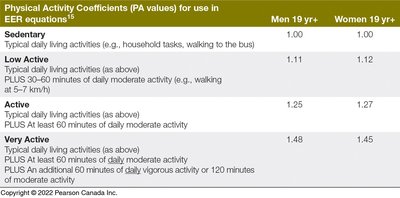
Physical Activity Coefficients (PA Values)
PA values are used in the EER equation to account for different levels of physical activity.
Activity Level | Men 19 yr+ | Women 19 yr+ | Description |
|---|---|---|---|
Sedentary | 1.00 | 1.00 | Typical daily living activities (e.g., household tasks, walking to the bus) |
Low Active | 1.11 | 1.12 | PLUS 30–60 minutes of daily moderate activity |
Active | 1.25 | 1.27 | PLUS at least 60 minutes of daily moderate activity |
Very Active | 1.48 | 1.45 | PLUS at least 60 minutes of daily moderate activity AND additional vigorous activity |
Example: Calculating EER
For a 30-year-old man, 180 cm tall, weighing 81 kg, who is active (PA = 1.25):
Convert height to meters: 180 cm = 1.8 m
Apply the formula: kcal/day
Additional info: The EER is an estimate and may vary by ±10% due to individual differences.
Summary of Key Concepts
Kilocalories (kcal) measure the energy potential of food as fuel for the human body.
Energy balance is the relationship between energy intake and energy expenditure.
Energy excess leads to weight gain; energy deficit leads to weight loss; weight maintenance occurs when intake equals expenditure.
Energy expenditure includes BMR, activity energy expenditure, and the thermic effect of food.
The EER equation estimates daily energy needs based on age, gender, weight, height, and physical activity.
