 뒤로
뒤로Chapter 4: Alkanes and Cycloalkanes: Structure, Nomenclature, Properties, and Conformations
스터디 가이드 - 스마트 노트
 자료에 맞춘 맞춤형 노트, 핵심 정의, 예시, 맥락을 확장해 제공합니다.
Alkanes and Cycloalkanes: Structure and Classification
Introduction to Alkanes
Alkanes are saturated hydrocarbons consisting only of carbon and hydrogen atoms, connected by single bonds. Their general formula is CnH2n+2 for acyclic alkanes. Cycloalkanes are ring structures with the formula CnH2n.
Alkanes: Straight-chain or branched hydrocarbons with only single bonds.
Cycloalkanes: Hydrocarbons with carbon atoms arranged in rings.
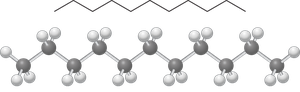
Example: Undecane (C11H24) is a straight-chain alkane.
Cycloalkane Structures
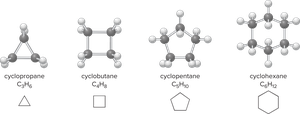
Cycloalkanes contain carbons joined in one or more rings. Their ring structure leads to unique properties compared to acyclic alkanes.
General formula: CnH2n
Examples: Cyclopropane, cyclobutane, cyclopentane, cyclohexane
Structure and Geometry of Alkanes
Tetrahedral Geometry of Carbon
All carbon atoms in alkanes are sp3 hybridized, resulting in a tetrahedral geometry with bond angles of 109.5°.
Three-dimensional models: Show tetrahedral arrangement.
Lewis structures: Do not represent 3D geometry.
Drawing Alkanes
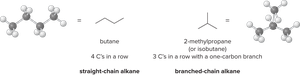
Alkanes can be represented in various ways, including zigzag skeletal structures and ball-and-stick models. All representations with the same number of carbons in a row are the same compound, not isomers.

Isomerism in Alkanes
Constitutional Isomers
Constitutional (structural) isomers are compounds with the same molecular formula but different connectivity of atoms.
Example: Butane and isobutane (C4H10)
Nomenclature of Alkanes and Cycloalkanes
Principles of IUPAC Nomenclature
The IUPAC system provides systematic rules for naming organic molecules. The name consists of three parts: prefix (substituents), parent (longest chain), and suffix (functional group).
Longest chain: Determines the parent name.
Substituents: Named and numbered for their position.
Functional group: Indicated by the suffix.
Naming Alkyl Groups
Alkyl groups are formed by removing one hydrogen from an alkane. The name changes from -ane to -yl.
Methane (CH4): Methyl (CH3−)
Ethane (CH3CH3): Ethyl (CH3CH2−)
Naming Three- and Four-Carbon Alkyl Groups
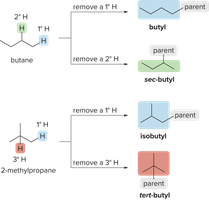
Propane and butane yield different alkyl groups depending on which hydrogen is removed (primary, secondary, or tertiary).
Propyl: Removal of a primary H from propane.
Isopropyl: Removal of a secondary H from propane.
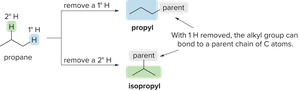
Butane and 2-methylpropane yield four possible alkyl groups: butyl, sec-butyl, isobutyl, and tert-butyl.
Steps for Naming Alkanes (IUPAC)
Step 1: Find the longest continuous carbon chain and add the suffix.
Step 2: Number the chain to give the first substituent the lowest number.
Step 3: Name and number the substituents.
Step 4: Combine substituent names and numbers, parent, and suffix.
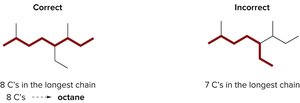

Naming Structures with Chains of Equal Length
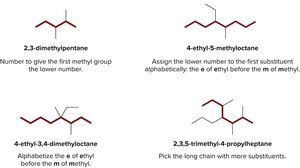
If two chains of equal length exist, choose the chain with more substituents.
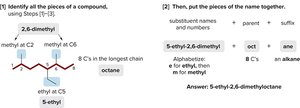
Numbering Alkanes with Substituents
Number the chain to give the first substituent the lowest possible number.
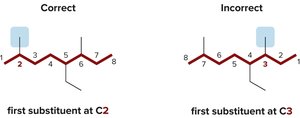
Numbering Chains with Equidistant Substituents
If substituents are equidistant, number the chain to give the second substituent the lower number.
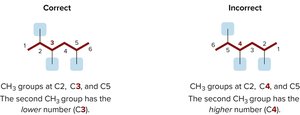
Alphabetical Rule for Numbering Substituents
When numbering results in the same numbers from either end, assign the lower number alphabetically to the first substituent.
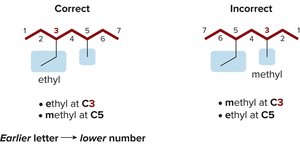
Naming Substituents and Using Prefixes
Use prefixes (di-, tri-, tetra-) for identical substituents. Each substituent needs its own number.
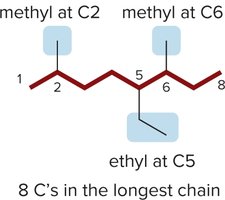
Combining Names and Hyphenation
Combine substituent names and numbers, parent, and suffix. Separate numbers by commas and numbers from letters by hyphens.
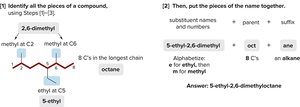
Examples of Alkane Nomenclature
Examples illustrate the application of IUPAC rules for naming alkanes.
Cycloalkane Nomenclature
Naming Cycloalkanes
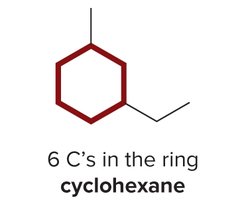
Cycloalkanes are named by adding the prefix 'cyclo-' to the name of the acyclic alkane with the same number of carbons.

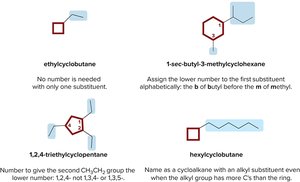
Naming and Numbering Substituents on Cycloalkanes
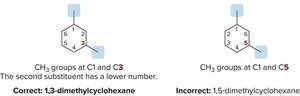
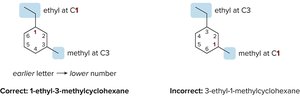
For rings with more than one substituent, begin numbering at one substituent and proceed around the ring to give the second substituent the lowest number. With two different substituents, assign the lower number alphabetically.

Examples of Cycloalkane Nomenclature
Examples show correct application of cycloalkane naming rules.
Natural Occurrence and Properties of Alkanes
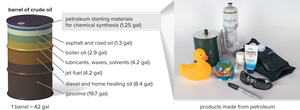
Fossil Fuels
Alkanes are found in natural gas and petroleum. Petroleum is a complex mixture of hydrocarbons.
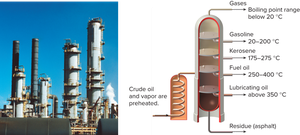
Refining of Oil
Distillation separates crude petroleum into fractions based on boiling points.
Physical Properties of Alkanes
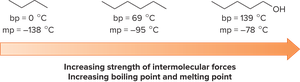
Alkanes contain only nonpolar C–C and C–H bonds, exhibiting weak van der Waals forces. They are soluble in organic solvents but insoluble in water.
Boiling and Melting Points
Boiling and melting points increase with the number of carbons due to increased surface area. Branching decreases boiling point, while symmetry increases melting point.
Conformations of Alkanes
Conformations of Acyclic Alkanes
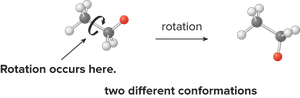
Conformations are different arrangements of atoms interconverted by rotation about single bonds.
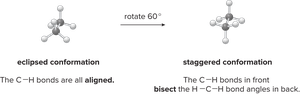
Eclipsed and Staggered Conformations
Eclipsed conformation: C–H bonds on adjacent carbons are aligned. Staggered conformation: C–H bonds bisect the H–C–H bond angle on adjacent carbons.
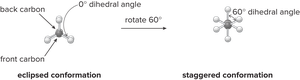
Dihedral Angle
The dihedral angle is the angle between bonds on adjacent atoms. For ethane, staggered conformation has a dihedral angle of 60°, eclipsed has 0°.
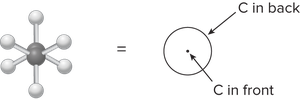
Newman Projections
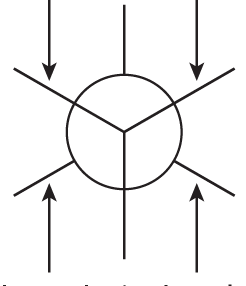
Newman projections are end-on representations used to visualize conformations.
Step 1: Look down the C–C bond and draw a circle with a dot in the center.
Step 2: Draw bonds for front and back carbons.
Step 3: Add atoms to each bond.
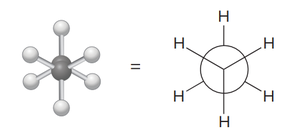
Newman Projections—Ethane
Staggered and eclipsed conformations of ethane are visualized using Newman projections.
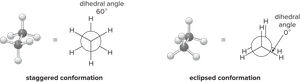
Conformations and Energy
Staggered conformations are more stable than eclipsed due to reduced electron–electron repulsion. The energy difference (~3 kcal/mol) is called torsional energy.
Newman Projections—Propane and Butane
Propane and butane have multiple C–C bonds, each capable of rotation, leading to several possible conformations.
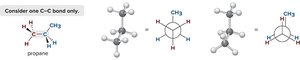
Anti and Gauche Conformations
Anti: Two large groups 180° apart (lowest energy). Gauche: Two large groups 60° apart (higher energy due to steric strain).
Skeletal Structures and Energy Minima
Alkanes are often drawn in zigzag skeletal structures to represent the lowest energy (all bonds staggered, large groups anti).
Conformations of Cycloalkanes
Angle Strain in Cycloalkanes
Angle strain occurs when bond angles deviate from the tetrahedral angle (109.5°). Cycloalkanes with more than three carbons are puckered to reduce strain.
Cyclohexane Conformations
Cyclohexane adopts a puckered "chair" conformation, which is most stable due to elimination of angle and torsional strain.
Chair Conformation Stability
The chair conformation eliminates angle strain (all C–C–C angles are 109.5°) and torsional strain (all hydrogens are staggered).
Axial and Equatorial Positions
Each carbon in cyclohexane has two hydrogens: axial (above/below ring) and equatorial (in the plane of the ring).
Drawing the Chair Form of Cyclohexane
Steps for drawing the chair form:
Step 1: Draw the carbon skeleton.
Step 2: Label up and down carbons.
Step 3: Draw axial hydrogens.
Step 4: Draw equatorial hydrogens.
Ring-Flipping in Cyclohexane
Cyclohexane undergoes ring-flipping, interconverting axial and equatorial positions.
Chair Conformations and Stability
Placing larger substituents in the equatorial position leads to more stable conformations due to reduced steric interactions.
Boat Conformation of Cyclohexane
The boat conformation is less stable due to torsional and steric strain (flagpole hydrogens).
Substituted Cyclohexanes
Steps for drawing two conformations for substituted cyclohexanes:
Step 1: Draw one chair form and add substituents.
Step 2: Ring-flip the cyclohexane ring.
Step 3: Add substituents to the second conformation.
Chair Conformations and Energy
Larger axial substituents create destabilizing 1,3-diaxial interactions. The equatorial conformation is more stable.
Preference of Equatorial Position
Three-dimensional representations show the preference for equatorial positions in substituted cyclohexanes.
Effect of Substituent Size
Larger substituents (e.g., tert-butyl) anchor the ring in the equatorial conformation.
Stereochemistry of Cycloalkanes
Disubstituted Cycloalkanes
Disubstituted cycloalkanes can be cis (same side) or trans (opposite sides) stereoisomers.
Cis and Trans Stereoisomers
Cis: Two groups on the same side of the ring. Trans: Two groups on opposite sides.
Cis–Trans Isomerism in 1,4-Disubstituted Cyclohexanes
Each stereoisomer has two possible chair conformations.
Drawing Disubstituted Cyclohexane
Steps for drawing trans-1,4-dimethylcyclohexane:
Step 1: Draw one chair form and add substituents (diaxial arrangement).
Step 2: Ring-flip the ring.
Step 3: Add substituents to the second conformation.
Trans and Cis Disubstituted Cycloalkanes
Trans isomers have both substituents in equatorial positions (lower energy). Cis isomers have one axial and one equatorial substituent (equally stable).
Oxidation and Reduction Reactions of Alkanes
Oxidation and Reduction
Oxidation increases the number of C–Z bonds and decreases C–H bonds. Reduction decreases C–Z bonds and increases C–H bonds.
Combustion of Alkanes
Alkanes undergo combustion in the presence of oxygen to form carbon dioxide and water. This is an oxidation–reduction reaction.
Summary Table: Straight-Chain Alkanes
Alkane | Molecular Formula | Structure |
|---|---|---|
Methane | CH4 | Single carbon |
Ethane | C2H6 | Two carbons |
Propane | C3H8 | Three carbons |
Butane | C4H10 | Four carbons |
Pentane | C5H12 | Five carbons |
Hexane | C6H14 | Six carbons |
Heptane | C7H16 | Seven carbons |
Octane | C8H18 | Eight carbons |
Nonane | C9H20 | Nine carbons |
Decane | C10H22 | Ten carbons |
Additional info: This summary table is inferred from standard alkane nomenclature and molecular formulas.
----------------------------------------
