 뒤로
Alkenes: Structure, Nomenclature, Thermodynamics, and Kinetics
스터디 가이드 - 스마트 노트
 자료에 맞춘 맞춤형 노트, 핵심 정의, 예시, 맥락을 확장해 제공합니다.
Alkenes: Structure, Nomenclature, and Reactivity
Molecular Formula and Degree of Unsaturation
The degree of unsaturation is a key concept in organic chemistry, indicating the number of π bonds and rings present in a molecule. It is calculated by comparing the molecular formula to that of a fully saturated hydrocarbon.
Degree of Unsaturation: Each π bond or ring reduces the number of hydrogens by two compared to the saturated formula.
Formula: Degree of unsaturation = total number of π bonds and rings.
Example: C5H10 has one degree of unsaturation (either a double bond or a ring).


Saturated and Unsaturated Hydrocarbons
Hydrocarbons are classified based on the presence or absence of double bonds.
Saturated hydrocarbons (alkanes): Contain only single bonds.
Unsaturated hydrocarbons (alkenes, alkynes): Contain one or more double or triple bonds.

Naming Alkenes
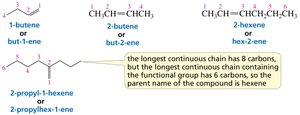
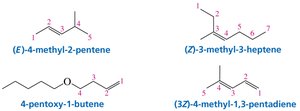
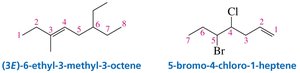
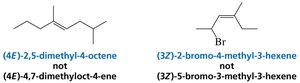
Alkenes are named by replacing the "-ane" suffix of alkanes with "-ene" and assigning the lowest possible number to the double bond.
Functional group: The double bond is prioritized in numbering.
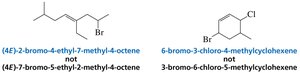
Substituents: Listed in alphabetical order and placed before the parent name.
Multiple double bonds: Use suffixes like diene (2), triene (3).
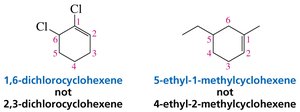
Cyclic alkenes: Numbering starts at the double bond, and the lowest substituent number is chosen.




Stereoisomers of Alkenes
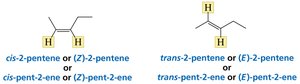
Alkenes can exhibit cis/trans (or E/Z) isomerism due to restricted rotation around the double bond.
cis (Z): Substituents on the same side of the double bond.
trans (E): Substituents on opposite sides.
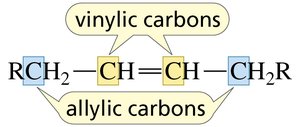
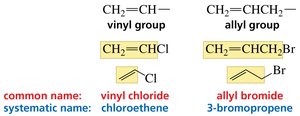
Vinylic and Allylic Carbons
Understanding the location of vinylic and allylic carbons is essential for predicting reactivity and naming groups.
Vinylic carbon: The sp2 carbon of an alkene.
Allylic carbon: A carbon adjacent to a vinylic carbon.
Structure and Bonding in Alkenes
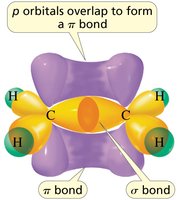
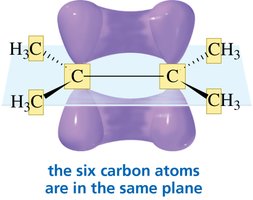
Alkenes are characterized by a double bond consisting of one σ bond and one π bond, formed by the overlap of p orbitals.
Planarity: The six atoms involved in the double bond are in the same plane.
Bonding: π bond is weaker and more reactive than the σ bond.
Reactions of Organic Compounds: Functional Groups and Families
Organic compounds are classified into families based on their functional groups, which determine their reactivity.
Functional group: The reactive part of the molecule.
Families: All members of a family react in similar ways.
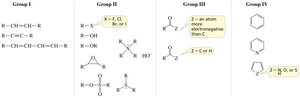
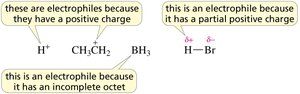
Electrophiles and Nucleophiles
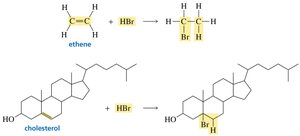
Electrophiles and nucleophiles are central to organic reaction mechanisms.
Electrophile: Has a positive charge, partial positive charge, or incomplete octet; seeks electrons.
Nucleophile: Has a negative charge, lone pair, or π bond; donates electrons.

Reaction Mechanisms and Curved Arrows
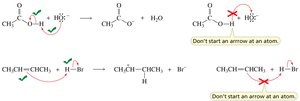
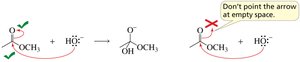
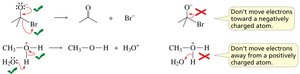
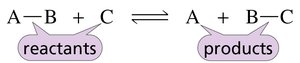
Mechanisms describe the stepwise conversion of reactants to products, using curved arrows to show electron movement.
Curved arrows: Start at a pair of electrons and point to where electrons move.
Rules: Never start at an atom; never point to empty space; move electrons away from negative or toward positive atoms.

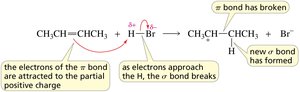
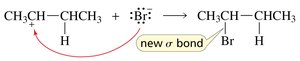
Reaction Coordinate Diagrams
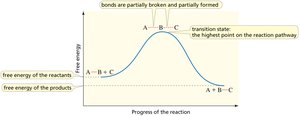
Reaction coordinate diagrams illustrate the energy changes during a reaction, including transition states and activation energy.
Transition state: Highest energy point; bonds are partially formed/broken.
Activation energy: Energy barrier for the reaction.
Thermodynamics and Kinetics
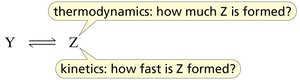
Thermodynamics determines the equilibrium position, while kinetics determines the rate of reaction.
Thermodynamics: How much product is formed.
Kinetics: How fast product is formed.
The Equilibrium Constant
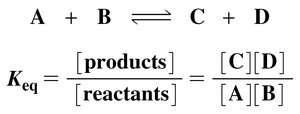
The equilibrium constant () quantifies the ratio of products to reactants at equilibrium.
Formula:
Exergonic and Endergonic Reactions
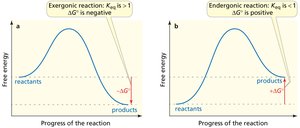
Reactions are classified based on the change in Gibbs free energy ().
Exergonic: is negative; products are lower in energy than reactants.
Endergonic: is positive; products are higher in energy than reactants.
Gibbs Free-Energy Change
Gibbs free energy change () is determined by enthalpy and entropy changes.
Formula:
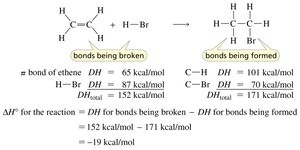
Enthalpy (): Heat required to break bonds minus heat released from forming bonds.
Entropy (): Change in freedom of motion.
Calculating Enthalpy of Reaction
Enthalpy change () is calculated by subtracting the total bond energies of products from those of reactants.
Formula:
Catalytic Hydrogenation
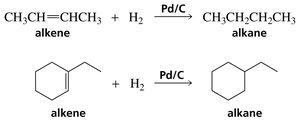
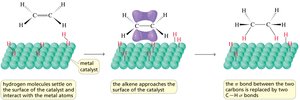
Catalytic hydrogenation is a reduction reaction where the number of C–H bonds increases, converting alkenes to alkanes.
Mechanism: The π bond breaks, and hydrogen atoms are added across the double bond.
Catalyst: Typically Pd/C or similar metal catalysts.
Heat of Hydrogenation
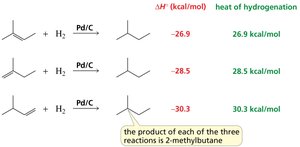
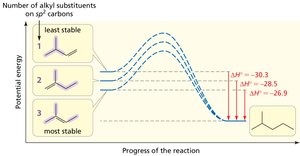
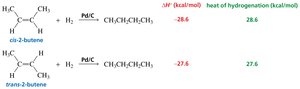
The heat of hydrogenation () measures the energy released when an alkene is converted to an alkane. It is used to compare alkene stabilities.
Stability: The most stable alkene has the smallest heat of hydrogenation.
Relative Stabilities of Alkenes
Alkene stability increases with the number of alkyl groups attached to the sp2 carbons.
Order: Tetrasubstituted > trisubstituted > disubstituted > monosubstituted.
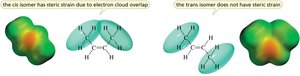
Trans alkenes: More stable than cis due to less steric strain.

Reaction Coordinate Diagrams for Fast and Slow Reactions
Reaction coordinate diagrams can illustrate differences in activation energy and reaction rates for exergonic and endergonic reactions.
Rate-limiting step: The step with the highest transition state energy.
Catalysts and Enzymes
Catalysts provide a lower energy pathway for reactions without changing the energies of reactants or products. Enzymes are biological catalysts, often proteins, that bind substrates at their active sites and catalyze reactions.
Active site: Region of enzyme where substrate binds.
Binding: Amino acid side chains interact with substrate via hydrogen bonds, London dispersion, and dipole–dipole forces.
Catalysis: Some side chains act as acids, bases, or nucleophiles.
Learning Objectives
5.1 Name an alkene given its structure and draw the condensed and/or skeletal structure of an alkene given its name.
5.2 Calculate the degree of unsaturation of a hydrocarbon from its molecular formula and determine the molecular formula of a hydrocarbon knowing the number of carbons and the degree of unsaturation.
5.3 Identify allylic and vinylic carbons and hydrogens.
5.4 Show how curved arrows can be used to describe the bond-breaking and bond-making steps that occur as reactants are converted into products and how curved arrows can be used to predict the product of a reaction.
5.5 Identify electrophiles and nucleophiles.
5.6 Describe how equilibrium constant is related to Gibbs free energy and how activation energy is related to the rate constant of a reaction.
5.7 Predict the relative stabilities of alkenes.
5.8 Identify the factors that determine the rate of a reaction.
Additional info: Academic context was added to clarify formulas, mechanisms, and the relationship between thermodynamics and kinetics.
