 뒤로
뒤로Aromaticity, Structure, and Reactivity of Benzene and Heterocyclic Compounds
스터디 가이드 - 스마트 노트
 자료에 맞춘 맞춤형 노트, 핵심 정의, 예시, 맥락을 확장해 제공합니다.
Aromatic Compounds: Structure and Properties
Introduction to Aromaticity
Aromatic compounds are a fundamental class of organic molecules characterized by their stability and unique electronic structure. The concept of aromaticity is central to understanding the chemistry of benzene and its derivatives, as well as heterocyclic aromatic compounds.
Aromaticity refers to the enhanced stability of certain cyclic, planar molecules due to delocalized π electrons.
Benzene is the prototypical aromatic compound, with a six-membered ring and alternating double bonds.
Hückel's rule states that a molecule is aromatic if it contains π electrons, where is a non-negative integer.
Examples include benzene, pyridine, furan, and other heterocycles.
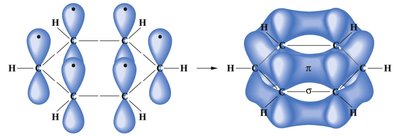
Electronic Structure of Benzene
Benzene's stability arises from the delocalization of its six π electrons over the six carbon atoms, forming a conjugated system.
Each carbon atom in benzene is sp2-hybridized, with one unhybridized p orbital.
The p orbitals overlap to form a continuous π system above and below the ring.
This delocalization results in equal bond lengths and a planar structure.
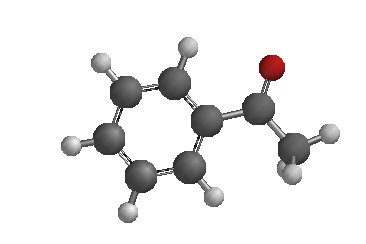
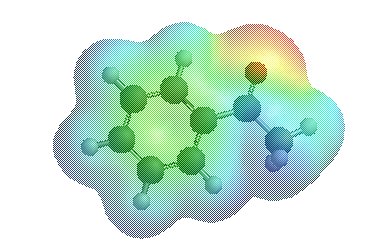
Visualizing Electron Density in Aromatic Rings
Molecular electrostatic potential maps help visualize electron density and charge distribution in aromatic compounds.
Regions of high electron density (negative potential) are often colored blue, while regions of low electron density (positive potential) are colored red.
These maps illustrate the effect of substituents on electron distribution.
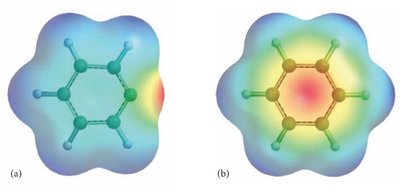
Heterocyclic Aromatic Compounds
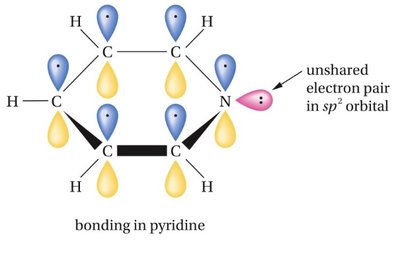
Bonding in Pyridine
Pyridine is an aromatic heterocycle with a nitrogen atom replacing one carbon in the benzene ring.
The nitrogen atom is sp2-hybridized and contributes one electron pair to the aromatic π system.
The unshared electron pair on nitrogen resides in an sp2 orbital, not participating in the π system.
Pyridine is basic due to the availability of the lone pair.
Bonding in Furan
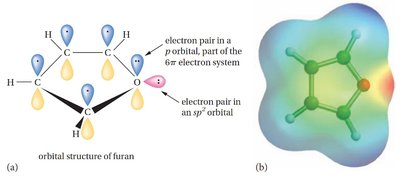
Furan is a five-membered aromatic ring containing an oxygen atom.
Oxygen in furan has two lone pairs; one is in a p orbital and participates in the π system, while the other is in an sp2 orbital.
Furan is aromatic because it has six π electrons (four from the double bonds, two from the oxygen lone pair).
Substituent Effects on Aromatic Reactivity
Activating and Deactivating Groups
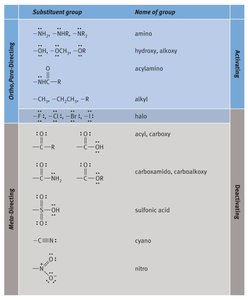
Substituents on the benzene ring influence its reactivity and the position of further substitution.
Activating groups increase the reactivity of the ring and direct new substituents to the ortho and para positions.
Deactivating groups decrease the ring's reactivity and often direct new substituents to the meta position.
Examples of activating groups: amino, hydroxy, alkoxy, acylamino, alkyl.
Examples of deactivating groups: nitro, cyano, sulfonic acid, carboxy, acyl.
Substituent group | Name of group |
|---|---|
NH2, NHR, NR2 | amino |
OH, OCH3, OR | hydroxy, alkoxy |
COOH, COOR, CONH2 | carboxy, carboxamido |
NO2, SO3H, CN | nitro, sulfonic acid, cyano |
CH3, C2H5 | alkyl |
Cl, Br, I | halo |
Special Aromatic Structures
Carbon Nanotubes and Fullerenes
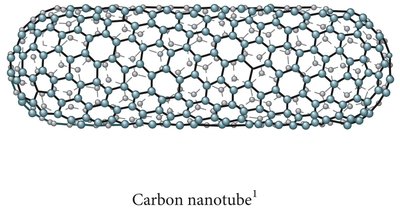
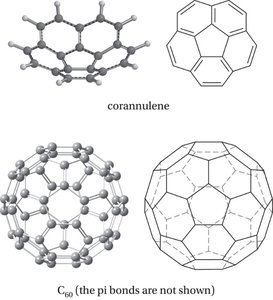
Extended aromatic systems include carbon nanotubes and fullerenes, which are composed of fused benzene rings.
Carbon nanotubes are cylindrical structures with remarkable strength and conductivity.
Fullerenes (e.g., C60) are spherical molecules made of fused rings, exhibiting unique electronic properties.
Corannulene is a bowl-shaped polycyclic aromatic hydrocarbon.
Reaction Mechanisms of Aromatic Compounds
Electrophilic Aromatic Substitution (EAS)
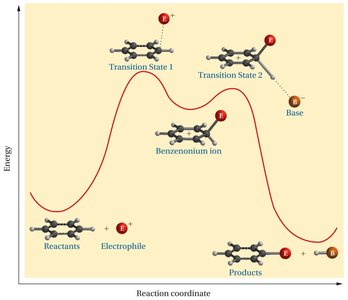
Aromatic rings undergo substitution reactions with electrophiles, preserving the aromatic system.
The mechanism involves formation of a benzenonium ion (arenium ion) intermediate.
Two transition states are involved: attack by the electrophile and removal of a proton by a base.
The aromaticity is temporarily lost in the intermediate but restored in the product.
Summary Table: Substituent Effects
Classification of Substituents
Substituents are classified based on their effect on reactivity and orientation of further substitution.
Ortho/Para-directing groups: generally activating, except halogens (which are deactivating but still ortho/para-directing).
Meta-directing groups: generally deactivating.
Substituent group | Name of group | Directing | Effect |
|---|---|---|---|
NH2, OH, OR | amino, hydroxy, alkoxy | ortho/para | activating |
CH3, C2H5 | alkyl | ortho/para | activating |
Cl, Br, I | halo | ortho/para | deactivating |
NO2, SO3H, CN | nitro, sulfonic acid, cyano | meta | deactivating |
Additional info:
Images included are directly relevant to the explanation of aromaticity, electronic structure, substituent effects, and reaction mechanisms.
Tables are recreated to clarify substituent effects and classification.
Electrostatic potential maps visually reinforce the discussion of electron density and substituent effects.
