 뒤로
뒤로Chemical Bonding and Lewis Structures: Mini-Textbook Study Notes
스터디 가이드 - 스마트 노트
 자료에 맞춘 맞춤형 노트, 핵심 정의, 예시, 맥락을 확장해 제공합니다.
Chemical Bonding and Lewis Structures
Types of Chemical Bonds
Chemical bonds are the forces that hold atoms together in compounds. The main types of chemical bonds are ionic, covalent, and metallic bonds. Each type arises from different interactions between atoms and results in distinct physical and chemical properties.
Ionic Bonds: Formed by the transfer of electrons from a metal to a nonmetal, resulting in oppositely charged ions held together by electrostatic attraction.
Covalent Bonds: Formed by the sharing of electrons between nonmetal atoms, resulting in molecules.
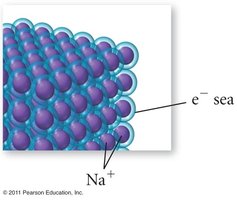
Metallic Bonds: Formed by the pooling of valence electrons among metal atoms, creating a 'sea' of delocalized electrons.
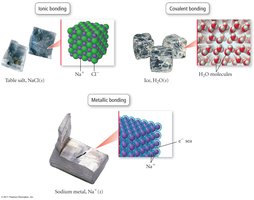
Why Do Atoms Bond?
Atoms bond to achieve lower potential energy and greater stability. The interactions considered include nucleus–nucleus repulsions, electron–electron repulsions, and nucleus–electron attractions. A bond forms when the potential energy of the bonded atoms is less than that of the separate atoms.

Lewis Bonding Theory
The Lewis Theory emphasizes the role of valence electrons in chemical bonding. Lewis structures (electron dot structures) are used to model the distribution of valence electrons in atoms and molecules, allowing predictions of molecular stability, shape, size, and polarity.
Valence Electrons: Electrons in the outermost shell, most involved in bonding.
Lewis Structures: Dots represent valence electrons around the element symbol.
Determining Valence Electrons
The number of valence electrons for main group elements is indicated by their column number in the periodic table. Most transition elements have two valence electrons.
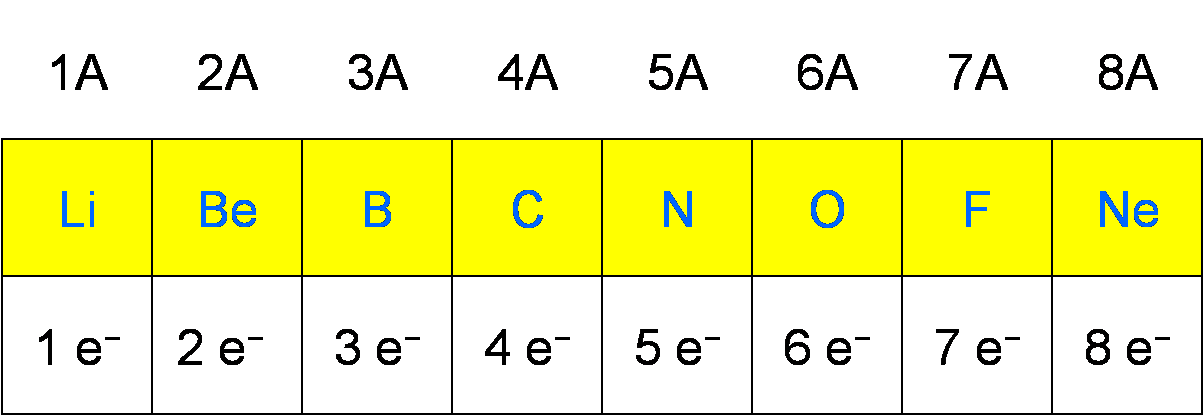
Lewis Structures of Atoms
Lewis structures represent valence electrons as dots around the element symbol. Pair the first two dots for s orbital electrons, then place one dot on each open side for the first three p electrons, pairing the rest for remaining p electrons.
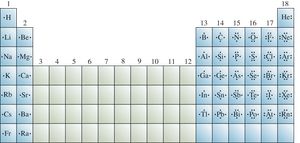
Stable Electron Arrangements and Ion Charge
Metals form cations by losing electrons to achieve the electron configuration of the previous noble gas. Nonmetals form anions by gaining electrons to achieve the configuration of the next noble gas. Noble gas configurations are very stable.
Octet Rule and Exceptions
Most atoms bond to obtain an outer shell with eight electrons (octet rule), achieving a noble gas configuration. Exceptions include H, Li, Be, and B, which may attain a duet (two electrons) or incomplete octets. Expanded octets occur for elements in Period 3 or below, using empty d orbitals.
Octet Rule: configuration
Exceptions: H, Li, Be, B, and expanded octets for Period 3 and below
Ionic Bonding
Ionic bonds form when a metal atom loses electrons (becoming a cation) and a nonmetal atom gains electrons (becoming an anion). The resulting oppositely charged ions are attracted to each other by electrostatic forces.
Electrostatic Attraction: Non-directional
Formation of Ionic Lattice: Large numbers of ions form a 3D lattice, held together by electrostatic attractions.
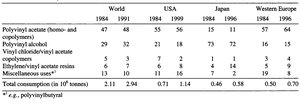
Table: Uses for Vinyl Acetate (%)
Product | World 1984 | World 1991 | USA 1984 | USA 1991 | Japan 1984 | Japan 1996 | Western Europe 1984 | Western Europe 1996 |
|---|---|---|---|---|---|---|---|---|
Polyvinyl acetate (homo- and copolymers) | 47 | 48 | 55 | 56 | 115 | 57 | 64 | 64 |
Polyvinyl alcohol | 25 | 22 | 21 | 18 | 73 | 72 | 16 | 15 |
Vinyl chloride/vinyl acetate copolymers | 5 | 3 | 7 | 6 | 4 | 1 | 7 | 4 |
Ethylene/vinyl acetate resins | 6 | 7 | 10 | 10 | 2 | 2 | 19 | 19 |
Miscellaneous uses* | 17 | 10 | 7 | 10 | 6 | 7 | 4 | 4 |
Total consumption (in 105 tonnes) | 2.11 | 2.04 | 0.171 | 1.14 | 0.46 | 0.58 | 0.560 | 0.780 |
Additional info: This table demonstrates the industrial uses of vinyl acetate, a compound relevant to organic and polymer chemistry, showing its application in various polymers and copolymers.
Metallic Bonding
Metallic bonds involve the sharing of valence electrons among all atoms in a metal, forming a 'sea' of delocalized electrons. This results in properties such as electrical conductivity, malleability, and ductility.
Covalent Bonding
Covalent bonds form when nonmetal atoms share valence electrons. The shared electrons are most stable when located between the nuclei of the bonding atoms. Covalent bonding results in the formation of molecules.
Lewis Structures of Molecules
Lewis structures allow prediction of the distribution of valence electrons in molecules, helping to understand bonding, molecular shapes, and properties. Common bonding patterns include:
C: 4 bonds, 0 lone pairs
N: 3 bonds, 1 lone pair
O: 2 bonds, 2 lone pairs
H and halogens: 1 bond
Resonance and Formal Charge
Resonance occurs when more than one valid Lewis structure can be drawn for a molecule, differing only in the position of electrons. The actual molecule is a resonance hybrid. Formal charge is used to determine the most stable Lewis structure.
Formal Charge Formula:
Bond Energies and Bond Length
Bond energy is the energy required to break one mole of a bond in the gas state. In general, the more electrons two atoms share, the stronger and shorter the bond. Bond length is the distance between the nuclei of bonded atoms.
Bond Strength: Triple bonds > Double bonds > Single bonds
Bond Length: Triple bonds < Double bonds < Single bonds
Summary Table: Types of Chemical Bonds
Bond Type | Nature | Properties |
|---|---|---|
Ionic | Transfer of electrons | High melting point, lattice energy, non-directional |
Covalent | Sharing of electrons | Directional, molecular units, low melting point |
Metallic | Delocalized electrons | Conductive, malleable, ductile |
Additional info: These notes provide a comprehensive overview of chemical bonding and Lewis structures, foundational concepts for understanding molecular structure and reactivity in organic chemistry.
