 뒤로
뒤로Chemical Thermodynamics: Foundations and Applications in Physical Chemistry
스터디 가이드 - 스마트 노트
 자료에 맞춘 맞춤형 노트, 핵심 정의, 예시, 맥락을 확장해 제공합니다.
Introduction to Thermodynamics
Thermodynamics is the branch of physical science concerned with heat and its relation to other forms of energy and work. It provides the fundamental laws that govern chemical and physical processes, allowing chemists to predict the direction of reactions, the amount of energy exchanged, and the feasibility of processes.
Key Concepts and Definitions
System: The part of the universe under study.
Surroundings: Everything outside the system.
Universe: System plus surroundings.
Open System: Exchanges both energy and matter with surroundings.
Closed System: Exchanges energy but not matter.
Isolated System: Exchanges neither energy nor matter.
State Function: Property dependent only on the current state, not the path taken (e.g., internal energy, enthalpy).
Extensive Property: Depends on the amount of substance (e.g., mass, volume).
Intensive Property: Independent of the amount of substance (e.g., temperature, pressure).
Properties of Gases
Ideal Gases
An ideal gas is a hypothetical gas whose molecules occupy negligible volume and do not interact. The behavior of ideal gases is described by the equation of state:
Best describes real gases at low pressure and high temperature.
Assumptions: point particles, no intermolecular forces, random motion, kinetic energy depends only on temperature.
Real Gases
Real gases deviate from ideal behavior due to finite molecular volume and intermolecular forces. Corrections are made using equations such as the Van der Waals equation:
a: Accounts for intermolecular attractions.
b: Accounts for finite molecular volume.
Molecular Motions and Energy
Types of Molecular Motions
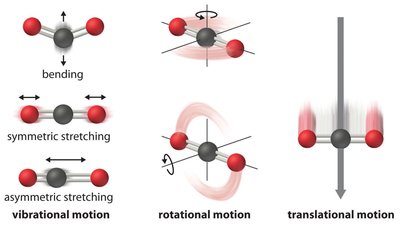
Molecules exhibit three main types of motion: translational, rotational, and vibrational. Each contributes to the internal energy of the system.
Translational Motion: Movement of the entire molecule through space.
Rotational Motion: Rotation of the molecule around its center of mass.
Vibrational Motion: Periodic motion of atoms within a molecule.
Energy Level Separations
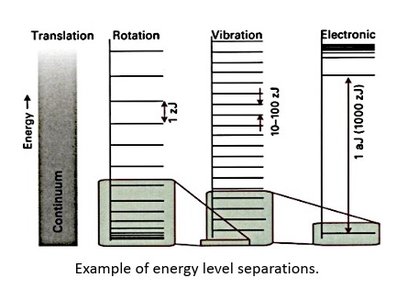
The energy associated with each type of motion is quantized, with translation having a continuum of energies, rotation having small separations, vibration larger, and electronic transitions the largest.
The Equipartition Theorem
The equipartition theorem states that each quadratic degree of freedom contributes to the average energy per molecule. For a monatomic ideal gas, the average translational kinetic energy is:
For 1 mole:
Rotational and vibrational contributions depend on molecular structure and temperature.
The First Law of Thermodynamics
Statement and Mathematical Formulation
The first law states that the internal energy of an isolated system is constant. For any process:
q: Heat exchanged
w: Work done
For infinitesimal changes:
Expansion Work
Work done by a system during volume change against an external pressure :
For constant external pressure:
Reversible and Irreversible Expansion
Reversible expansion occurs when the system is always in equilibrium with its surroundings. For isothermal reversible expansion of an ideal gas:
Heat, Calorimetry, and Heat Capacity
Calorimetry
Calorimetry measures the heat exchanged in a process. The heat change is related to the temperature change by the calorimeter constant :
Heat Capacity
Heat Capacity (C): Amount of heat required to raise the temperature by 1 K.
Molar Heat Capacity (C_m): Heat capacity per mole.
Specific Heat Capacity: Heat capacity per gram.
At constant volume:
At constant pressure:
Enthalpy and Its Measurement
Definition of Enthalpy
Enthalpy () is defined as:
At constant pressure, the change in enthalpy equals the heat supplied:
Standard Enthalpy Changes
The standard enthalpy change of vaporization is the enthalpy change per mole when a pure liquid vaporizes at 1 bar:

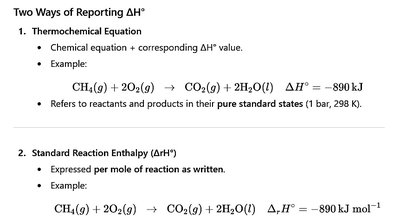
Two Ways of Reporting Standard Enthalpy Changes
Thermochemical Equation: Chemical equation with corresponding value.
Standard Reaction Enthalpy (): Expressed per mole of reaction as written.
Hess's Law
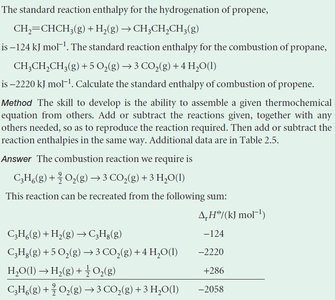
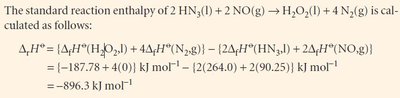
Hess's law states that the standard enthalpy of an overall reaction is the sum of the standard enthalpies of the individual steps into which the reaction can be divided. This allows calculation of enthalpy changes for reactions that are difficult to measure directly.
Standard Enthalpy of Formation
The standard enthalpy of formation () is the enthalpy change for the formation of one mole of a compound from its elements in their standard states (most stable form at 1 bar and specified temperature).
The Second and Third Laws of Thermodynamics
The Second Law
The second law states that the entropy of an isolated system increases in a spontaneous process (). It can be expressed as:
Kelvin's Statement: No process is possible in which the sole result is the absorption of heat from a reservoir and its complete conversion into work.
Clausius' Statement: Heat does not flow spontaneously from a cold body to a hot body.
Entropy (S)
Thermodynamic Definition:
Statistical Definition (Boltzmann):
Molar Entropy: (intensive property)
The Third Law
The third law states that the entropy of all perfect crystalline substances is zero at absolute zero temperature ( K).
Summary Table: Thermodynamic Processes
Process | Work (w) | Heat (q) | ΔU | ΔH |
|---|---|---|---|---|
Isochoric (ΔV=0) | w = 0 | q = ΔU | ΔU = q | ΔH = ΔU |
Isobaric (ΔP=0) | w = PΔV = nRT | q = ΔU + w | ΔU = q - w | ΔH = ΔU + PΔV |
Isothermal (ΔT=0) | w = q | q = w | ΔU = 0 | ΔH = -PΔV |
Adiabatic (q=0) | w = nC_VΔT | q = 0 | ΔU = -w | ΔH = 0 |
Adiabatic and Isothermal Processes
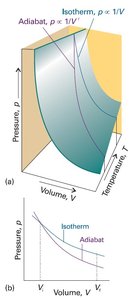
Adiabatic processes occur without heat exchange (). For a reversible adiabatic expansion of a perfect gas:
, where
Isothermal processes occur at constant temperature. The pressure-volume relationship differs from adiabatic processes, as shown in the following diagram:
Thermochemistry
Thermochemistry studies the energy transferred as heat during chemical reactions. Calorimetry is used to measure these changes, and the results are interpreted in terms of changes in internal energy (ΔU) or enthalpy (ΔH), depending on the conditions (constant volume or pressure).
Exothermic Process: ΔH < 0 (releases heat)
Endothermic Process: ΔH > 0 (absorbs heat)
Summary of Key Equations
Ideal Gas Law:
First Law:
Work (expansion):
Isothermal reversible work:
Enthalpy:
Heat capacity at constant volume:
Heat capacity at constant pressure:
Relationship: (for ideal gases)
Entropy (thermodynamic):
Entropy (statistical):
Gibbs Free Energy:
