 뒤로
Functional Groups in Organic Chemistry: Structure, Properties, and Reactivity
스터디 가이드 - 스마트 노트
 자료에 맞춘 맞춤형 노트, 핵심 정의, 예시, 맥락을 확장해 제공합니다.
Functional Groups in Organic Chemistry
Objectives and Overview
Understanding functional groups is fundamental in organic chemistry, as they determine the chemical and physical properties of organic molecules. This section introduces the concept of functional groups, their structural features, and their impact on molecular reactivity and properties.
Functional Group: An atom or group of atoms with characteristic chemical and physical properties.
Heteroatom: Any atom in a molecule that is not carbon or hydrogen (e.g., O, N, S, halogens).
Polar Bond: A bond between atoms with different electronegativities, resulting in partial charges.
Geometry: The spatial arrangement of atoms in a molecule, influenced by functional groups.
Structural Features of Functional Groups
Functional groups are attached to a carbon backbone and often contain heteroatoms and/or π bonds, which confer specific reactivity to the molecule.
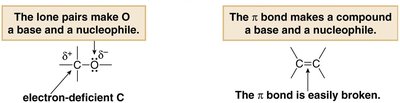
Heteroatoms create electron-deficient sites on carbon due to their electronegativity.
π Bonds (double or triple bonds) are easily broken and make molecules reactive as bases and nucleophiles.
Parts of a Functional Group
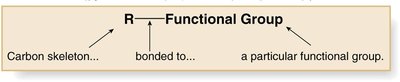
A functional group is typically represented as an R group (carbon skeleton) bonded to a specific functional group, which determines the molecule's properties.
R group: Represents the rest of the molecule (carbon skeleton).
Functional group: The reactive part of the molecule.
Functional Groups and Molecular Properties
Functional groups distinguish one organic molecule from another and determine its geometry, physical properties, and reactivity.
Geometry: The shape of the molecule is influenced by the functional group.
Physical Properties: Such as boiling point, solubility, and melting point.
Reactivity: Functional groups dictate how molecules react with others.

Reactivity of Functional Groups
Heteroatoms and π bonds are key contributors to the reactivity of organic molecules. Heteroatoms have lone pairs, creating electron-deficient sites, while π bonds are easily broken in reactions.
Electron-deficient carbon: Created by electronegative heteroatoms.
π bonds: Make molecules bases and nucleophiles.

Ethane: A Molecule with No Functional Group
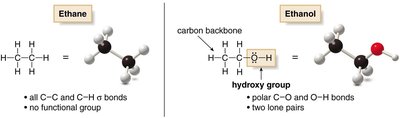
Ethane contains only C–C and C–H σ bonds, with no polar bonds, lone pairs, or π bonds. As a result, it is very unreactive and lacks functional groups.
Alkanes: Molecules like ethane are classified as alkanes and are generally unreactive.

Ethanol: A Molecule with a Functional Group
Ethanol contains a hydroxy group (–OH) attached to its carbon backbone, making it an alcohol. The presence of lone pairs and polar bonds increases its reactivity compared to ethane.
Alcohols: Compounds containing an –OH group.
Hydroxy group: Responsible for the distinct properties of alcohols.
Hydrocarbons: Classification and Functional Groups
Hydrocarbons are compounds made up of only carbon and hydrogen. They are classified as aliphatic (alkanes, alkenes, alkynes) or aromatic.
Aliphatic hydrocarbons: Include alkanes, alkenes, and alkynes.
Aromatic hydrocarbons: Contain benzene rings and are characterized by strong odors.
Aliphatic Hydrocarbons
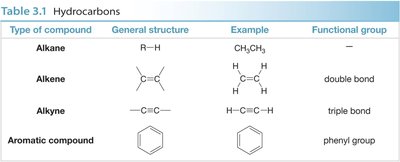
Aliphatic hydrocarbons are divided into three subgroups based on their bonding:
Alkanes: Only C–C σ bonds, no functional group.
Alkenes: Contain C–C double bonds (π bonds).
Alkynes: Contain C–C triple bonds.

Type of compound | General structure | Example | Functional group |
|---|---|---|---|
Alkane | R–H | CH3CH3 | – |
Alkene | C=C | H2C=CH2 | Double bond |
Alkyne | C≡C | HC≡CH | Triple bond |
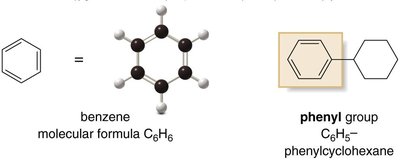
Aromatic compound |
| Benzene | Phenyl group |
Aromatic Hydrocarbons
Aromatic hydrocarbons, such as benzene, are characterized by a six-membered ring with three π bonds. The phenyl group is a common functional group in aromatic compounds.
Benzene: Simplest aromatic hydrocarbon, molecular formula .
Phenyl group: –, found in many aromatic compounds.
Functional Groups with Carbon-Heteroatom (C–Z) σ Bonds
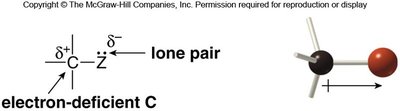
Many functional groups contain C–Z σ bonds, where Z is an electronegative heteroatom. These polar bonds make the carbon atom electron-deficient and reactive.
Electronegative heteroatom: Creates a polar bond and electron-deficient carbon.
Lone pairs: On Z, contribute to reactivity.
Functional Groups with Carbonyl (C=O) Group
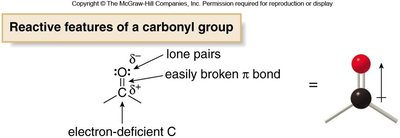
The carbonyl group (C=O) is a highly reactive functional group due to its polar C–O bond and the presence of a π bond. The carbonyl carbon acts as an electrophile, while the oxygen can act as a nucleophile and base.
Electrophilic carbon: Attracts nucleophiles.
Nucleophilic oxygen: Can donate lone pairs.
π bond: Easily broken in reactions.
Importance of Functional Groups
Functional groups determine the bonding, shape, intermolecular forces, physical properties, nomenclature, and chemical reactivity of organic molecules.
Bonding and shape: Dictated by the functional group.
Intermolecular forces: Type and strength depend on functional groups.
Physical properties: Such as boiling point and solubility.
Nomenclature: Functional groups are central to naming organic compounds.
Chemical reactivity: Determines how molecules interact in reactions.
Molecules with Multiple Functional Groups
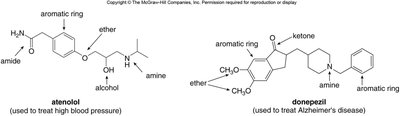
Many organic molecules contain several different functional groups, resulting in diverse types of reactivity and complex chemical behavior.
Multiple functional groups: Lead to multiple reactive sites and varied properties.
Examples: Pharmaceuticals and biomolecules often contain several functional groups.
Additional info: Functional groups are central to understanding organic chemistry, as they provide a framework for predicting molecular behavior, designing synthetic routes, and interpreting spectroscopic data.
