 뒤로
뒤로Molecular Representations, Functional Groups, and Resonance in Organic Chemistry
스터디 가이드 - 스마트 노트
 자료에 맞춘 맞춤형 노트, 핵심 정의, 예시, 맥락을 확장해 제공합니다.
Molecular Representations in Organic Chemistry
Units of Unsaturation
Units of unsaturation are a fundamental concept used to determine the degree of saturation in organic molecules. They help predict the presence of rings and π-bonds (double or triple bonds) in a compound based on its molecular formula.
Definition: 1 unit of unsaturation corresponds to either a ring or a π-bond (double or triple bond).
Formula: where C = number of carbons, H = number of hydrogens, N = number of nitrogens, X = number of halides (F, Cl, Br, I).
Fully Saturated Molecule: Contains only single bonds and no rings or π-bonds.
Example: For C3NH7, calculate units of unsaturation and propose possible structures.
Functional Groups in Organic Chemistry
Overview and Importance
Functional groups are specific groups of atoms within molecules that are responsible for the characteristic chemical reactions of those molecules. Small changes in functional groups can lead to significant differences in biological activity and chemical properties.
Examples: Adrenaline and dopamine differ by small structural changes but have vastly different physiological effects.
Classification: Functional groups are classified based on the atoms and bonds present, such as O-H, C=O, C-O, C-N, C-X, and hydrocarbon types.
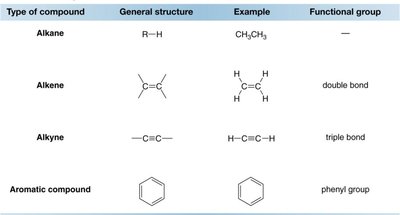
Summary Table of Hydrocarbon Functional Groups
Hydrocarbons are classified based on the types of bonds between carbon atoms.
Type of compound | General structure | Example | Functional group |
|---|---|---|---|
Alkane | R–H | CH3CH3 | — |
Alkene | C=C | H2C=CH2 | Double bond |
Alkyne | C≡C | H–C≡C–H | Triple bond |
Aromatic compound |
|
| Phenyl group |
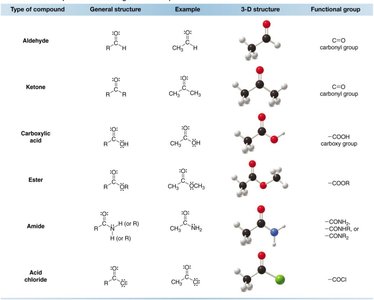
Summary Table of Carbonyl-Containing Functional Groups
Type of compound | General structure | Example | 3-D structure | Functional group |
|---|---|---|---|---|
Aldehyde | R–CHO | CH3CHO | C=O (carbonyl group) | |
Ketone | R–CO–R' | CH3COCH3 | C=O (carbonyl group) | |
Carboxylic acid | R–COOH | CH3COOH | –COOH (carboxy group) | |
Ester | R–COOR' | CH3COOCH3 | –COOR | |
Amide | R–CONH2 | CH3CONH2 | –CONH2, –CONHR, –CONR2 | |
Acid chloride | R–COCl | CH3COCl | –COCl |
Identifying Functional Groups
O-H (hydroxy groups): Found in alcohols and carboxylic acids.
C=O (carbonyl groups): Present in carboxylic acids, esters, ketones, aldehydes, acyl chlorides, anhydrides, and amides.
C-O bonds: Found in alcohols, ethers, epoxides, carboxylic acids, anhydrides, and esters.
C-N bonds (single): Present in amines and amides.
C-N bonds (triple): Nitriles.
C-X (halides): Alkyl halides (F, Cl, Br, I).
Hydrocarbons: Alkanes, alkenes, alkynes, aromatics.
Resonance Structures and Electron Delocalization
Curved Arrow Notation
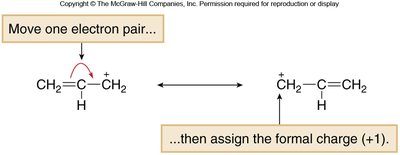
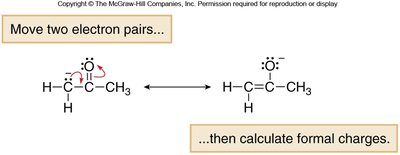
Curved arrows are used to show the movement of electrons in resonance structures. The tail of the arrow starts at the electron source (bond or lone pair), and the head points to the destination.
Full arrow: Movement of two electrons.
Fishhook arrow: Movement of one electron.
Principles of Resonance
Resonance: Delocalization of lone pair and π-bond electrons across two or more atoms.
Does not involve: Movement of σ-bond electrons, change in atom connectivity, or addition/removal of atoms.
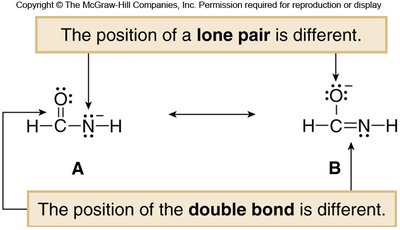
Resonance structures: Represent different electron arrangements with the same atom placement.
Resonance hybrid: Composite structure showing delocalized electrons, more stable than any individual resonance form.
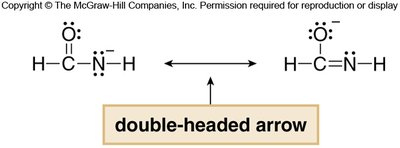
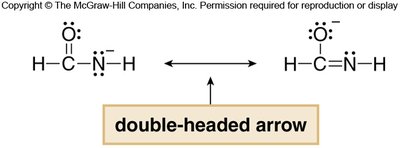
Rules for Drawing Resonance Structures
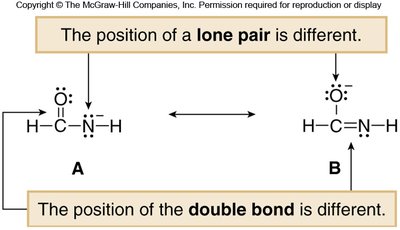
Rule 1: Resonance structures differ in the position of multiple bonds and nonbonded electrons; atom connectivity and net charge remain unchanged.
Rule 2: Resonance structures must have the same number of unpaired electrons.
Rule 3: Resonance structures must be valid Lewis structures (hydrogen has two electrons, second-row elements have no more than eight electrons).

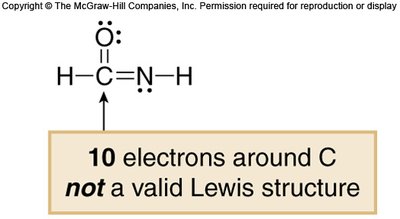
Occurrence of Resonance
Resonance occurs when lone pairs or π-electrons can be delocalized across aligned and overlapping orbitals. Only lone pairs and π-electrons participate in resonance, not σ-bond electrons.
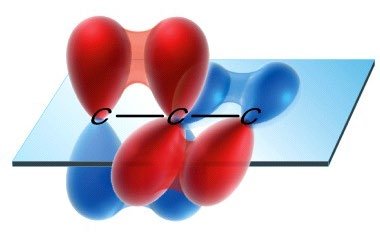
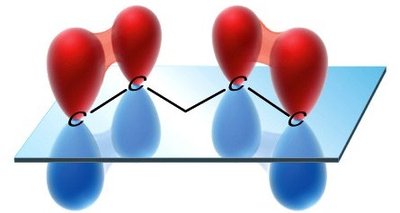
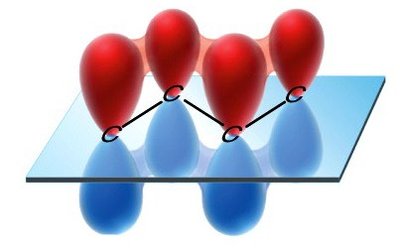
Types of π-bond arrangements: Cumulated, conjugated, and isolated.
Delocalization: Requires proper orbital alignment and overlap.

Resonance with Charges and Lone Pairs
Lone pairs adjacent to π-bonds or cations: Can participate in resonance.
π-bonds adjacent to cations or other π-bonds: Can participate in resonance.
Resonance with electronegative atoms: Electrons are pulled toward the more electronegative atom.





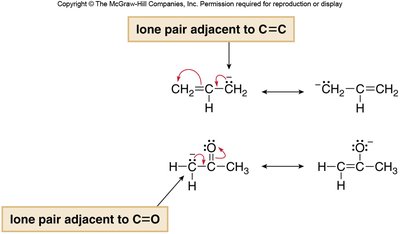
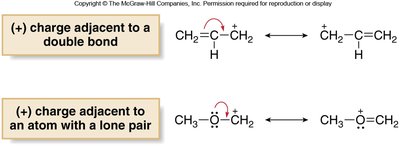
Resonance Hybrid and Major Contributors
The resonance hybrid is a composite of all possible resonance structures, with electron pairs delocalized. The major contributor is the resonance structure that best represents the molecule's stability and electron distribution.
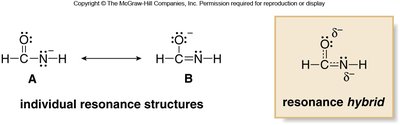
Example: Both O and N have negative charges in the resonance structure, so each atom is δ- in the hybrid.
Summary
Molecular representations are essential for understanding organic structures.
Functional groups define the reactivity and properties of organic molecules.
Resonance stabilizes molecules by delocalizing electrons, and resonance hybrids represent the true structure.
