 뒤로
뒤로Sigma and Pi Bonds, Bond Order, Formal Charge, and Hybridization: Core Concepts in Organic Chemistry
스터디 가이드 - 스마트 노트
 자료에 맞춘 맞춤형 노트, 핵심 정의, 예시, 맥락을 확장해 제공합니다.
Sigma (σ) and Pi (π) Bonds
Definition and Formation
Sigma and pi bonds are the two fundamental types of covalent bonds found in organic molecules. Their formation and properties are crucial for understanding molecular structure and reactivity.
Sigma (σ) Bond: The first bond formed between two atoms, resulting from head-on (axial) overlap of atomic orbitals. This overlap creates a region of high electron density directly between the nuclei.
Pi (π) Bond: Any additional bond formed after a sigma bond, resulting from the side-by-side (lateral) overlap of p orbitals. Pi bonds cannot exist without an underlying sigma bond and are present only in double and triple bonds.
Strength and Rotation: Sigma bonds are generally stronger than pi bonds. Sigma bonds allow free rotation around the bond axis, while pi bonds restrict rotation, which is significant in organic chemistry (e.g., cis-trans isomerism).
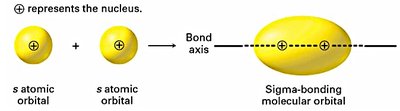
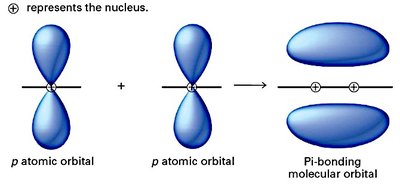
Example: Ethene (C2H4)
In ethene, each carbon forms three sigma bonds (two with hydrogen, one with carbon) and one pi bond (between the carbons). The pi bond arises from the unhybridized p orbitals on each carbon atom.
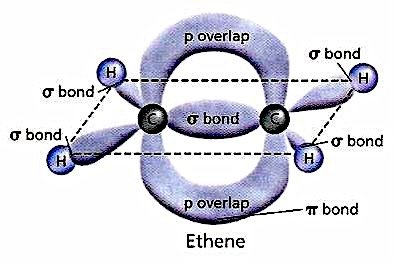
Comparison Table: Sigma vs. Pi Bonds
Single Bond | Double Bond | Triple Bond | |
|---|---|---|---|
Composition | 1 σ | 1 σ + 1 π | 1 σ + 2 π |
Free Rotation? | Yes | No | No |
Bond Length | Longest | Intermediate | Shortest |
Bond Strength | Weakest | Intermediate | Strongest |
Bond Energy | Lowest | Intermediate | Highest |
Counting Sigma and Pi Bonds
To determine the number of sigma and pi bonds in a molecule, count each single bond as one sigma bond. In double bonds, there is one sigma and one pi bond; in triple bonds, one sigma and two pi bonds.
Bond Order
Definition and Calculation
Bond order is the number of chemical bonds between a pair of atoms. It is a key indicator of bond strength, length, and energy.
Bond Order 1: Single bond (one sigma bond)
Bond Order 2: Double bond (one sigma, one pi bond)
Bond Order 3: Triple bond (one sigma, two pi bonds)
Fractional Bond Orders: Occur in resonance structures and are calculated as the number of bonds divided by the number of bonding locations.
Relationship: As bond order increases, bond length decreases, and bond energy increases.
Formula:
Resonance
Concept and Importance
Resonance occurs when more than one valid Lewis structure can be drawn for a molecule. The actual structure is a hybrid (average) of these resonance forms, with electrons delocalized over the molecule.
Delocalization: Shared electrons are spread out, stabilizing the molecule.
Fractional Bond Orders: Resonance leads to bond orders that are not whole numbers.
Example: The acetate ion (CH3CO2-) and nitrate ion (NO3-) both exhibit resonance, resulting in equivalent bond lengths and fractional bond orders.
Formal Charge
Definition and Calculation
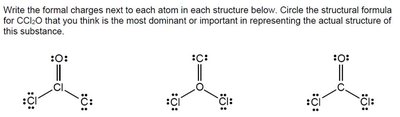
Formal charge is a bookkeeping tool used to determine the most likely Lewis structure when multiple are possible. The most stable structure has formal charges closest to zero, with any negative charge on the most electronegative atom.
Formula:
The sum of all formal charges must equal the overall charge of the molecule or ion.
Formal charges do not represent actual charges but help identify the dominant resonance structure.
Hybridization
Concept and Types
Hybridization is the mixing of atomic orbitals to form new, equivalent hybrid orbitals suitable for bonding. The type of hybridization depends on the number of electron domains (regions of electron density) around an atom.
sp Hybridization: 2 electron domains (linear geometry)
sp2 Hybridization: 3 electron domains (trigonal planar geometry)
sp3 Hybridization: 4 electron domains (tetrahedral geometry)
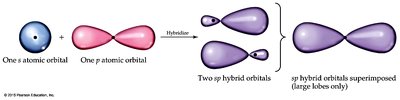
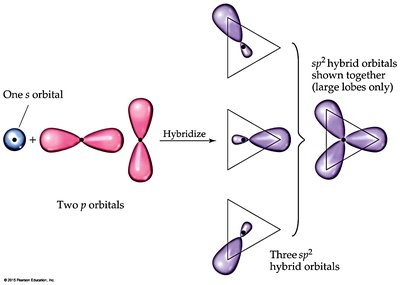
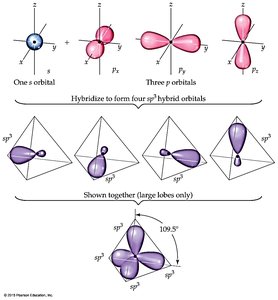
To determine hybridization, count the total number of electron domains (sigma bonds + lone pairs) around the atom. Pi bonds do not count toward hybridization because they use unhybridized p orbitals.
Examples
Ethane (C2H6): Each carbon is sp3 hybridized (4 sigma bonds).
Ethene (C2H4): Each carbon is sp2 hybridized (3 sigma bonds, 1 pi bond).
Summary Table: Hybridization Types
Electron Domains | Hybridization | Geometry |
|---|---|---|
2 | sp | Linear |
3 | sp2 | Trigonal planar |
4 | sp3 | Tetrahedral |
Note: Hybridization beyond sp3 is not typically discussed in introductory organic chemistry.
Additional info: The images provided reinforce the concepts of orbital overlap, hybridization, and formal charge calculation, which are foundational for understanding molecular structure and reactivity in organic chemistry.
