 뒤로
뒤로Chapter 5 : Stereochemistry: Structure, Isomerism, and Chirality in Organic Molecules
스터디 가이드 - 스마트 노트
 자료에 맞춘 맞춤형 노트, 핵심 정의, 예시, 맥락을 확장해 제공합니다.
Stereochemistry
Introduction to Stereochemistry
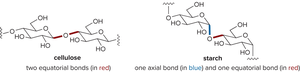
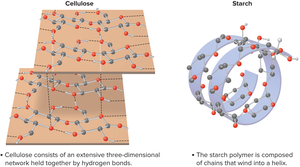
Stereochemistry is the study of the three-dimensional arrangement of atoms within molecules. Small differences in spatial arrangement can lead to significant differences in chemical and physical properties. For example, starch and cellulose are both composed of glucose units, but their different stereochemistry results in distinct biological properties.
Stereochemistry affects molecular recognition, metabolism, and biological activity.
Minor changes in three-dimensional structure can result in molecules with vastly different properties.
Example: Humans can digest starch but not cellulose due to differences in the orientation of glycosidic bonds.
Isomerism in Organic Chemistry
The Two Major Classes of Isomers
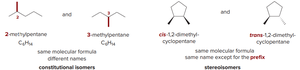
Isomers are compounds with the same molecular formula but different structures or spatial arrangements. The two main classes are constitutional isomers and stereoisomers.
Constitutional (structural) isomers: Differ in the connectivity of their atoms.
Stereoisomers: Atoms are connected in the same order but differ in spatial arrangement.
Chirality and Stereoisomers
Chiral and Achiral Molecules
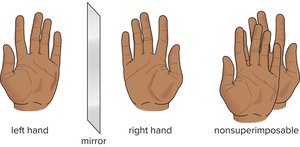
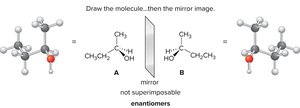
A molecule is chiral if it is not superimposable on its mirror image, much like left and right hands. An achiral molecule is superimposable on its mirror image, like a pair of socks.
Chiral objects: No plane of symmetry; not superimposable on their mirror image.
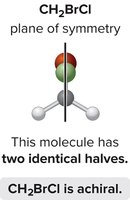
Achiral objects: Have a plane of symmetry; superimposable on their mirror image.
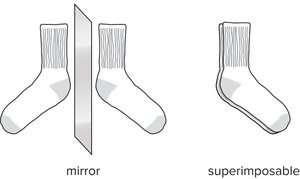
Examples of Achiral and Chiral Molecules
To determine chirality, compare a molecule with its mirror image. If all atoms can be aligned, the molecule is achiral; if not, it is chiral.
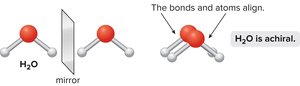
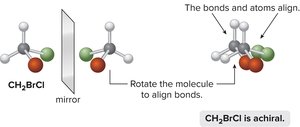
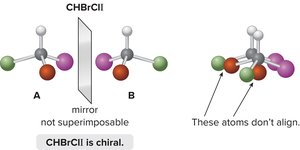
Planes of Symmetry
A plane of symmetry divides a molecule into two mirror-image halves. Achiral molecules usually have a plane of symmetry, while chiral molecules do not.
Stereogenic Centers
Definition and Identification
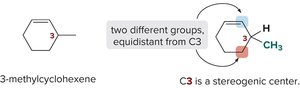
A stereogenic center (or chiral center) is a tetrahedral atom (usually carbon) bonded to four different groups. The presence of stereogenic centers is a key factor in molecular chirality.
No stereogenic centers: Usually achiral (with some exceptions).
One stereogenic center: Always chiral.
Two or more stereogenic centers: May be chiral or achiral (meso compounds).

Stereogenic Centers in Cyclic Compounds
Stereogenic centers can also be found in ring systems. To identify them, draw the ring as a flat polygon and look for tetrahedral carbons bonded to four different groups.
Enantiomers and Diastereomers
Enantiomers
Enantiomers are pairs of molecules that are nonsuperimposable mirror images of each other. They have identical physical and chemical properties except for their interaction with plane-polarized light and chiral environments.
Diastereomers
Diastereomers are stereoisomers that are not mirror images of each other. They have different physical and chemical properties and can be separated by standard laboratory techniques.
Assigning R and S Configurations
Cahn-Ingold-Prelog Priority Rules
To distinguish between enantiomers, the R (rectus, right) and S (sinister, left) system is used. The steps are:
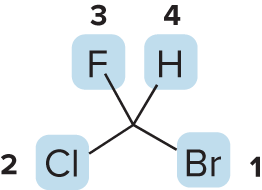
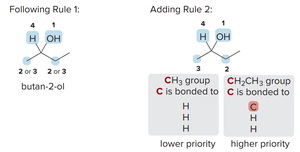
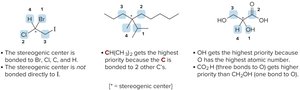
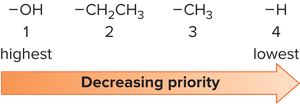
Assign priorities to the four groups attached to the stereogenic center based on atomic number (highest atomic number = highest priority).
If two atoms are the same, move outward along the chain until a difference is found.
For isotopes, higher mass number gets higher priority.
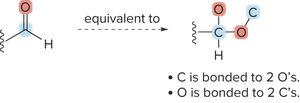
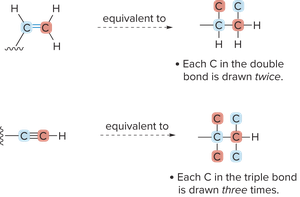
For multiple bonds, treat the multiply bonded atom as an equivalent number of singly bonded atoms.
Determining R or S
Once priorities are assigned:
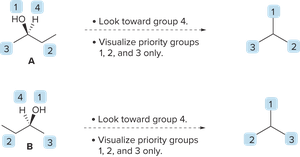
Orient the molecule so the lowest priority group is pointing away from you.
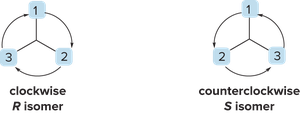
Trace a path from priority 1 → 2 → 3.
If the path is clockwise, the configuration is R; if counterclockwise, it is S.
Molecules with Multiple Stereogenic Centers
Number of Stereoisomers
A molecule with n stereogenic centers can have up to 2n stereoisomers. However, the presence of a plane of symmetry (meso compounds) can reduce this number.
Meso Compounds
Meso compounds are achiral molecules that contain stereogenic centers but have a plane of symmetry, making them superimposable on their mirror image.
Summary Table: Types of Isomers
Type | Definition | Example |
|---|---|---|
Constitutional Isomers | Same molecular formula, different connectivity | 2-methylpentane vs. 3-methylpentane |
Stereoisomers | Same connectivity, different spatial arrangement | cis- and trans-1,2-dimethylcyclopentane |
Enantiomers | Nonsuperimposable mirror images | R- and S-2-butanol |
Diastereomers | Not mirror images, differ at one or more stereocenters | 2R,3R- vs. 2R,3S-dibromopentane |
Meso Compounds | Achiral with stereogenic centers and a plane of symmetry | meso-tartaric acid |
Optical Activity
Interaction with Plane-Polarized Light
Chiral compounds rotate plane-polarized light, a property measured using a polarimeter. The direction and degree of rotation are characteristic of each enantiomer.
Dextrorotatory (d or +): Rotates light clockwise.
Levorotatory (l or −): Rotates light counterclockwise.
Enantiomers rotate light to equal degrees but in opposite directions.
Racemic mixtures (equal amounts of enantiomers) are optically inactive.
Specific Rotation
Specific rotation is a standardized measure of a compound's ability to rotate plane-polarized light, defined as:
= specific rotation
= observed rotation (degrees)
= path length (dm)
= concentration (g/mL)
Enantiomeric Excess (Optical Purity)
Enantiomeric excess (ee) quantifies the excess of one enantiomer over the racemic mixture:
Alternatively, if the specific rotation of a mixture and the pure enantiomer are known:
Physical and Chemical Properties of Stereoisomers
Physical Properties
Enantiomers: Identical physical properties except for optical activity.
Diastereomers and constitutional isomers: Different physical properties; can be separated by standard techniques.
Chemical Properties
Enantiomers: Identical chemical properties except in reactions with chiral reagents or environments.
Many drugs are chiral; only one enantiomer may be biologically active.
Applications and Biological Relevance
Chirality in Drugs and Senses
Enantiomers can have drastically different biological effects (e.g., thalidomide, ibuprofen, fluoxetine).
Chirality affects molecular recognition, such as the sense of smell, where enantiomers may have different odors due to their interaction with chiral receptors.
Summary
Stereochemistry is crucial for understanding the structure, reactivity, and biological activity of organic molecules.
Chirality, stereogenic centers, and isomerism are foundational concepts in organic chemistry.
Proper identification and naming of stereoisomers are essential for communication in science and medicine.
