 뒤로
뒤로Stereochemistry: The Three-Dimensional Structure of Organic Molecules
스터디 가이드 - 스마트 노트
 자료에 맞춘 맞춤형 노트, 핵심 정의, 예시, 맥락을 확장해 제공합니다.
Stereochemistry: The Three-Dimensional Structure of Organic Molecules
Introduction to Stereochemistry
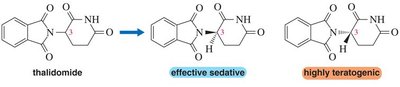
Stereochemistry is the branch of chemistry concerned with the three-dimensional arrangement of atoms within molecules. It is crucial for understanding the properties and reactivity of organic compounds, as different spatial arrangements can lead to dramatically different biological and chemical behaviors. The importance of stereochemistry is exemplified by the drug thalidomide, where one enantiomer is a sedative and the other is teratogenic.
Types of Isomers
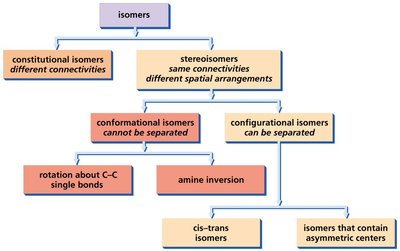
Isomers are compounds with the same molecular formula but different structures. They are classified into constitutional isomers and stereoisomers:
Constitutional isomers: Same molecular formula, different connectivity of atoms.
Stereoisomers: Same molecular formula and connectivity, but different spatial arrangements.
Constitutional Isomers
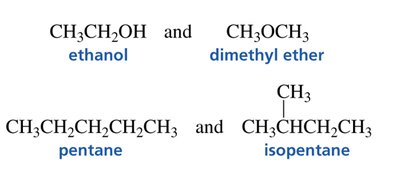
Constitutional isomers differ in the order in which atoms are connected. This can result in different functional groups and chemical properties.
Example: Ethanol (CH3CH2OH) and dimethyl ether (CH3OCH3) are constitutional isomers.
Stereoisomers
Stereoisomers have the same connectivity but differ in the arrangement of atoms in space. They are further divided into:
Conformational isomers (conformers): Interconvert by rotation around single bonds or amine inversion; cannot be separated.
Configurational isomers: Can only interconvert by breaking covalent bonds; can be separated due to different physical properties.
Conformational Isomers
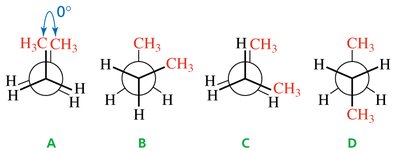
Conformational isomers arise from rotation about single (C–C) bonds or amine inversion. They rapidly interconvert at room temperature and cannot be isolated. Some conformers are more stable than others due to steric and torsional strain.
Key terms: Eclipsed, staggered, anti, gauche, ring flip (axial vs equatorial).
Configurational Isomers
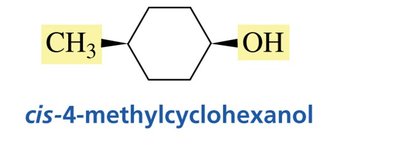
Configurational isomers cannot interconvert without breaking covalent bonds. They have distinct physical properties and can be separated. This category includes cis-trans isomers and isomers with asymmetric centers (chiral centers).

Chirality and Asymmetric Centers
Chirality and Mirror Images
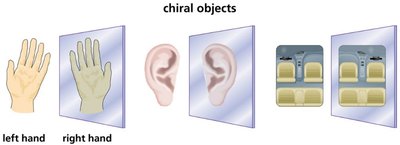
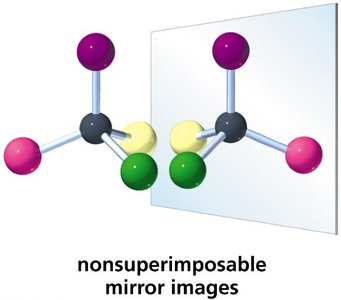
Chirality is a property where an object or molecule is not superimposable on its mirror image. A molecule is achiral if its mirror image is superimposable, and chiral if it is not.
Identifying Chiral Centers
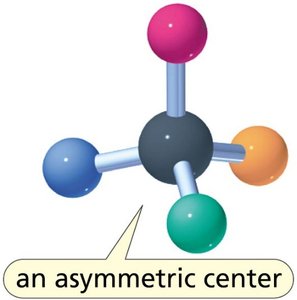
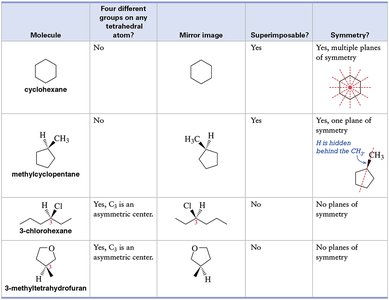
A chiral (asymmetric) center is typically a tetrahedral atom (usually carbon) bonded to four different groups. The absence of a plane of symmetry is a key indicator of chirality.
Determining Chirality in Molecules
To determine if a molecule is chiral, look for asymmetric centers and check for planes of symmetry. If a molecule has one chiral center, it is always chiral. If it has more than one, further analysis is needed.
Enantiomers and Diastereomers
Enantiomers
Enantiomers are pairs of molecules that are nonsuperimposable mirror images of each other. They have identical physical and chemical properties except for their interaction with plane-polarized light and reactions in chiral environments (e.g., biological systems).
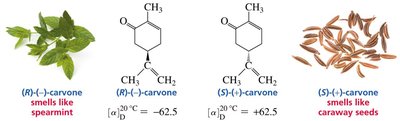
Example: The two enantiomers of carvone smell like spearmint and caraway seeds, respectively.
Diastereomers
Diastereomers are stereoisomers with two or more chiral centers that are not mirror images of each other. They have different physical and chemical properties and can be separated by conventional means.
Maximum number of stereoisomers: , where is the number of chiral centers.

Meso Compounds
Meso compounds contain two or more chiral centers but are achiral due to an internal plane of symmetry. They are superimposable on their mirror images and do not rotate plane-polarized light.
Key feature: Plane of symmetry within the molecule.
Naming Stereoisomers: The R/S System
Cahn-Ingold-Prelog Priority Rules
The R/S system is used to specify the absolute configuration of chiral centers. The steps are:
Assign priorities to the four groups attached to the chiral center based on atomic number (higher atomic number = higher priority).
If two atoms are the same, move outward along the chain until a difference is found.
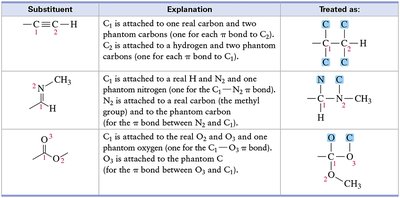
For double/triple bonds, treat as if the atom is bonded to equivalent "phantom" atoms.
Orient the molecule so the lowest priority group is pointing away from you.
Trace a path from priority 1 → 2 → 3. If clockwise, the configuration is R; if counterclockwise, it is S.
Examples of R/S Assignment
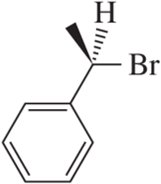
Practice assigning priorities and determining R or S configuration for various molecules.
Optical Activity and Measurement
Optical Activity
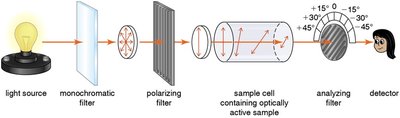
Chiral molecules can rotate plane-polarized light, a property known as optical activity. Enantiomers rotate light in equal but opposite directions. A racemic mixture (equal amounts of both enantiomers) shows no net rotation.
Dextrorotatory (+): Rotates light clockwise.
Levorotatory (−): Rotates light counterclockwise.
Specific Rotation and Optical Purity
The specific rotation is a standardized measure of a compound's ability to rotate plane-polarized light, dependent on temperature, concentration, path length, and wavelength.
Equation for specific rotation:
= observed rotation (degrees)
= path length (dm)
= concentration (g/100 mL)

Optical purity (enantiomeric excess) is calculated as:
Summary Table: Properties of Isomers
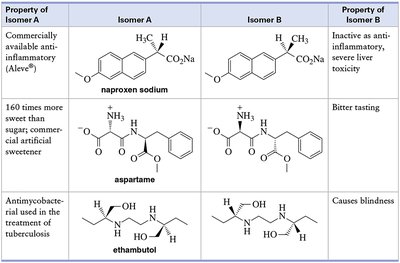
Property of Isomer A | Isomer A | Isomer B | Property of Isomer B |
|---|---|---|---|
Commercially available anti-inflammatory (Aleve®) | naproxen sodium | Inactive as anti-inflammatory, severe liver toxicity | |
160 times more sweet than sugar; commercial artificial sweetener | aspartame | Bitter tasting | |
Antimycobacterial used in the treatment of tuberculosis | ethambutol | Causes blindness |
Key Takeaways
Stereochemistry is essential for understanding the function and behavior of organic molecules.
Isomers can be constitutional or stereoisomers, with stereoisomers further divided into conformational and configurational types.
Chirality and the presence of asymmetric centers lead to enantiomers and diastereomers, which have important implications in chemistry and biology.
The R/S system provides a systematic way to name and distinguish stereoisomers.
Optical activity is a key experimental property for identifying and quantifying enantiomers.
