Ch. 12 - Radicals
Bruice - Organic Chemistry 8th Edition
Bruice8th EditionOrganic ChemistryISBN: 9780135213711당신이 사용하는 게 아니라요?교과서 변경
12장, 문제 28

Explain why iodine (I2) does not react with ethane, even though I2 is more easily cleaved homolytically than the other halogens.

검증된 단계별 안내
1
Iodine (I2) is more easily cleaved homolytically than other halogens because the I-I bond is weaker due to the larger atomic size of iodine, which results in poorer orbital overlap and a longer bond length.
For a reaction to occur between iodine (I2) and ethane (C2H6), the homolytic cleavage of the I-I bond must produce iodine radicals (I•), which can then abstract a hydrogen atom from ethane to form ethyl radicals (C2H5•).
However, the C-H bond in ethane is relatively strong, with a bond dissociation energy of approximately 410 kJ/mol. This means that a significant amount of energy is required to break the C-H bond and form the ethyl radical.
The iodine radicals (I•) generated from the homolytic cleavage of I2 are not sufficiently reactive to overcome the high bond dissociation energy of the C-H bond in ethane. As a result, the reaction does not proceed.
In contrast, halogens like chlorine (Cl2) and bromine (Br2) are more reactive because their radicals (Cl• and Br•) are more energetic and can more readily abstract hydrogen atoms from ethane, leading to a reaction.

비슷한 문제에 대한 검증된 영상 답변:

이 영상 해법은 위 문제에 도움이 된다고 튜터들이 추천한 것입니다.
영상 길이:
4m

주요 개념

질문에 올바르게 답하기 위해 반드시 이해해야 하는 핵심 개념들은 다음과 같습니다.

Homolytic Cleavage

Homolytic cleavage refers to the breaking of a covalent bond in such a way that each atom involved in the bond retains one of the shared electrons, resulting in the formation of two radicals. In the case of iodine (I2), this process occurs more readily than in other halogens due to its weaker bond strength. However, the presence of radicals alone does not guarantee a reaction with ethane, as other factors must also be considered.
추천 영상:
04:39
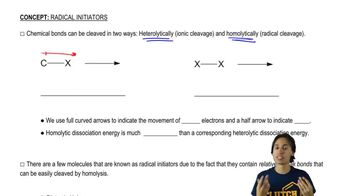
Heterolytic vs. Homolytic Bond Cleavage .

Reactivity of Alkanes

Alkanes, such as ethane, are generally unreactive due to their stable C-C and C-H bonds, which do not easily participate in reactions without the presence of strong electrophiles or radical initiators. The lack of functional groups in alkanes means they do not readily undergo reactions like halogenation unless conditions are favorable, such as the presence of heat or light to initiate radical formation.
추천 영상:
02:47
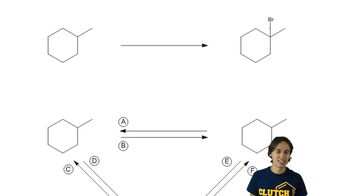
Functionalizing Alkanes

Radical Stability and Selectivity

The stability of radicals plays a crucial role in determining the outcome of reactions involving radical species. Iodine radicals, while formed easily, are less stable compared to other halogen radicals, such as those from chlorine or bromine. This instability leads to a lower likelihood of reaction with ethane, as the formation of less stable radicals is energetically unfavorable, resulting in a lack of reactivity.
추천 영상:
03:43
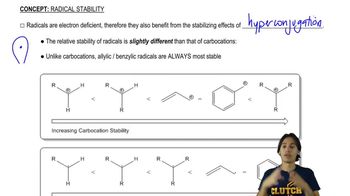
The radical stability trend.