Ch. 12 - Radicals
Bruice - Organic Chemistry 8th Edition
Bruice8th EditionOrganic ChemistryISBN: 9780135213711당신이 사용하는 게 아니라요?교과서 변경
12장, 문제 29a

What is the major product obtained from treating an excess of each of the following compounds with Cl2 in the presence of ultraviolet light at room temperature? Disregard stereoisomers.
a.

검증된 단계별 안내
1
Step 1: Recognize the reaction type. The reaction involves the treatment of the compound with Cl₂ in the presence of ultraviolet (UV) light, which indicates a free radical halogenation reaction. This reaction typically occurs at the most reactive hydrogen positions.
Step 2: Analyze the structure of the compound. The given compound is a cyclohexane ring with two methyl groups attached at different positions. Identify all the types of hydrogens present: primary, secondary, and tertiary.
Step 3: Determine the reactivity of hydrogens. In free radical halogenation, tertiary hydrogens are the most reactive, followed by secondary hydrogens, and then primary hydrogens. Locate the tertiary hydrogens in the molecule, if any.
Step 4: Predict the major product. Since the reaction is performed in excess Cl₂, the chlorine will replace the most reactive hydrogen (likely tertiary or secondary) to form the major product. Consider the positions of the methyl groups and the hydrogens attached to the ring carbons.
Step 5: Disregard stereoisomers. The problem specifies to disregard stereoisomers, so focus only on the connectivity of the atoms in the major product without considering spatial arrangement.

비슷한 문제에 대한 검증된 영상 답변:

이 영상 해법은 위 문제에 도움이 된다고 튜터들이 추천한 것입니다.
영상 길이:
3m

주요 개념

질문에 올바르게 답하기 위해 반드시 이해해야 하는 핵심 개념들은 다음과 같습니다.

Free Radical Halogenation

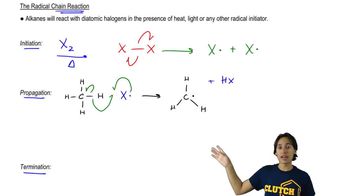
Free radical halogenation is a reaction where alkanes react with halogens (like Cl2) in the presence of ultraviolet light, leading to the substitution of hydrogen atoms with halogen atoms. This process involves the formation of free radicals, which are highly reactive species that drive the reaction forward. The reaction typically proceeds through initiation, propagation, and termination steps, resulting in various halogenated products.
추천 영상:
12:11
Radical Chain Reaction Mechanism.

Excess Reagent Effect

Using an excess of a reagent, such as Cl2, influences the reaction outcome by favoring the formation of the major product. In free radical halogenation, an excess of Cl2 increases the likelihood of multiple substitution reactions occurring, leading to more halogen atoms being incorporated into the organic molecule. This can result in a more heavily halogenated product, which is crucial for predicting the major product formed.
추천 영상:
04:21
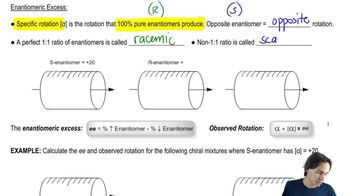
How to calculate enantiomeric excess.

Reaction Conditions and Temperature

The reaction conditions, including the presence of ultraviolet light and room temperature, are critical in free radical halogenation. Ultraviolet light provides the energy needed to initiate the formation of free radicals from Cl2, while room temperature ensures that the reaction proceeds without excessive energy that could lead to side reactions. Understanding these conditions helps predict the efficiency and selectivity of the halogenation process.
추천 영상:
가이드 코스
3:22
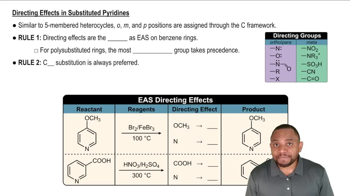
EAS Reactions of Pyridine Concept 3