

Ch. 13 - Mass Spectrometry; Infrared Spectroscopy; UV/Vis Spectroscopy
Bruice - Organic Chemistry 8th Edition
Bruice8th EditionOrganic ChemistryISBN: 9780135213711당신이 사용하는 게 아니라요?교과서 변경
13장, 문제 25b

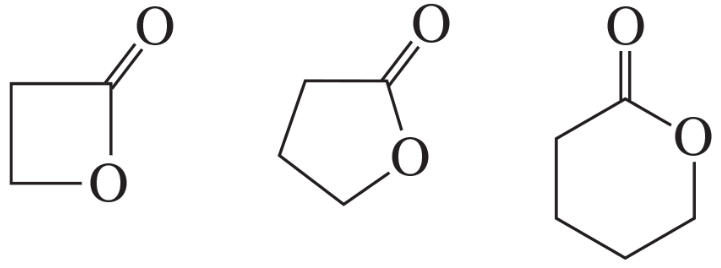
Rank the following compounds from highest wavenumber to lowest wavenumber for their C=O absorption bands:
b.

검증된 단계별 안내
1
Identify the functional groups in each compound that contain a C=O bond. For example, ketones, aldehydes, esters, carboxylic acids, and amides all have C=O bonds, but their environments differ, affecting the absorption wavenumber.
Recall the general trend for C=O stretching frequencies in IR spectroscopy. The wavenumber is influenced by the electronic environment around the carbonyl group. For example, electron-withdrawing groups increase the wavenumber, while electron-donating groups or resonance effects lower it.
Consider the hybridization and resonance effects. For example, esters typically have a higher wavenumber than ketones because the lone pair on the oxygen in esters participates in resonance, reducing the electron density on the carbonyl carbon less effectively than in ketones.
Account for any conjugation effects. Conjugation with a double bond or aromatic ring lowers the C=O stretching frequency because it delocalizes the electrons, reducing the bond strength and thus the wavenumber.
Rank the compounds based on the above considerations, starting with the compound that has the least resonance or conjugation effects (highest wavenumber) and ending with the compound that has the most resonance or conjugation effects (lowest wavenumber).

비슷한 문제에 대한 검증된 영상 답변:

이 영상 해법은 위 문제에 도움이 된다고 튜터들이 추천한 것입니다.
영상 길이:
9m

주요 개념

질문에 올바르게 답하기 위해 반드시 이해해야 하는 핵심 개념들은 다음과 같습니다.

Infrared Spectroscopy

Infrared spectroscopy is a technique used to identify molecular structures by measuring the absorption of infrared light by a compound. Different functional groups absorb infrared radiation at characteristic wavenumbers, which are measured in cm⁻¹. The C=O bond, for example, typically shows strong absorption in the range of 1700-1750 cm⁻¹, making it a key feature in organic compound analysis.
추천 영상:
가이드 코스
2:56
The UV-Vis Spectroscopy Concept 1

C=O Bond Strength and Wavenumber

The strength of the C=O bond influences the wavenumber of its absorption band in infrared spectroscopy. Stronger bonds generally absorb at higher wavenumbers due to the increased energy required to stretch the bond. Factors such as hybridization and the presence of electron-withdrawing groups can also affect the bond strength and, consequently, the wavenumber of the C=O absorption.
추천 영상:
가이드 코스
3:15
Disulfide Bonds Example 2

Functional Group Effects

Different functional groups can influence the wavenumber of C=O absorption bands through electronic effects. For instance, electron-withdrawing groups (like halogens or nitro groups) can increase the wavenumber due to increased bond polarity, while electron-donating groups can lower it. Understanding these effects is crucial for accurately ranking compounds based on their C=O absorption characteristics.
추천 영상:
02:36
Identifying Functional Groups