Ch. 13 - Mass Spectrometry; Infrared Spectroscopy; UV/Vis Spectroscopy
Bruice - Organic Chemistry 8th Edition
Bruice8th EditionOrganic ChemistryISBN: 9780135213711당신이 사용하는 게 아니라요?교과서 변경
13장, 문제 24

Why is the C–O absorption band of 1-hexanol at a smaller wavenumber (1060 cm–1) than the C–O absorption band of pentanoic acid (1220 cm–1)?

검증된 단계별 안내
1
Understand that the C-O absorption band in IR spectroscopy corresponds to the stretching vibration of the carbon-oxygen bond. The position of this band depends on the bond strength and the surrounding chemical environment.
Recognize that 1-hexanol contains a hydroxyl (-OH) group attached to a carbon atom, forming an alcohol. In contrast, pentanoic acid contains a carboxylic acid functional group (-COOH), where the C-O bond is part of a carboxyl group.
Explain that in pentanoic acid, the C-O bond is part of a resonance structure. The resonance between the carbonyl group (C=O) and the hydroxyl group (-OH) in the carboxylic acid delocalizes electron density, giving the C-O bond partial double-bond character. This increases the bond strength and shifts the absorption band to a higher wavenumber (1220 cm⁻¹).
In 1-hexanol, the C-O bond is a single bond without resonance effects. The lack of resonance and the single-bond character make the bond weaker, resulting in a lower wavenumber for the absorption band (1060 cm⁻¹).
Conclude that the difference in wavenumber arises from the resonance stabilization in pentanoic acid, which strengthens the C-O bond, compared to the single-bond character of the C-O bond in 1-hexanol.

비슷한 문제에 대한 검증된 영상 답변:

이 영상 해법은 위 문제에 도움이 된다고 튜터들이 추천한 것입니다.
영상 길이:
4m

주요 개념

질문에 올바르게 답하기 위해 반드시 이해해야 하는 핵심 개념들은 다음과 같습니다.

Infrared Spectroscopy

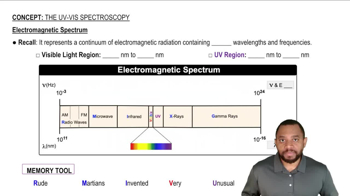
Infrared spectroscopy is a technique used to identify molecular structures by measuring the absorption of infrared light at different wavelengths. Different functional groups absorb infrared light at characteristic wavenumbers, allowing chemists to deduce the presence of specific bonds in a molecule. The position of these absorption bands can provide insights into molecular interactions and the environment surrounding the functional groups.
추천 영상:
가이드 코스
2:56
The UV-Vis Spectroscopy Concept 1

Functional Groups and Their Influence on Wavenumbers

Functional groups, such as alcohols and carboxylic acids, have distinct vibrational modes that influence their infrared absorption wavenumbers. The presence of electronegative atoms, hydrogen bonding, and molecular structure can shift these bands. For instance, the C-O bond in alcohols typically appears at lower wavenumbers compared to carboxylic acids due to differences in bonding and molecular interactions.
추천 영상:
02:36
Identifying Functional Groups

Hydrogen Bonding

Hydrogen bonding is a type of intermolecular force that occurs when a hydrogen atom covalently bonded to an electronegative atom interacts with another electronegative atom. In the case of pentanoic acid, the presence of a carboxylic group allows for strong hydrogen bonding, which can stabilize the molecule and affect the vibrational frequency of the C-O bond, resulting in a higher wavenumber compared to 1-hexanol, which lacks such extensive hydrogen bonding.
추천 영상:
00:48
The definition of hydrogenation.