Ch. 15 - Reactions of Carboxylic Acids and Carboxylic Acid Derivatives
Bruice - Organic Chemistry 8th Edition
Bruice8th EditionOrganic ChemistryISBN: 9780135213711당신이 사용하는 게 아니라요?교과서 변경
15장, 문제 21c,d

In the mechanism for the acid-catalyzed hydrolysis of an ester,
c. what species is HB+ most likely to be in the hydrolysis reaction?
d. what species is HB+ most likely to be in the reverse reaction?

검증된 단계별 안내
1
Step 1: Understand the context of the problem. The acid-catalyzed hydrolysis of an ester involves breaking the ester bond in the presence of an acid catalyst, typically resulting in the formation of a carboxylic acid and an alcohol. The acid catalyst donates a proton (H⁺) to facilitate the reaction.
Step 2: Identify the role of HB⁺ in the hydrolysis reaction. HB⁺ represents the conjugate acid of the base (B) present in the reaction. In the hydrolysis reaction, HB⁺ is most likely the protonated form of the solvent or a species that can donate a proton to stabilize intermediates.
Step 3: Analyze the forward reaction (hydrolysis). In the forward reaction, water (H₂O) is typically the nucleophile that attacks the carbonyl carbon of the ester. The acid catalyst (H⁺) protonates the carbonyl oxygen to make the carbonyl carbon more electrophilic. HB⁺ is most likely H₃O⁺ (hydronium ion), which is the protonated form of water.
Step 4: Analyze the reverse reaction (esterification). In the reverse reaction, the carboxylic acid and alcohol combine to reform the ester. The acid catalyst (H⁺) protonates the hydroxyl group of the carboxylic acid to make it a better leaving group. HB⁺ in this case is also most likely H₃O⁺, as the reaction occurs in an acidic environment.
Step 5: Conclude that in both the forward (hydrolysis) and reverse (esterification) reactions, HB⁺ is most likely H₃O⁺, as it is the conjugate acid of water and plays a key role in the acid-catalyzed mechanism.

비슷한 문제에 대한 검증된 영상 답변:

이 영상 해법은 위 문제에 도움이 된다고 튜터들이 추천한 것입니다.
영상 길이:
1m

주요 개념

질문에 올바르게 답하기 위해 반드시 이해해야 하는 핵심 개념들은 다음과 같습니다.

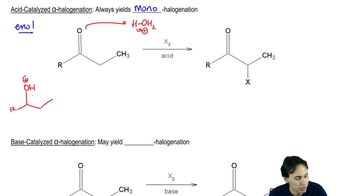
Acid-Catalyzed Hydrolysis

Acid-catalyzed hydrolysis is a reaction where an ester reacts with water in the presence of an acid catalyst, typically a proton donor like HCl or H2SO4. The acid increases the electrophilicity of the carbonyl carbon in the ester, facilitating the nucleophilic attack by water. This process results in the formation of an alcohol and a carboxylic acid.
추천 영상:
03:09
Acid Catalyzed

Protonation and HB+ Species

In organic reactions, HB+ represents a protonated species, often a conjugate acid formed when a base accepts a proton. In the context of acid-catalyzed hydrolysis, HB+ is likely to be the protonated form of the alcohol or water, which stabilizes the transition state and promotes the reaction. Understanding the role of HB+ is crucial for predicting the direction and products of the reaction.
추천 영상:
03:
Proton Splitting

Reversibility of Reactions

Many organic reactions, including hydrolysis, are reversible. In the reverse reaction, the products (alcohol and carboxylic acid) can recombine to form the original ester, especially under certain conditions. The species HB+ in the reverse reaction is typically the protonated form of the carboxylic acid, which can facilitate the reformation of the ester by donating a proton to the alcohol.
추천 영상:
11:50
EAS Reactions Overview