Ch. 15 - Reactions of Carboxylic Acids and Carboxylic Acid Derivatives
Bruice - Organic Chemistry 8th Edition
Bruice8th EditionOrganic ChemistryISBN: 9780135213711당신이 사용하는 게 아니라요?교과서 변경
15장, 문제 19a

Which ester hydrolyzes more rapidly? a. methyl acetate or phenyl acetate?

검증된 단계별 안내
1
Step 1: Understand the concept of ester hydrolysis. Ester hydrolysis involves breaking the ester bond (C-O bond) in the presence of water or a base/acid catalyst. The rate of hydrolysis depends on the electronic and steric effects of the substituents attached to the ester group.
Step 2: Analyze the structures of methyl acetate and phenyl acetate. Methyl acetate has a methyl group (-CH3) attached to the oxygen atom, while phenyl acetate has a phenyl group (-C6H5) attached to the oxygen atom.
Step 3: Consider the steric effects. The phenyl group is bulkier than the methyl group, which can hinder the approach of water or hydroxide ions to the ester bond, slowing down the hydrolysis reaction.
Step 4: Evaluate the electronic effects. The phenyl group can stabilize the transition state through resonance, but it also withdraws electron density from the ester bond, making it less reactive compared to the methyl group in methyl acetate.
Step 5: Conclude that methyl acetate hydrolyzes more rapidly than phenyl acetate due to the smaller steric hindrance and higher reactivity of the methyl group compared to the phenyl group.

비슷한 문제에 대한 검증된 영상 답변:

이 영상 해법은 위 문제에 도움이 된다고 튜터들이 추천한 것입니다.
영상 길이:
3m

주요 개념

질문에 올바르게 답하기 위해 반드시 이해해야 하는 핵심 개념들은 다음과 같습니다.

Ester Hydrolysis

Ester hydrolysis is a chemical reaction where an ester reacts with water to form an alcohol and a carboxylic acid. This reaction can occur under acidic or basic conditions and is crucial in organic chemistry for understanding the reactivity of esters. The rate of hydrolysis can vary significantly based on the structure of the ester, particularly the nature of the alkyl groups attached to the ester functional group.
추천 영상:
가이드 코스
0:48
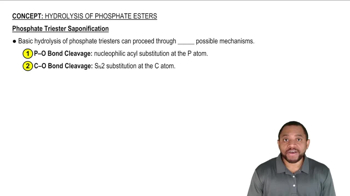
Hydrolysis of Phosphate Esters Concept 2

Electronic Effects

Electronic effects, such as inductive and resonance effects, influence the stability of the transition state during hydrolysis. In the case of methyl acetate versus phenyl acetate, the presence of the phenyl group can stabilize the transition state through resonance, making the hydrolysis slower compared to the more straightforward methyl group. Understanding these effects is essential for predicting the reactivity of different esters.
추천 영상:
04:29
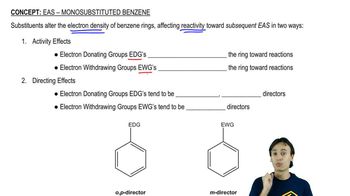
Activity and Directing Effects

Steric Hindrance

Steric hindrance refers to the prevention of chemical reactions due to the spatial arrangement of atoms within a molecule. In the context of ester hydrolysis, bulky groups can hinder the approach of water molecules to the ester bond, slowing down the reaction. Comparing methyl acetate, which has less steric hindrance, to phenyl acetate, which has a larger phenyl group, highlights how steric factors can affect hydrolysis rates.
추천 영상:
02:53
Understanding steric effects.