Ch. 15 - Reactions of Carboxylic Acids and Carboxylic Acid Derivatives
Bruice - Organic Chemistry 8th Edition
Bruice8th EditionOrganic ChemistryISBN: 9780135213711당신이 사용하는 게 아니라요?교과서 변경
15장, 문제 45

We saw that acid anhydrides react with alcohols, water, and amines. In which of these reactions can the tetrahedral intermediate eliminate the carboxylate ion even if it does not lose a proton before the elimination step? Explain.

검증된 단계별 안내
1
Step 1: Understand the reaction mechanism of acid anhydrides with alcohols, water, and amines. Acid anhydrides are reactive compounds that undergo nucleophilic acyl substitution reactions. The key intermediate in these reactions is a tetrahedral intermediate formed when the nucleophile attacks the carbonyl carbon.
Step 2: Analyze the elimination step in the reaction mechanism. The tetrahedral intermediate can eliminate a leaving group, such as a carboxylate ion, without losing a proton if the leaving group is already negatively charged. This is because the carboxylate ion is a stable leaving group due to resonance stabilization.
Step 3: Examine the nucleophiles provided in the image: ethanol (CH₃CH₂OH), ethylamine (CH₃CH₂NH₂), and water (H₂O). Ethanol and water are neutral nucleophiles, meaning they will likely lose a proton before elimination occurs. Ethylamine, however, is a basic nucleophile and can form a tetrahedral intermediate where the carboxylate ion is eliminated directly without proton loss.
Step 4: Consider the role of the nucleophile's basicity and the stability of the leaving group. Amines, such as ethylamine, are stronger nucleophiles and can facilitate direct elimination of the carboxylate ion due to their ability to stabilize the intermediate without requiring proton transfer.
Step 5: Conclude that the reaction of acid anhydrides with amines (e.g., CH₃CH₂NH₂) allows the tetrahedral intermediate to eliminate the carboxylate ion directly, even without losing a proton before the elimination step. This is due to the inherent properties of the amine nucleophile and the stability of the carboxylate ion.

비슷한 문제에 대한 검증된 영상 답변:

이 영상 해법은 위 문제에 도움이 된다고 튜터들이 추천한 것입니다.
영상 길이:
8m

주요 개념

질문에 올바르게 답하기 위해 반드시 이해해야 하는 핵심 개념들은 다음과 같습니다.

Tetrahedral Intermediate

A tetrahedral intermediate is a transient species formed during nucleophilic acyl substitution reactions, where a nucleophile attacks the carbonyl carbon of a carboxylic acid derivative. This intermediate has a tetrahedral geometry due to the addition of the nucleophile, which temporarily disrupts the carbonyl's planar structure. Understanding this concept is crucial for analyzing how the intermediate can lead to the elimination of leaving groups, such as carboxylate ions.
추천 영상:
04:31
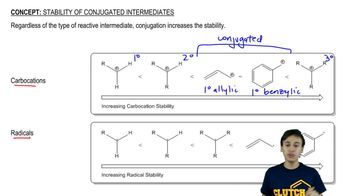
Stability of Conjugated Intermediates

Carboxylate Ion

A carboxylate ion is the conjugate base of a carboxylic acid, formed when the acid loses a proton from its carboxyl group. In the context of acid anhydrides, the carboxylate ion can act as a leaving group during nucleophilic substitution reactions. Recognizing the role of the carboxylate ion is essential for understanding the conditions under which it can be eliminated from the tetrahedral intermediate without prior proton loss.
추천 영상:
가이드 코스
3:39
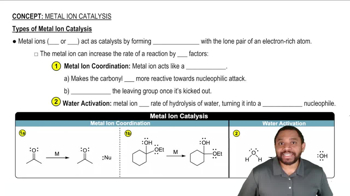
Metal Ion Catalysis Concept 1

Nucleophilic Acyl Substitution

Nucleophilic acyl substitution is a fundamental reaction in organic chemistry where a nucleophile attacks the electrophilic carbon of a carbonyl compound, leading to the substitution of a leaving group. This reaction is characteristic of carboxylic acid derivatives, including acid anhydrides, esters, and amides. Grasping this concept helps in predicting the outcomes of reactions involving acid anhydrides with alcohols, amines, and water, particularly in the context of tetrahedral intermediates.
추천 영상:
01:47
Nucleophiles and Electrophiles can react in Substitution Reactions.