Ch. 15 - Reactions of Carboxylic Acids and Carboxylic Acid Derivatives
Bruice - Organic Chemistry 8th Edition
Bruice8th EditionOrganic ChemistryISBN: 9780135213711당신이 사용하는 게 아니라요?교과서 변경
15장, 문제 68a,b

What are the products of the following reactions?
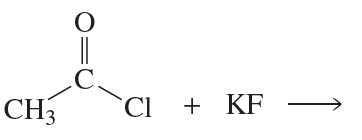
a. Chemical reaction showing acyl chloride and potassium fluoride as reactants, leading to nucleophilic acyl substitution.
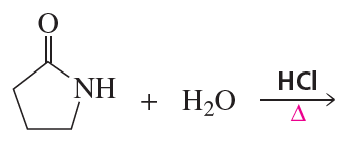
b. Chemical reaction diagram showing a cyclic compound with NH and O reacting with water and HCl, indicating nucleophilic acyl substitution.

검증된 단계별 안내
1
Step 1: For reaction (i), identify the reactants. The starting compound is an acyl chloride (CH3C=O(Cl)), and the reagent is NaF. Acyl chlorides are reactive and can undergo substitution reactions where the chloride group is replaced by another nucleophile.
Step 2: Recognize the role of NaF in reaction (i). Fluoride ion (F-) acts as a nucleophile and replaces the chloride ion (Cl-) in the acyl chloride. This substitution results in the formation of an acyl fluoride (CH3C=O(F)).
Step 3: For reaction (ii), identify the reactants. The starting compound is an amide (CH3C=O(NHCH2CH3)), and the reagents are NaOH, H2O, and heat. Amides can undergo hydrolysis under basic conditions to yield carboxylic acids or their salts.
Step 4: Recognize the mechanism of hydrolysis in reaction (ii). Under basic conditions, the amide bond is broken, and the nitrogen group is removed as ammonia (NH3) or an amine. The remaining carbonyl group forms a carboxylate ion (CH3COO-) due to the presence of NaOH.
Step 5: Summarize the products. For reaction (i), the product is acyl fluoride (CH3C=O(F)). For reaction (ii), the products are sodium acetate (CH3COO-Na+) and ethylamine (CH3CH2NH2).

비슷한 문제에 대한 검증된 영상 답변:

이 영상 해법은 위 문제에 도움이 된다고 튜터들이 추천한 것입니다.
영상 길이:
2m

주요 개념

질문에 올바르게 답하기 위해 반드시 이해해야 하는 핵심 개념들은 다음과 같습니다.

Nucleophilic Acyl Substitution

Nucleophilic acyl substitution is a fundamental reaction in organic chemistry where a nucleophile attacks the carbonyl carbon of an acyl compound, leading to the replacement of a leaving group (like Cl) with the nucleophile. This reaction is crucial for understanding how acyl chlorides react with nucleophiles, such as fluoride ions in the presence of NaF, resulting in the formation of a new product.
추천 영상:
01:47
Nucleophiles and Electrophiles can react in Substitution Reactions.

Role of Nucleophiles

Nucleophiles are species that donate an electron pair to form a chemical bond in a reaction. In the context of the provided reactions, fluoride ions (from KF) and hydroxide ions (from NaOH) act as nucleophiles that attack the electrophilic carbonyl carbon, facilitating the substitution process. Understanding the nature and strength of nucleophiles is essential for predicting the outcome of these reactions.
추천 영상:
08:27
Nucleophilic Addition

Hydrolysis of Amides

The hydrolysis of amides involves the reaction of an amide with water, often in the presence of an acid or base, leading to the formation of a carboxylic acid and an amine or ammonia. In the second reaction, heating an amide with NaOH and water promotes hydrolysis, which is important for understanding how amides can be converted into more reactive carboxylic acids and amines under specific conditions.
추천 영상:
01:33
Amide Nomenclature