Ch. 15 - Reactions of Carboxylic Acids and Carboxylic Acid Derivatives
Bruice - Organic Chemistry 8th Edition
Bruice8th EditionOrganic ChemistryISBN: 9780135213711당신이 사용하는 게 아니라요?교과서 변경
15장, 문제 68g,h

What are the products of the following reactions?
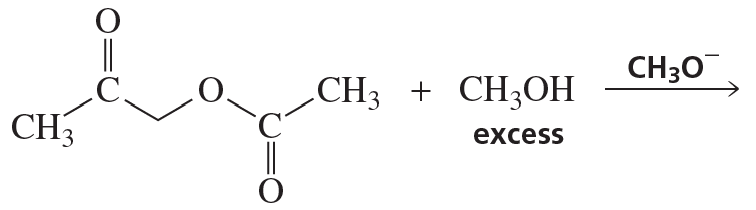
g. Chemical reaction diagram showing reactants and products, including a carbon chain and methanol with a reaction arrow.
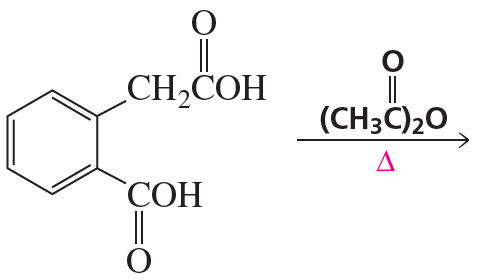
h. Chemical structures illustrating elimination reactions with reactants and products labeled, including a heat symbol.

검증된 단계별 안내
1
Step 1: For reaction (g), recognize that CH3OH (methanol) is in excess and CH3O- (methoxide ion) is present. This suggests a nucleophilic substitution or esterification reaction. Analyze the structure of the starting material to determine the reactive sites.
Step 2: Identify the functional groups in the starting material. If the starting material contains a leaving group (e.g., halide or tosylate), methoxide ion (CH3O-) will act as a nucleophile and replace the leaving group. If the starting material contains a carbonyl group, methanol may react to form an ester.
Step 3: Write the mechanism for the reaction. For nucleophilic substitution, show the attack of CH3O- on the electrophilic carbon attached to the leaving group, followed by the departure of the leaving group. For esterification, show the reaction of methanol with the carbonyl group, forming an ester and releasing a byproduct (e.g., water).
Step 4: For reaction (h), recognize that (CH3C=O)2O is acetic anhydride. Heating (Δ) acetic anhydride typically leads to its reaction with nucleophiles or decomposition. Analyze the conditions to predict the products.
Step 5: Write the mechanism for the reaction of acetic anhydride under heat. If no nucleophile is present, acetic anhydride may decompose into acetic acid and ketene. If a nucleophile is present, acetic anhydride may react to form an ester or amide, depending on the nucleophile.

비슷한 문제에 대한 검증된 영상 답변:

이 영상 해법은 위 문제에 도움이 된다고 튜터들이 추천한 것입니다.

주요 개념

질문에 올바르게 답하기 위해 반드시 이해해야 하는 핵심 개념들은 다음과 같습니다.

Nucleophilic Substitution

Nucleophilic substitution is a fundamental reaction in organic chemistry where a nucleophile, such as methanol (CH3OH), attacks an electrophilic carbon atom, resulting in the replacement of a leaving group. In the given reaction, methanol acts as a nucleophile, forming a methoxy group (CH3O-) as a product when it reacts with an appropriate electrophile.
추천 영상:
01:47
Nucleophiles and Electrophiles can react in Substitution Reactions.

Acid Anhydrides

Acid anhydrides, like (CH3C=O)2O, are compounds formed from two acyl groups and are reactive intermediates in organic synthesis. When heated (Δ), they can undergo reactions such as hydrolysis or nucleophilic acyl substitution, leading to the formation of carboxylic acids or esters, depending on the nucleophile involved.
추천 영상:
03:35
Anhydride Nomenclature

Reaction Conditions

Reaction conditions, including temperature, solvent, and the presence of catalysts, significantly influence the outcome of organic reactions. For instance, the use of excess methanol and heat in the reactions can drive the formation of specific products, such as esters or ethers, by favoring the nucleophilic attack and stabilizing the transition states.
추천 영상:
가이드 코스
1:18
EAS Reactions of Pyridine Example 1