Ch. 15 - Reactions of Carboxylic Acids and Carboxylic Acid Derivatives
Bruice - Organic Chemistry 8th Edition
Bruice8th EditionOrganic ChemistryISBN: 9780135213711당신이 사용하는 게 아니라요?교과서 변경
15장, 문제 17a

Write a mechanism for each of the following reactions:
a. the uncatalyzed hydrolysis of methyl propionate.

검증된 단계별 안내
1
Identify the functional group in methyl propionate. Methyl propionate is an ester, which has the general structure RCOOR'. The hydrolysis of an ester involves breaking the ester bond to form a carboxylic acid and an alcohol.
Understand the reaction conditions. Since the problem specifies 'uncatalyzed hydrolysis,' the reaction will proceed without the aid of an acid or base catalyst. This means the reaction will rely on water as the nucleophile and proceed more slowly.
Initiate the mechanism. The lone pair of electrons on the oxygen atom in a water molecule attacks the carbonyl carbon of the ester group. This is a nucleophilic addition step. Represent this step as: R1(C=O)OR2+H2O→R1(C-OH)OR2.
Form the tetrahedral intermediate. After the nucleophilic attack, the carbonyl carbon becomes sp³ hybridized, and a tetrahedral intermediate is formed. This intermediate contains a hydroxyl group (-OH) and the original alkoxy group (-OR') attached to the same carbon.
Complete the reaction. The tetrahedral intermediate undergoes a rearrangement where the alkoxy group (-OR') is eliminated, leading to the formation of a carboxylic acid (RCOOH) and an alcohol (R'OH). This step regenerates the carbonyl group in the carboxylic acid.

비슷한 문제에 대한 검증된 영상 답변:

이 영상 해법은 위 문제에 도움이 된다고 튜터들이 추천한 것입니다.
영상 길이:
6m

주요 개념

질문에 올바르게 답하기 위해 반드시 이해해야 하는 핵심 개념들은 다음과 같습니다.

Hydrolysis

Hydrolysis is a chemical reaction involving the breaking of a bond in a molecule using water. In organic chemistry, it often refers to the reaction of esters or amides with water, leading to the formation of an alcohol and a carboxylic acid. Understanding hydrolysis is crucial for analyzing reactions involving esters, such as methyl propionate, as it dictates the pathway and products formed.
추천 영상:
가이드 코스
1:00
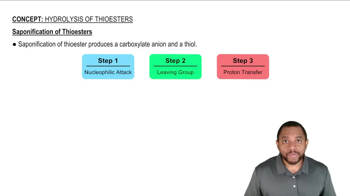
Hydrolysis of Thioesters Concept 2

Mechanism of Reaction

A reaction mechanism is a step-by-step description of the process by which reactants are converted into products. It outlines the individual steps, intermediates, and transition states involved in the reaction. For the uncatalyzed hydrolysis of methyl propionate, detailing the mechanism helps in understanding how water interacts with the ester bond and the subsequent formation of acetic acid and methanol.
추천 영상:
02:16
Heck Reaction Mechanism

Esters and Their Reactivity

Esters are organic compounds formed from the reaction of an alcohol and a carboxylic acid, characterized by the functional group -COO-. They are generally reactive towards nucleophiles, such as water in hydrolysis reactions. Recognizing the structure and reactivity of esters like methyl propionate is essential for predicting the outcome of hydrolysis and understanding the role of the ester functional group in organic reactions.
추천 영상:
02:39
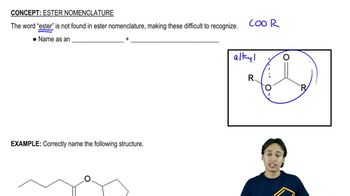
Ester Nomenclature