Ch. 16 - Reactions of Aldehydes and Ketones • More Reactions of Carboxylic Acid Derivatives
Bruice - Organic Chemistry 8th Edition
Bruice8th EditionOrganic ChemistryISBN: 9780135213711당신이 사용하는 게 아니라요?교과서 변경
16장, 문제 65a

Identify A through O:
Diagram illustrating a series of radical reactions with labeled steps A through O, showing chemical transformations and reagents.

검증된 단계별 안내
1
Step 1: Analyze the first reaction. The starting material is a cyclopentane ring with a methyl group attached. The reaction involves bromine (Br₂) and light (hν), which indicates a free radical halogenation reaction. This reaction typically occurs at the most stable radical position, which is the benzylic or allylic position if available, or the tertiary carbon if not.
Step 2: Predict the product of the first reaction (A). The methyl group attached to the cyclopentane ring has hydrogens that can be abstracted to form a radical. Bromine will replace one of these hydrogens, resulting in a brominated product at the methyl group.
Step 3: Analyze the second reaction. The product (A) reacts with ethoxide ion (CH₃CH₂O⁻). This suggests a nucleophilic substitution reaction (likely SN2 due to the primary alkyl bromide formed in step 1). The ethoxide ion will attack the carbon bonded to bromine, replacing the bromine atom.
Step 4: Predict the product of the second reaction (B). The ethoxide ion substitutes the bromine atom, forming an ether. The final product will have the ethoxy group (CH₃CH₂O-) attached to the methyl group on the cyclopentane ring.
Step 5: Summarize the transformations. The first step involves free radical bromination at the methyl group, and the second step involves nucleophilic substitution with ethoxide to form an ether. Carefully verify the positions and connectivity of all atoms in the final product.

비슷한 문제에 대한 검증된 영상 답변:

이 영상 해법은 위 문제에 도움이 된다고 튜터들이 추천한 것입니다.
영상 길이:
8m

주요 개념

질문에 올바르게 답하기 위해 반드시 이해해야 하는 핵심 개념들은 다음과 같습니다.

Radical Reactions

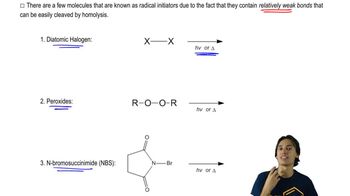
Radical reactions involve the formation and reaction of free radicals, which are highly reactive species with unpaired electrons. In the context of the provided reaction, the bromine (Br2) undergoes homolytic cleavage upon exposure to light (hv), generating bromine radicals that can react with the cyclic compound to form intermediate A. Understanding the mechanism of radical formation is crucial for predicting the products of such reactions.
추천 영상:
03:49
What are Radical Initiators?

Electrophilic Addition

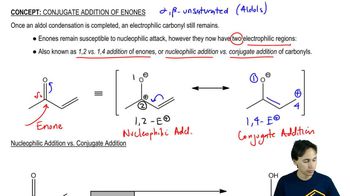
Electrophilic addition is a fundamental reaction mechanism in organic chemistry where an electrophile reacts with a nucleophile, leading to the formation of a new bond. In this case, the bromine radical acts as an electrophile that adds to the double bond of the cyclic compound, resulting in the formation of intermediate A. Recognizing how electrophiles interact with nucleophiles is essential for understanding the progression of the reaction to product B.
추천 영상:
09:23
1,2 vs 1,4 Addition

Nucleophilic Substitution

Nucleophilic substitution is a reaction where a nucleophile replaces a leaving group in a molecule. In the transition from intermediate A to product B, the alkoxide ion (CH3CH2O-) acts as a nucleophile, attacking the carbon atom bonded to the bromine in A, leading to the substitution of bromine and the formation of B. Grasping this concept is vital for predicting the outcome of reactions involving nucleophiles and electrophiles.
추천 영상:
01:47
Nucleophiles and Electrophiles can react in Substitution Reactions.