Step 1: Analyze the first reaction. The starting compound is an alkene (cyclopentene with a methyl group attached). The first step involves ozonolysis using O₃ at -78°C followed by reduction with dimethyl sulfide ((CH₃)₂S). This reaction cleaves the double bond in the alkene and forms two carbonyl compounds (aldehydes or ketones).
Step 2: Predict the products of ozonolysis. The double bond in the cyclopentene ring will be cleaved, resulting in two fragments. Since the methyl group is attached to the double bond, one of the fragments will be a ketone, and the other will be an aldehyde.
Step 3: Identify compound A. Based on the ozonolysis reaction, compound A will consist of the two carbonyl compounds formed: a ketone and an aldehyde. The exact structures depend on the position of the double bond and substituents in the starting material.
Step 4: Analyze the second reaction. Compound A is treated with H₂CrO₄ (chromic acid), which is a strong oxidizing agent. Chromic acid oxidizes aldehydes to carboxylic acids but does not affect ketones.
Step 5: Predict compound B. After oxidation with H₂CrO₄, the aldehyde in compound A will be converted to a carboxylic acid, while the ketone remains unchanged. Compound B will therefore consist of a carboxylic acid and a ketone.
비슷한 문제에 대한 검증된 영상 답변:
이 영상 해법은 위 문제에 도움이 된다고 튜터들이 추천한 것입니다.
영상 길이:
4m
영상 재생:
0 댓글
주요 개념
질문에 올바르게 답하기 위해 반드시 이해해야 하는 핵심 개념들은 다음과 같습니다.
Ozonolysis
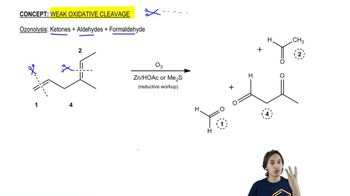
Ozonolysis is a reaction involving the cleavage of alkenes or alkynes using ozone (O3) to form carbonyl compounds. In this process, the alkene is treated with ozone at low temperatures, typically around -78 °C, leading to the formation of ozonides, which can be further reduced to aldehydes or ketones using a reducing agent like dimethyl sulfide ((CH3)2S).
Oxidation reactions in organic chemistry involve the increase of oxidation state of a molecule, often through the addition of oxygen or the removal of hydrogen. In this context, the compound A formed from ozonolysis is subjected to oxidation using chromium trioxide (H2CrO4), which can convert aldehydes to carboxylic acids or further oxidize alcohols, leading to the formation of compound B.
Functional group transformation refers to the process of converting one functional group into another through chemical reactions. In this scenario, the ozonolysis of the alkene leads to the formation of carbonyl groups, which are then transformed into carboxylic acids through oxidation. Understanding these transformations is crucial for predicting the structure of compounds A and B.

 Bruice 8th Edition

 검증된 단계별 안내

 06:30