Ch. 16 - Reactions of Aldehydes and Ketones • More Reactions of Carboxylic Acid Derivatives
Bruice - Organic Chemistry 8th Edition
Bruice8th EditionOrganic ChemistryISBN: 9780135213711당신이 사용하는 게 아니라요?교과서 변경
16장, 문제 65f

Identify A through O:
Diagram illustrating a series of radical reactions with labeled steps A through O, showing chemical transformations and reagents.

검증된 단계별 안내
1
Step 1: Analyze the first reaction. The starting compound is a secondary alcohol. The reagent HOCl (hypochlorous acid) is commonly used for oxidation reactions. In this case, the secondary alcohol is oxidized to a ketone. The hydroxyl group (-OH) is replaced by a carbonyl group (C=O). This forms compound A.
Step 2: Examine the second reaction. Compound A, which is a ketone, reacts with excess CH3OH (methanol) in the presence of HCl. This is an example of acetal formation. Ketones react with alcohols under acidic conditions to form acetals or ketals.
Step 3: In the acetal formation reaction, the carbonyl group (C=O) of the ketone undergoes nucleophilic attack by methanol. This leads to the formation of a hemiacetal intermediate.
Step 4: The hemiacetal intermediate reacts with another molecule of methanol under acidic conditions to form the final acetal product, compound B. The acetal contains two -OCH3 groups attached to the original carbonyl carbon.
Step 5: Summarize the transformations: The secondary alcohol is oxidized to a ketone (compound A), and the ketone reacts with excess methanol in acidic conditions to form an acetal (compound B).

비슷한 문제에 대한 검증된 영상 답변:

이 영상 해법은 위 문제에 도움이 된다고 튜터들이 추천한 것입니다.
영상 길이:
3m

주요 개념

질문에 올바르게 답하기 위해 반드시 이해해야 하는 핵심 개념들은 다음과 같습니다.

Oxidation-Reduction Reactions

Oxidation-reduction (redox) reactions involve the transfer of electrons between species, leading to changes in oxidation states. In the context of the reaction shown, hypochlorous acid (HOCI) acts as an oxidizing agent, facilitating the conversion of compound A to a more oxidized form. Understanding redox principles is crucial for predicting the products of such reactions.

추천 영상:
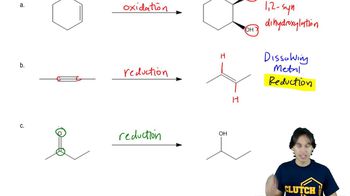
00:54
Distinguishing between Oxidation and Reduction

Nucleophilic Substitution

Nucleophilic substitution is a fundamental reaction mechanism in organic chemistry where a nucleophile attacks an electrophile, replacing a leaving group. In the second part of the reaction, methanol (CH3OH) acts as a nucleophile, attacking the electrophilic center of compound A to form compound B. Recognizing this mechanism is essential for understanding how functional groups transform during reactions.
추천 영상:
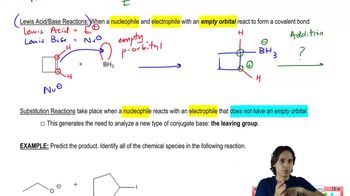
01:47
Nucleophiles and Electrophiles can react in Substitution Reactions.

Reagent Functionality

The functionality of reagents in organic reactions determines their role and the type of reaction that occurs. In this case, HOCI serves as an oxidizing agent, while CH3OH acts as a nucleophile in the presence of HCl, which can facilitate the reaction by protonating the nucleophile. Grasping the roles of different reagents is vital for predicting reaction pathways and outcomes.
추천 영상:
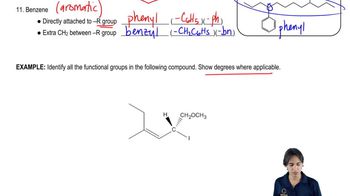
02:36
Identifying Functional Groups