Ch. 16 - Reactions of Aldehydes and Ketones • More Reactions of Carboxylic Acid Derivatives
Bruice - Organic Chemistry 8th Edition
Bruice8th EditionOrganic ChemistryISBN: 9780135213711당신이 사용하는 게 아니라요?교과서 변경
16장, 문제 54b

What are the products of the following reactions?
b.

검증된 단계별 안내
1
Step 1: Identify the reactants. The first reactant is benzoyl chloride (C6H5COCl), which contains a benzene ring attached to a carbonyl group and a chlorine atom. The second reactant is a Gilman reagent, specifically lithium di-n-propylcuprate ((CH3CH2CH2)2CuLi).
Step 2: Understand the reaction mechanism. Gilman reagents are organocuprates that are commonly used for nucleophilic substitution reactions. They selectively react with acyl chlorides to form ketones, replacing the chlorine atom with the alkyl group from the Gilman reagent.
Step 3: Predict the product. The Gilman reagent ((CH3CH2CH2)2CuLi) donates one of its alkyl groups (n-propyl, CH3CH2CH2) to the carbonyl carbon of benzoyl chloride, replacing the chlorine atom. This results in the formation of a ketone.
Step 4: Write the structure of the product. The product will be a ketone with the benzene ring (C6H5) attached to the carbonyl group, and the n-propyl group (CH3CH2CH2) attached to the carbonyl carbon. The chemical structure of the product is C6H5COCH2CH2CH3.
Step 5: Verify the reaction conditions. Ensure that the reaction proceeds under appropriate conditions, typically in a nonpolar solvent like ether, and at a low temperature to prevent side reactions.

비슷한 문제에 대한 검증된 영상 답변:

이 영상 해법은 위 문제에 도움이 된다고 튜터들이 추천한 것입니다.
영상 길이:
1m

주요 개념

질문에 올바르게 답하기 위해 반드시 이해해야 하는 핵심 개념들은 다음과 같습니다.

Reaction Mechanisms

Understanding reaction mechanisms is crucial in organic chemistry as they describe the step-by-step process by which reactants transform into products. This includes identifying intermediates, transition states, and the movement of electrons. Familiarity with mechanisms helps predict the outcome of reactions and the stability of products formed.
추천 영상:
02:16
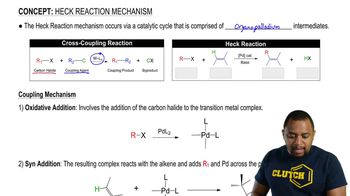
Heck Reaction Mechanism

Functional Groups

Functional groups are specific groups of atoms within molecules that are responsible for the characteristic chemical reactions of those molecules. Recognizing functional groups is essential for predicting the behavior of organic compounds during reactions, as they dictate reactivity and the types of products formed.
추천 영상:
02:36
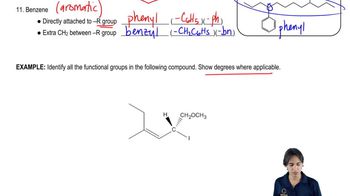
Identifying Functional Groups

Stereochemistry

Stereochemistry involves the study of the spatial arrangement of atoms in molecules and how this affects their chemical behavior. It is important for understanding isomerism, where compounds with the same molecular formula can have different structures and properties. This concept is vital when determining the products of reactions, especially in cases involving chiral centers.
추천 영상:
가이드 코스
1:38
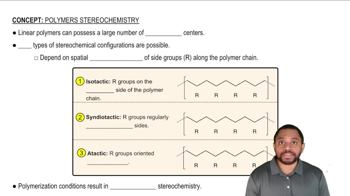
Polymer Stereochemistry Concept 1