Ch. 16 - Reactions of Aldehydes and Ketones • More Reactions of Carboxylic Acid Derivatives
Bruice - Organic Chemistry 8th Edition
Bruice8th EditionOrganic ChemistryISBN: 9780135213711당신이 사용하는 게 아니라요?교과서 변경
16장, 문제 52a

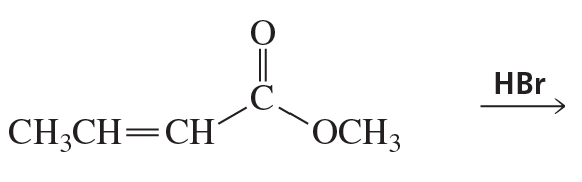
What is the major product of each of the following reactions?
a. Chemical structure showing a carbonyl compound with an alkene and an ether, with HBr indicated as a reagent.

검증된 단계별 안내
1
Analyze the structure of the reactant: The molecule contains a conjugated system with an alkene and a carbonyl group (α,β-unsaturated ester). This is a common structure for electrophilic addition reactions.
Identify the reagent: HBr is a strong acid and provides Br⁻ as a nucleophile and H⁺ as an electrophile. The reaction will proceed via electrophilic addition to the alkene.
Determine the regioselectivity: The addition of HBr follows Markovnikov's rule, where the H⁺ will add to the carbon of the double bond that is less substituted, and Br⁻ will add to the more substituted carbon.
Consider resonance stabilization: The carbocation intermediate formed after H⁺ addition will be stabilized by resonance with the adjacent carbonyl group. This stabilization influences the reaction pathway.
Predict the major product: The Br⁻ will attack the resonance-stabilized carbocation, resulting in the formation of a brominated product at the β-carbon of the α,β-unsaturated ester.

비슷한 문제에 대한 검증된 영상 답변:

이 영상 해법은 위 문제에 도움이 된다고 튜터들이 추천한 것입니다.
영상 길이:
2m

주요 개념

질문에 올바르게 답하기 위해 반드시 이해해야 하는 핵심 개념들은 다음과 같습니다.

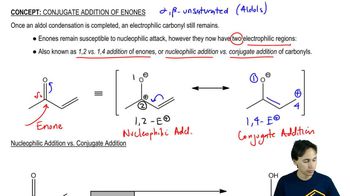
Conjugate Addition

Conjugate addition refers to the addition of a nucleophile to an α,β-unsaturated carbonyl compound. In this reaction, the nucleophile attacks the β-carbon, leading to the formation of a new bond. This process is significant in organic synthesis as it allows for the construction of complex molecules with specific functional groups.
추천 영상:
09:23
1,2 vs 1,4 Addition

Electrophilic Addition

Electrophilic addition is a fundamental reaction mechanism in organic chemistry where an electrophile reacts with a nucleophile, resulting in the formation of a new covalent bond. In the context of the given reaction, HBr acts as the electrophile, adding across the double bond of the unsaturated compound, which is crucial for determining the major product of the reaction.
추천 영상:
09:23
1,2 vs 1,4 Addition

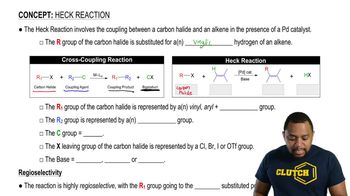
Regioselectivity

Regioselectivity refers to the preference of a chemical reaction to yield one structural isomer over others when multiple possibilities exist. In the case of the reaction with HBr, the regioselectivity will dictate whether the bromine atom attaches to the more substituted or less substituted carbon, influencing the major product formed in the reaction.
추천 영상:
05:09
Heck Reaction