Ch. 16 - Reactions of Aldehydes and Ketones • More Reactions of Carboxylic Acid Derivatives
Bruice - Organic Chemistry 8th Edition
Bruice8th EditionOrganic ChemistryISBN: 9780135213711당신이 사용하는 게 아니라요?교과서 변경
16장, 문제 51a

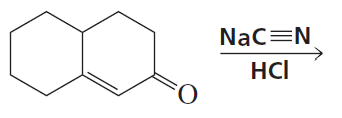
What is the major product of each of the following reactions?
a. Chemical structure showing a bicyclic compound with a carbonyl group and a reaction involving sodium cyanide and hydrochloric acid.

검증된 단계별 안내
1
Step 1: Analyze the structure of the starting material. The molecule is a cyclic ketone (cyclohexanone derivative) with a methyl group at the 2-position and a double bond at the 3-position.
Step 2: Identify the reagents. Potassium cyanide (KCN) in water is used, which suggests a nucleophilic addition reaction involving cyanide ion (CN⁻). Cyanide is a strong nucleophile.
Step 3: Determine the site of reactivity. The carbonyl group (C=O) is highly electrophilic due to the partial positive charge on the carbon atom. The cyanide ion will attack this carbon atom, leading to the formation of a cyanohydrin.
Step 4: Predict the mechanism. The cyanide ion attacks the carbonyl carbon, breaking the π bond of the C=O group. This results in the formation of a tetrahedral intermediate, which is stabilized by protonation from water to form the cyanohydrin.
Step 5: Consider stereochemistry. Since the starting material is cyclic and the reaction creates a new chiral center, the product may exist as a mixture of stereoisomers (enantiomers) depending on the orientation of the cyanide addition.

비슷한 문제에 대한 검증된 영상 답변:

이 영상 해법은 위 문제에 도움이 된다고 튜터들이 추천한 것입니다.
영상 길이:
2m

주요 개념

질문에 올바르게 답하기 위해 반드시 이해해야 하는 핵심 개념들은 다음과 같습니다.

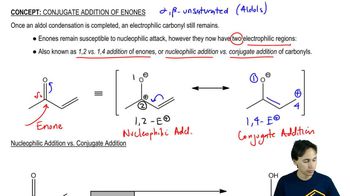
Conjugate Addition

Conjugate addition refers to the nucleophilic addition of a reagent to an α,β-unsaturated carbonyl compound. In this reaction, the nucleophile attacks the β-carbon, leading to the formation of a new bond while the double bond shifts. This process is crucial in organic synthesis as it allows for the formation of more complex molecules from simpler ones.
추천 영상:
09:23
1,2 vs 1,4 Addition

Nucleophiles

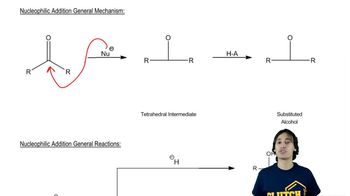
Nucleophiles are species that donate an electron pair to form a chemical bond in a reaction. In the context of the given reaction, KCN acts as a nucleophile, where the cyanide ion (CN-) attacks the electrophilic carbon of the carbonyl group. Understanding the nature of nucleophiles is essential for predicting the outcome of organic reactions.
추천 영상:
08:27
Nucleophilic Addition

Hydrolysis

Hydrolysis is a chemical reaction involving the breaking of a bond in a molecule using water. In the context of the reaction shown, after the nucleophilic addition of KCN, hydrolysis occurs when water is used to convert the intermediate into a stable product, typically resulting in the formation of a hydroxyl group. This step is vital for completing the reaction and determining the final product.
추천 영상:
가이드 코스
1:00
Hydrolysis of Thioesters Concept 2