Ch. 17 - Reactions at the Alpha-Carbon
Bruice - Organic Chemistry 8th Edition
Bruice8th EditionOrganic ChemistryISBN: 9780135213711당신이 사용하는 게 아니라요?교과서 변경
17장, 문제 72b

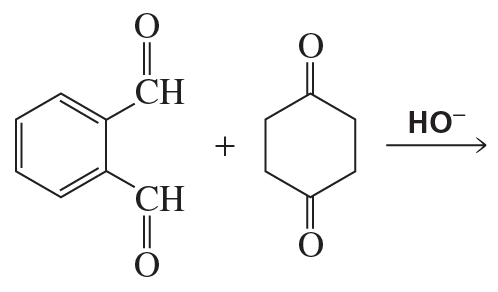
Draw the products of the following reactions:
b. Chemical structures illustrating the aldol condensation reaction between two organic compounds.

검증된 단계별 안내
1
Step 1: Identify the type of reaction taking place. Determine whether the reaction is an addition, substitution, elimination, or rearrangement reaction based on the reactants and conditions provided.
Step 2: Analyze the functional groups present in the reactants. Look for key reactive sites such as double bonds, halides, hydroxyl groups, or carbonyl groups that will participate in the reaction.
Step 3: Consider the reagents and reaction conditions provided. For example, if the reaction involves an electrophile and a nucleophile, predict how they will interact to form the product.
Step 4: Apply the mechanism of the reaction to predict the structure of the product. Use curved arrows to show the movement of electrons during bond formation and bond breaking.
Step 5: Verify the stereochemistry and regiochemistry of the product, if applicable. Ensure that the product adheres to Markovnikov's rule, anti-Markovnikov's rule, or stereochemical requirements based on the reaction conditions.

비슷한 문제에 대한 검증된 영상 답변:

이 영상 해법은 위 문제에 도움이 된다고 튜터들이 추천한 것입니다.
영상 길이:
15m

주요 개념

질문에 올바르게 답하기 위해 반드시 이해해야 하는 핵심 개념들은 다음과 같습니다.

Reaction Mechanisms

Understanding reaction mechanisms is crucial in organic chemistry as they describe the step-by-step process by which reactants transform into products. This includes identifying intermediates, transition states, and the movement of electrons. Familiarity with mechanisms helps predict the outcome of reactions and the stability of products formed.
추천 영상:
02:16
Heck Reaction Mechanism

Functional Groups

Functional groups are specific groups of atoms within molecules that are responsible for the characteristic chemical reactions of those molecules. Recognizing functional groups is essential for predicting reactivity and understanding how different compounds will behave in reactions. Common functional groups include alcohols, carboxylic acids, and amines.
추천 영상:
02:36
Identifying Functional Groups

Stereochemistry

Stereochemistry involves the study of the spatial arrangement of atoms in molecules and how this affects their chemical behavior. It is important for understanding isomerism, where compounds with the same molecular formula can have different structures and properties. Stereochemical considerations are vital when drawing reaction products, especially in reactions involving chiral centers.
추천 영상:
가이드 코스
1:38
Polymer Stereochemistry Concept 1