Ch. 17 - Reactions at the Alpha-Carbon
Bruice - Organic Chemistry 8th Edition
Bruice8th EditionOrganic ChemistryISBN: 9780135213711당신이 사용하는 게 아니라요?교과서 변경
17장, 문제 72d

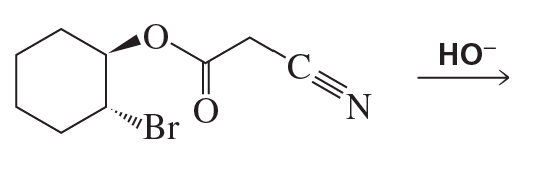
Draw the products of the following reactions:
d. Chemical structure showing a condensation reaction with a benzene ring, bromine, and a nitrogen-containing compound.

검증된 단계별 안내
1
Step 1: Analyze the reactants and reagents. The starting material is a compound containing a chloro group, an ester functional group, and a nitro group. The reagent is hydroxide ion (OH⁻), which is a strong nucleophile and base.
Step 2: Identify the reaction mechanism. Hydroxide ion can act as a nucleophile to attack the ester group, leading to hydrolysis of the ester into a carboxylic acid. Additionally, the chloro group may undergo substitution if conditions favor nucleophilic substitution.
Step 3: Predict the hydrolysis of the ester. The hydroxide ion attacks the carbonyl carbon of the ester, forming a tetrahedral intermediate. This intermediate collapses, expelling the alkoxide group and forming a carboxylic acid.
Step 4: Consider the fate of the chloro group. The hydroxide ion may also attack the carbon attached to the chloro group, leading to nucleophilic substitution and replacing the chlorine atom with a hydroxyl group.
Step 5: Combine the transformations. The final products will include a carboxylic acid derived from the ester hydrolysis and potentially a hydroxyl group replacing the chlorine atom, depending on reaction conditions.

비슷한 문제에 대한 검증된 영상 답변:

이 영상 해법은 위 문제에 도움이 된다고 튜터들이 추천한 것입니다.
영상 길이:
3m

주요 개념

질문에 올바르게 답하기 위해 반드시 이해해야 하는 핵심 개념들은 다음과 같습니다.

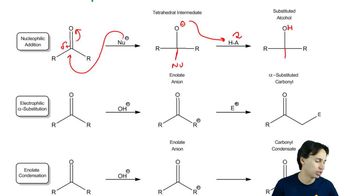
Condensation Reaction

A condensation reaction is a chemical process where two molecules combine to form a larger molecule, accompanied by the loss of a small molecule, often water. In organic chemistry, this type of reaction is crucial for forming complex structures, such as esters or amides, from simpler reactants. Understanding this concept is essential for predicting the products of reactions involving functional groups like alcohols and acids.
추천 영상:
05:53
Condensation Reactions

Electrophilic Substitution

Electrophilic substitution is a fundamental reaction mechanism in organic chemistry where an electrophile replaces a hydrogen atom in an aromatic compound. This process is significant for introducing various substituents, such as nitro or halogen groups, onto aromatic rings. Recognizing the role of electrophiles and the stability of intermediates is vital for predicting the outcomes of reactions involving aromatic compounds.
추천 영상:
01:47
Nucleophiles and Electrophiles can react in Substitution Reactions.

Functional Groups

Functional groups are specific groups of atoms within molecules that are responsible for the characteristic chemical reactions of those molecules. Common functional groups include hydroxyl (-OH), carboxyl (-COOH), and nitro (-NO2) groups. Identifying functional groups in a molecule is crucial for understanding its reactivity and the types of reactions it can undergo, which is essential for predicting the products of organic reactions.
추천 영상:
02:36
Identifying Functional Groups