Ch. 18 - Reactions of Benzene and Substituted Benzenes
Bruice - Organic Chemistry 8th Edition
Bruice8th EditionOrganic ChemistryISBN: 9780135213711당신이 사용하는 게 아니라요?교과서 변경
18장, 문제 78b

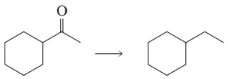
b. Describe two ways the following reaction can be carried out:
Chemical reaction diagram showing the transformation of a compound on the left to a different compound on the right.

검증된 단계별 안내
1
Step 1: Analyze the reaction. The starting material is a ketone (2-pentanone), and the product is an alkane (pentane). This indicates that the reaction involves the reduction of the carbonyl group to a hydrocarbon, likely through a process such as complete reduction or deoxygenation.
Step 2: Method 1 - Clemmensen Reduction. This method uses zinc amalgam (Zn(Hg)) and concentrated hydrochloric acid (HCl) to reduce the ketone to an alkane. The acidic conditions facilitate the removal of the oxygen atom from the carbonyl group.
Step 3: Method 2 - Wolff-Kishner Reduction. This method involves hydrazine (N₂H₄) and a strong base such as potassium hydroxide (KOH) under high temperatures. The hydrazine reacts with the ketone to form a hydrazone intermediate, which is then decomposed to yield the alkane.
Step 4: Compare the two methods. Clemmensen Reduction is typically used for compounds stable under acidic conditions, while Wolff-Kishner Reduction is preferred for compounds stable under basic conditions and high temperatures.
Step 5: Choose the appropriate method based on the substrate's stability and reaction conditions. For example, if the substrate is sensitive to acid, Wolff-Kishner Reduction would be the better choice.

비슷한 문제에 대한 검증된 영상 답변:

이 영상 해법은 위 문제에 도움이 된다고 튜터들이 추천한 것입니다.
영상 길이:
4m

주요 개념

질문에 올바르게 답하기 위해 반드시 이해해야 하는 핵심 개념들은 다음과 같습니다.

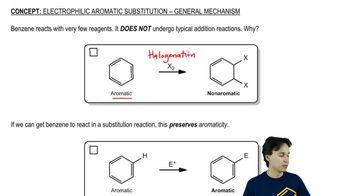
Electrophilic Aromatic Substitution (EAS)

Electrophilic Aromatic Substitution is a fundamental reaction in organic chemistry where an electrophile replaces a hydrogen atom on an aromatic ring. This process typically involves the formation of a sigma complex, where the aromaticity is temporarily lost, followed by deprotonation to restore aromaticity. Understanding EAS is crucial for predicting the outcomes of reactions involving aromatic compounds.
추천 영상:
03:07
EAS Review

Retrosynthetic Analysis

Retrosynthetic analysis is a strategy used in organic synthesis to break down complex molecules into simpler precursors. By working backward from the target molecule, chemists can identify potential starting materials and reaction pathways. This concept is essential for designing efficient synthetic routes and understanding how to achieve the desired product from given reactants.
추천 영상:
01:22
Retrosynthesis

Reaction Mechanisms

A reaction mechanism describes the step-by-step sequence of elementary reactions that occur during a chemical transformation. It provides insight into how reactants are converted into products, including the intermediates formed and the energy changes involved. Familiarity with reaction mechanisms is vital for predicting reaction outcomes and optimizing conditions for desired transformations.
추천 영상:
02:16
Heck Reaction Mechanism