Ch. 18 - Reactions of Benzene and Substituted Benzenes
Bruice - Organic Chemistry 8th Edition
Bruice8th EditionOrganic ChemistryISBN: 9780135213711당신이 사용하는 게 아니라요?교과서 변경
18장, 문제 80c

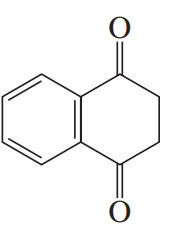
How can you prepare the following compounds with benzene as one of the starting materials?
c. Chemical structure of a benzene derivative with a carbonyl group, illustrating a reaction pathway in organic chemistry.

검증된 단계별 안내
1
Step 1: Begin with benzene as the starting material. Perform a Friedel-Crafts acylation reaction using succinic anhydride (C4H4O3) and a Lewis acid catalyst such as AlCl3. This introduces a four-carbon chain with a ketone group onto the benzene ring.
Step 2: The product from Step 1 will be benzoyl succinic acid. Cyclize this intermediate by heating it under acidic conditions to form a cyclic ketone structure. This step involves intramolecular aldol condensation.
Step 3: Perform a second Friedel-Crafts acylation reaction using another equivalent of succinic anhydride and AlCl3. This introduces another four-carbon chain with a ketone group onto the benzene ring.
Step 4: Cyclize the second intermediate under acidic conditions to form the second cyclic ketone structure. This step involves another intramolecular aldol condensation.
Step 5: The final product is the compound shown in the image, which contains two fused cyclic ketone structures attached to the benzene ring.

비슷한 문제에 대한 검증된 영상 답변:

이 영상 해법은 위 문제에 도움이 된다고 튜터들이 추천한 것입니다.
영상 길이:
5m

주요 개념

질문에 올바르게 답하기 위해 반드시 이해해야 하는 핵심 개념들은 다음과 같습니다.

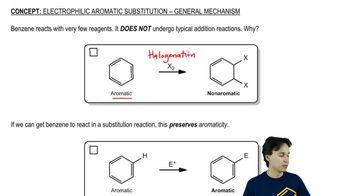
Electrophilic Aromatic Substitution (EAS)

Electrophilic Aromatic Substitution is a fundamental reaction in organic chemistry where an electrophile replaces a hydrogen atom on an aromatic ring, such as benzene. This reaction is crucial for synthesizing various substituted aromatic compounds. The process typically involves the generation of a highly reactive electrophile, which then attacks the electron-rich aromatic system, leading to the formation of a sigma complex before restoring aromaticity.
추천 영상:
03:07
EAS Review

Aromaticity

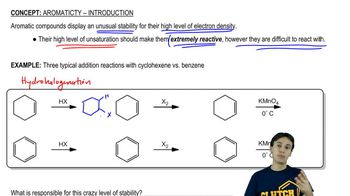
Aromaticity refers to the special stability and reactivity of certain cyclic compounds that contain conjugated pi electron systems, such as benzene. For a compound to be aromatic, it must follow Hückel's rule, which states that it should have 4n + 2 pi electrons (where n is a non-negative integer). This property is essential for understanding why benzene and its derivatives undergo substitution reactions rather than addition reactions.
추천 영상:
08:19
Intro to Aromaticity

Substituent Effects

Substituent effects are the influences that different groups attached to an aromatic ring have on the reactivity and orientation of electrophilic substitution reactions. Electron-donating groups (EDGs) activate the ring and direct incoming electrophiles to ortho and para positions, while electron-withdrawing groups (EWGs) deactivate the ring and direct electrophiles to the meta position. Understanding these effects is vital for predicting the outcomes of reactions involving substituted aromatic compounds.
추천 영상:
가이드 코스
2:02
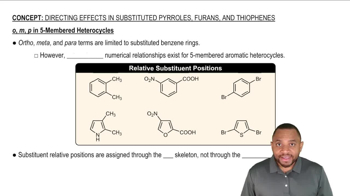
Directing Effects in Substituted Pyrroles, Furans, and Thiophenes Concept 1