Ch. 18 - Reactions of Benzene and Substituted Benzenes
Bruice - Organic Chemistry 8th Edition
Bruice8th EditionOrganic ChemistryISBN: 9780135213711당신이 사용하는 게 아니라요?교과서 변경
18장, 문제 48h

Draw the product(s) of each of the following reactions:
h. m-xylene + Na2Cr2O7 + HCl + ∆

검증된 단계별 안내
1
Step 1: For reaction g (ethylbenzene + Br2/FeBr3), recognize that this is an electrophilic aromatic substitution reaction. The FeBr3 acts as a Lewis acid catalyst, helping to generate the bromonium ion (Br⁺) from Br2, which is the electrophile in this reaction.
Step 2: Identify the directing effects of the ethyl group on the benzene ring. The ethyl group is an electron-donating group, which activates the ring and directs substitution to the ortho and para positions relative to itself.
Step 3: Predict the major product of the reaction. Due to steric hindrance, the para position is typically favored over the ortho position. Draw the brominated product at the para position relative to the ethyl group, and optionally include the minor ortho product.
Step 4: For reaction h (m-xylene + Na2Cr2O7 + HCl + ∆), recognize that this is an oxidation reaction. Sodium dichromate (Na2Cr2O7) in acidic conditions (HCl) and heat (∆) is a strong oxidizing agent that converts benzylic positions (positions adjacent to the benzene ring) with at least one hydrogen into carboxylic acids.
Step 5: Analyze the structure of m-xylene. It has two methyl groups attached to the benzene ring in the meta positions. Each methyl group has benzylic hydrogens, so both will be oxidized to carboxylic acids. Draw the product, which is m-phthalic acid (benzene ring with two carboxylic acid groups in the meta positions).

비슷한 문제에 대한 검증된 영상 답변:

이 영상 해법은 위 문제에 도움이 된다고 튜터들이 추천한 것입니다.

주요 개념

질문에 올바르게 답하기 위해 반드시 이해해야 하는 핵심 개념들은 다음과 같습니다.

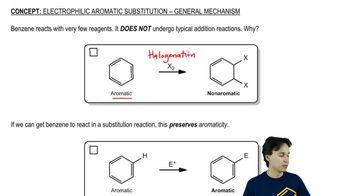
Electrophilic Aromatic Substitution

Electrophilic aromatic substitution (EAS) is a fundamental reaction mechanism in organic chemistry where an electrophile replaces a hydrogen atom on an aromatic ring. In the case of ethylbenzene reacting with Br2 in the presence of FeBr3, the bromine acts as the electrophile, leading to the substitution of a hydrogen atom on the benzene ring, resulting in brominated products.
추천 영상:
03:07
EAS Review

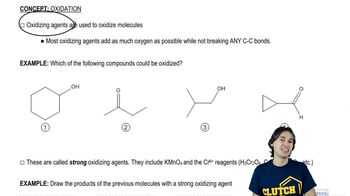
Oxidation of Aromatic Compounds

The oxidation of aromatic compounds involves the addition of oxygen or the removal of hydrogen, often resulting in the formation of carboxylic acids or ketones. In the reaction of m-xylene with Na2Cr2O7 and HCl, the m-xylene undergoes oxidation, which can lead to the formation of phthalic acid or other oxidized products, depending on the reaction conditions.
추천 영상:
08:19
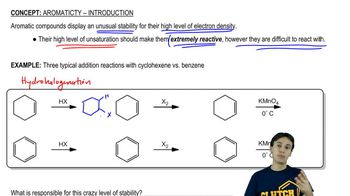
Intro to Aromaticity

Reagents and Reaction Conditions

Understanding the role of reagents and reaction conditions is crucial in organic reactions. In the provided reactions, FeBr3 serves as a catalyst for the bromination of ethylbenzene, while Na2Cr2O7 is a strong oxidizing agent that facilitates the oxidation of m-xylene. The presence of HCl and heat (∆) further influences the reaction pathway and product formation.
추천 영상:
01:52
Reagents