Ch. 18 - Reactions of Benzene and Substituted Benzenes
Bruice - Organic Chemistry 8th Edition
Bruice8th EditionOrganic ChemistryISBN: 9780135213711당신이 사용하는 게 아니라요?교과서 변경
18장, 문제 50c

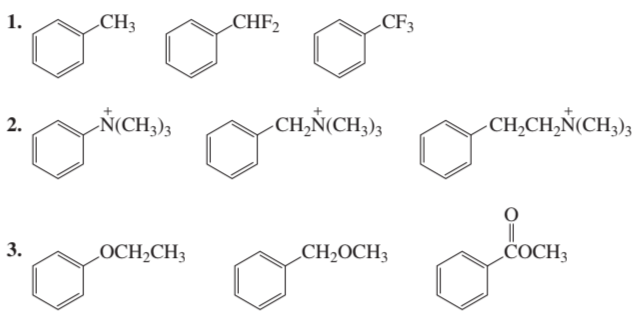
For each horizontal row of substituted benzenes, indicate
c. the one that yields the highest percentage of meta product in an electrophilic aromatic substitution reaction.

검증된 단계별 안내
1
Understand the concept of electrophilic aromatic substitution (EAS): This reaction involves the replacement of a hydrogen atom on a benzene ring with an electrophile. The reactivity of substituted benzenes in EAS depends on the electronic effects of the substituents present on the ring.
Identify the substituents on the benzene rings: Substituents can either activate or deactivate the benzene ring toward EAS. Activating groups (electron-donating groups) increase reactivity, while deactivating groups (electron-withdrawing groups) decrease reactivity.
Classify the substituents based on their electronic effects: Activating groups include -OH, -OCH₃, -NH₂, etc., which donate electrons through resonance or induction. Deactivating groups include -NO₂, -CF₃, -CN, etc., which withdraw electrons through resonance or induction.
Determine the least reactive benzene: The benzene with the strongest electron-withdrawing group (most deactivating substituent) will be the least reactive in an EAS reaction. Compare the substituents in the given row to identify the one with the strongest deactivating effect.
Conclude the analysis: Once the least reactive benzene is identified, confirm your reasoning by considering the resonance and inductive effects of the substituents. Ensure that the substituent's position (ortho, meta, or para) is also considered, as it can influence the reactivity.

비슷한 문제에 대한 검증된 영상 답변:

이 영상 해법은 위 문제에 도움이 된다고 튜터들이 추천한 것입니다.
영상 길이:
4m

주요 개념

질문에 올바르게 답하기 위해 반드시 이해해야 하는 핵심 개념들은 다음과 같습니다.

Electrophilic Aromatic Substitution (EAS)

Electrophilic Aromatic Substitution is a fundamental reaction in organic chemistry where an electrophile replaces a hydrogen atom on an aromatic ring. This reaction is crucial for modifying aromatic compounds and is influenced by the nature of substituents already present on the ring, which can either activate or deactivate the ring towards further substitution.
추천 영상:
03:07
EAS Review

Activating and Deactivating Substituents

Substituents on a benzene ring can be classified as activating or deactivating based on their electronic effects. Activating groups, such as -OH or -NH2, donate electron density to the ring, enhancing its reactivity towards electrophiles. In contrast, deactivating groups, like -NO2 or -CF3, withdraw electron density, making the ring less reactive in EAS reactions.
추천 영상:
03:27
Activating and deactivating groups

Ortho/Para vs. Meta Directing

The position of substituents on a benzene ring affects the orientation of subsequent electrophilic attacks. Activating groups typically direct new substituents to the ortho and para positions, while deactivating groups often direct them to the meta position. Understanding these directing effects is essential for predicting the reactivity and product distribution in EAS reactions.
추천 영상:
04:42
Ortho, Para major products